DEEP DIVE No. 007
Reading Time: 4 Minutes
Keralam, India’s southernmost state, is becoming a real-world test of what it takes to build an electric freight corridor. Along its 622-km NH-66, the question is no longer simply whether electric trucks can operate on Indian roads, but whether the roads, chargers, electricity networks, policies and commercial ecosystem around them are ready.
THE CORRIDOR FOR THE FUTURE
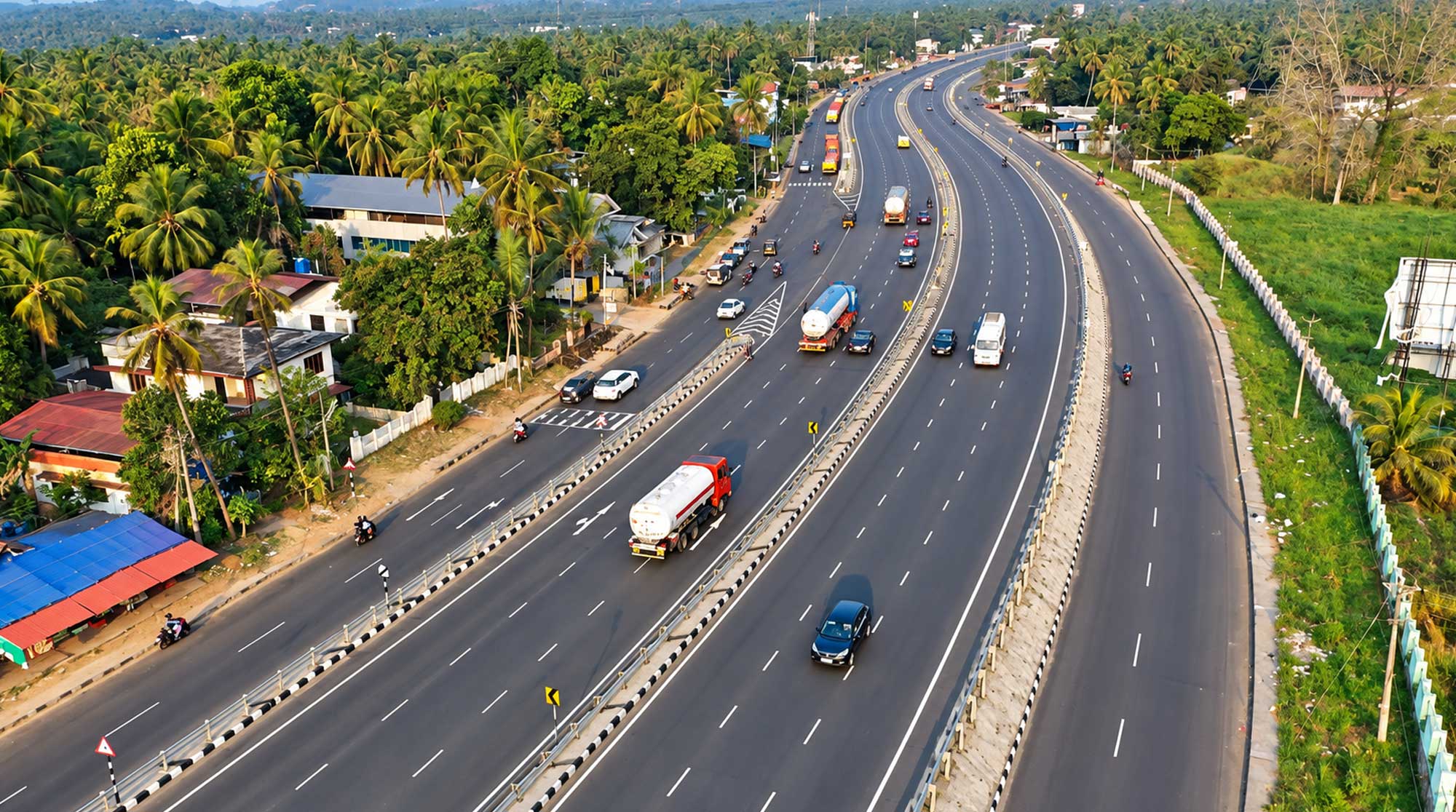
NH-66 runs for 622 km along Keralam’s western coast, connecting Kasaragod in the north with Thiruvananthapuram in the south and linking ports, industrial clusters and urban centres that underpin the state’s coastal freight economy.
Keralam has taken a step to develop India’s first state-led electric truck corridor along the highway.
The International Council on Clean Transportation (ICCT), in partnership with Keralam State Electricity Board Limited (KSEBL), has assessed what that transition would require — from charger numbers and locations to installed capacity, grid demand and investment.
The study uses FASTag toll data, national battery-electric-truck deployment projections and GPS-based truck parking data covering 13,355 unique trucks and 339,692 parking events.
The result is a corridor-level picture of what electric freight infrastructure could look like.
THE TRUCKS ARE ONLY THE START
An electric truck can be ready for the road without the road being ready for the truck.
For freight operators, charging is connected to where vehicles stop, how long they remain there, how much energy they need, the capacity of the local electricity network and whether the overall operation makes commercial sense.
That makes corridor electrification fundamentally different from simply increasing the number of electric vehicles. The real challenge is matching vehicle movement with charging opportunity.
WHERE SHOULD THE CHARGERS GO?
One of the study’s most useful elements is its use of actual truck parking behaviour. Freight vehicles already have established stopping patterns. Understanding those patterns can help identify locations where charging can be integrated into existing operations rather than simply being placed along a map at fixed intervals.
The analysis identifies Kochi, Kozhikode and Kollam as priority charging locations. The Thiruvangad–Kumbalam section, identified as the corridor’s longest and busiest, is projected to require 76.4 MW by 2050. Thalappady–Thiruvangad follows at 70.7 MW, while Kumbalam–Thiruvallam reaches 57.4 MW.
The wider lesson is significant.
Electric-freight infrastructure needs to follow freight behaviour, not simply road geography.
THE POWER BEHIND THE PLUG
The charger is visible.
The electricity system behind it is not.
The ICCT assessment projects 90 chargers and 12.5 MW of installed capacity by 2030 along NH-66. By 2050, the requirement rises to 1,939 chargers and 204.5 MW. Yet the study also finds that charging demand is expected to remain below 0.2% of Keralam’s electricity consumption through 2040. That suggests the central challenge is not simply the total amount of electricity available.
It is ensuring that charging infrastructure and the distribution network are developed at the right locations and at the right time. The investment estimates also need context. The study's figures cover charging equipment and exclude upstream grid upgrades. The physical charger is therefore only one component of the infrastructure equation.
THE COST OF GOING ELECTRIC
ICCT estimates charging-infrastructure investment along NH-66 at approximately ₹19 crore by 2030.
By 2050, that rises to ₹338 crore, as electric-truck adoption and the number of chargers expand. The study notes that the near-term requirement fits within approved PM E-DRIVE funding, while also emphasising that its estimates cover equipment costs rather than upstream grid upgrades.
The number is therefore important, but it is not the whole investment story. A functioning electric corridor also requires coordinated action around land, electricity connections, charging operations, vehicles, fleet economics and freight demand.
WHO NEEDS TO MAKE IT WORK?
An electric freight corridor has no single owner of the transition.
The Government of India provides the national policy and funding framework, including PM E-DRIVE support for public charging infrastructure. The Government of Keralam has the responsibility of translating that framework into state-level implementation. KSEBL brings the electricity-system dimension, connecting charging infrastructure with power planning.
Then come the commercial participants.
Truck manufacturers need suitable battery-electric vehicles. Charging operators need viable infrastructure. Fleet operators need vehicles and charging systems that fit their duty cycles. Freight businesses need sufficient utilisation and commercial logic to support adoption. ICCT's work on Keralam's e-truck ecosystem has also brought government departments, KSEBL, transport authorities and industry into discussions around coordinated deployment.
The transition is therefore not a single project.
It is a chain of interdependent decisions.
WHEN THE GRID MEETS THE HIGHWAY
A diesel truck carries its energy with it. An electric truck depends on energy being available where it needs to stop. That creates a new relationship between highway geography and electricity infrastructure. A charging hub drawing substantial power at a particular location can create very different infrastructure requirements from the same amount of electricity consumed gradually elsewhere.
This is why electric-freight planning is also energy planning. The NH-66 study suggests that the overall electricity impact can remain manageable, while demonstrating that location, timing and scale still matter.
THE DATA BEHIND THE ROAD
Perhaps the most transferable lesson from NH-66 is methodological.
The study combines freight movement, parking behaviour, vehicle projections and energy requirements to determine where infrastructure may be needed. That gives mobility data a new role.
The highway is no longer just a physical corridor. It is also a source of information about where vehicles move, where they stop and where future energy demand could emerge. For an industry increasingly shaped by connected fleets and digital data, this could become an important part of infrastructure planning.
FROM KERALAM TO THE REST OF INDIA
NH-66 should not be treated as a template that can simply be copied onto every Indian freight route. Different corridors have different freight volumes, distances, terrain, parking patterns, industrial clusters, electricity networks and vehicle duty cycles.
But the planning principle is transferable:
Understand the freight movement. Identify the stopping points. Map the charging requirement. Assess the grid. Match infrastructure with vehicle adoption. Build the commercial case. Keralam’s experiment is therefore about more than electrifying one highway.
It is testing a more integrated way of planning electric freight.
WHY THIS MATTERS
India’s electric-truck transition will ultimately depend on more than the number of electric vehicles entering service.
Those vehicles must be able to charge reliably, complete their routes, carry their intended loads and make commercial sense for the businesses operating them.
The NH-66 study brings these questions together in one corridor.
It also demonstrates the value of beginning infrastructure planning with real freight behaviour and data.
THE emBRWace PERSPECTIVE
The electric truck is only one component of an electric freight corridor.
The real transition begins when vehicle, charger, electricity, road, data, policy and commercial demand start working as one system. NH-66 offers an early glimpse of that transition. The future of electric freight will not be built by the truck alone. It will be built around it.
emBRWace EXPLAINS
Electric truck corridor — A freight route supported by charging infrastructure and the energy network required for electric commercial vehicles to operate along it.
Charging capacity — The electrical power that charging infrastructure can deliver, expressed in megawatts (MW).
PM E-DRIVE — India’s national electric-mobility support programme, including support for public charging infrastructure.
Grid readiness — The ability of the electricity system to accommodate additional charging demand at the required locations and times.
BY THE NUMBERS
622 km
NH-66 corridor
13,355
Unique trucks analysed
339,692
Parking events analysed
90
Chargers projected by 2030
12.5 MW
Charging capacity by 2030
₹19 crore
Charging infrastructure investment by 2030
1,939
Chargers projected by 2050
204.5 MW
Charging capacity by 2050
₹338 crore
Charging infrastructure investment by 2050
3
Priority locations: Kochi, Kozhikode and Kollam
Source: ICCT–KSEBL, 2026. Investment estimates cover charging equipment and exclude upstream grid upgrades.
THOUGHT TO TAKE AWAY
An electric truck can travel a corridor only when the corridor is ready to travel with it.