Reading time: 4 minutes
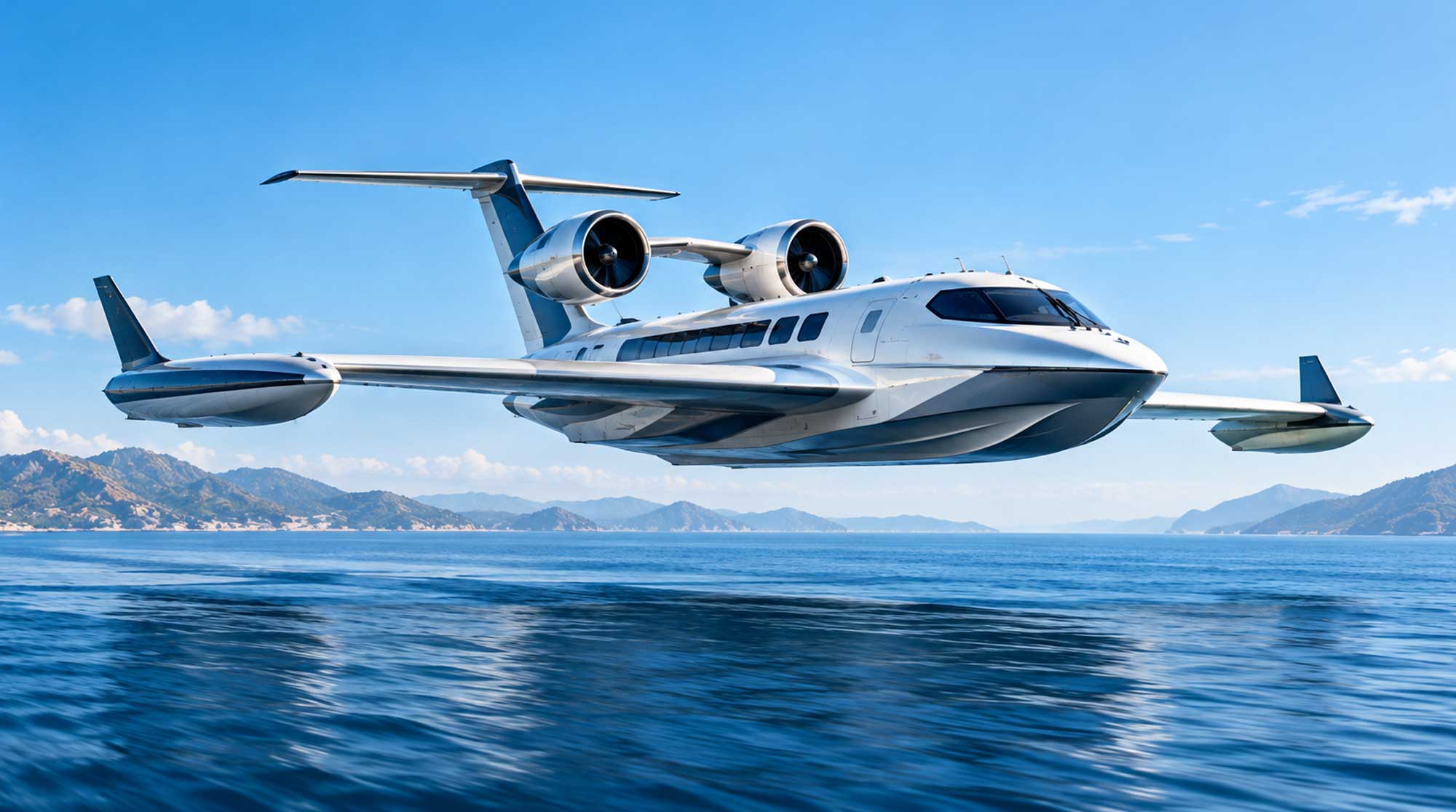
Wing-in-ground craft skim just above the sea, flying like aircraft and docking like boats. After decades on the margins, a crewed flight and a new factory suggest the idea is edging towards reality.
There is a space between ships and aircraft that has existed for decades but has rarely made it into mainstream mobility. It sits only a few metres above the water. There, wings can draw lift from the surface below, vehicles can skim rather than sail, and the rules of maritime and aviation engineering begin to overlap.
A new generation of developers is asking whether that space could become commercially useful. Among them are India's Waterfly Technologies, which is developing wing-in-ground (WIG) craft, and the US company REGENT, which has just put people aboard one.
The idea sounds futuristic. The technology is not.
A VEHICLE BETWEEN WORLDS
A WIG craft flies close to the surface by exploiting ground effect: the aerodynamic phenomenon that increases lift and reduces induced drag when a wing operates near a surface. That makes it fundamentally different from both a conventional ship and an aircraft.
The International Maritime Organization defines a WIG craft as a multimodal craft that, in its main operating mode, flies by using ground effect above water or another surface, without constant contact with it. Its 2018 guidelines recognise three types. Type A is certified for operation only in ground effect. Type B can also climb temporarily out of ground effect, to no more than 150 metres. Type C is certified for limited operation above that height.
So, this is not simply a boat that flies. It is a transport machine occupying the space between two established worlds.
THE OLD IDEA FINDS A NEW MOMENT
Ground-effect vehicles date back to the 1960s, when the Soviet Union developed ekranoplans for military use. Since then, commercial promise has repeatedly struggled against engineering complexity, regulation and the difficulty of finding the right application.
What is different now is the ecosystem around the idea. Electric propulsion, advanced composites, digital flight controls, autonomous systems and new approaches to maritime mobility give developers tools that earlier generations lacked. The result is not one universal WIG vehicle but a family of possibilities: passenger transport, coastal logistics, defence, emergency response and cargo.
WATERFLY'S BIGGER AMBITION
Waterfly's story began at IIT Madras, where its team had previously built the institute's first electric race car. The company is developing electric WIG craft as an alternative to both air and ferry travel, aiming to combine the speed and comfort of aircraft with the affordability and manoeuvrability of boats. Its chief executive has suggested that a 1,600 km journey from Kolkata to Chennai could cost ₹600 a seat.
At Aero India 2025, Waterfly set out a roadmap: a battery-powered craft with a range of 500 km, a hydrogen-electric variant reaching 2,000 km, and a larger version capable of intercontinental routes by 2029, with Dubai to Los Angeles among those mentioned. It also said it was targeting certification from the Indian Register of Shipping by 2026. Those were plans announced in early 2025, and emBRWace has found no public confirmation that the milestones have been met, so they should be read as ambitions, not achievements.
WHEN THE SEAGLIDER TAKES FLIGHT
Waterfly is not alone, and the strongest evidence that the category is moving beyond concept comes from REGENT. Its Viceroy Seaglider combines three operating modes: floating on its hull, travelling on hydrofoils and flying in ground effect.
On 2 September 2026, the Viceroy prototype completed its first human-crewed flight over Narragansett Bay in Rhode Island, which REGENT describes as the largest all-electric WIG craft to fly with people aboard. It was a short hop: two captains, about 30 seconds, roughly 10 metres above the water, covering about 600 metres.
Then came a bigger step. On 30 September, REGENT opened what it calls the world's first Seaglider manufacturing facility, saying it has raised $340 million and aims to deliver the first Viceroys to customers as early as late 2027, building towards 75 Viceroys and 300 Squire drones a year. The company reports an order book spanning six continents, including an order for up to 60 Viceroys from the US coastal travel operator The Twenty Five.
The question is no longer simply whether a WIG craft can fly. It is whether the technology can become a repeatable transport system.
THE WATER COULD BECOME THE INFRASTRUCTURE
One of WIG's most intriguing characteristics is that its main operating mode does not need a conventional runway. It needs water. That could change the infrastructure equation on certain routes. A coastal city would not necessarily need a new airport to reach another coastal city, and a remote community with suitable maritime access could join a high-speed network without the footprint of conventional aviation.
But this is not infrastructure-free technology. Ports, terminals, charging or fuelling systems, navigation, maintenance facilities, weather monitoring and trained crews will all still matter. The advantage is different: the operating surface already exists.
WHERE THE RULES MEET
The technology's hybrid character creates a regulatory challenge, though not an unregulated one. The IMO has dedicated WIG guidelines, and they recognise that flight outside the influence of ground effect should also fall under the rules of the International Civil Aviation Organization. REGENT, for its part, describes its craft as operated by a captain who steers it like a boat in flight.
The machine may cross a physical boundary. The regulatory system has to cross one too.
THE LESSON FROM LIBERTY LIFTER
Another programme offers a reality check. DARPA's Liberty Lifter explored a large ground-effect seaplane that would combine the speed of air transport with the payload of maritime platforms. DARPA completed its work in June 2025 without building a demonstrator, saying simulation and materials testing had shown the concept viable and that it would pass what it learned to industry. The agency spent about $98 million, and its director later said the programme was ended because it failed to meet its metrics, with manufacturing proving harder than expected.
Not every ambitious flying-watercraft programme will become a commercial vehicle. Technology development is rarely a straight line.
THE BOUNDARY IS THE OPPORTUNITY
WIG technology sits in an unusual position. It is too aircraft-like to be treated simply as another boat, and too closely tied to the water to behave like conventional aviation. That may be exactly where its opportunity lies.
Transport has traditionally been divided into modes: road, rail, sea and air. Some of the most interesting mobility innovations are beginning to challenge those divisions. The future may not always belong to a faster ship or a more efficient aircraft. It may belong to the machine that asks why it has to be one or the other.
emBRWace Perspective
The significance of WIG technology may extend beyond the craft itself. If it succeeds, its greatest contribution could be conceptual: showing that mobility infrastructure does not always have to be built from scratch. Sometimes innovation comes from finding a different way to use what already exists.
The world's oceans are already connected. The question is whether a new generation of machines can turn that connectivity into a new layer of mobility.
emBRWace Explains
Wing-in-ground effect
When a wing flies very close to a surface, aerodynamic interaction with that surface can increase lift and reduce induced drag. WIG craft deliberately exploit this phenomenon to operate efficiently at low altitude above water or another surface.
Hydrofoil
A wing-like foil beneath a hull that lifts it clear of the water as speed increases, reducing the drag the waves would otherwise cause.
Seaglider
REGENT's name for its hydrofoiling WIG craft, which float on their hull, rise onto foils and then fly in ground effect.
Thought to Take Away
The next mobility boundary may not be a place we have to build. It may be a space we have yet to use.
THE NEXT READ
BEYOND BOUNDARIES
continues to explore mobility technologies that cross established lines between modes, industries, environments and disciplines.Coming soon…
Sources:
International Maritime Organization, guidance on wing-in-ground craft (MSC.1/Circ.1592, 2018); International Hydrographic Organization working paper on WIG craft; REGENT Craft press releases (June, September 2026) and trade coverage of the Viceroy Seaglider's first crewed flight and factory opening; Waterfly Technologies coverage from Aero India 2025; DARPA Liberty Lifter programme information.