Reading Time: 2 Minutes
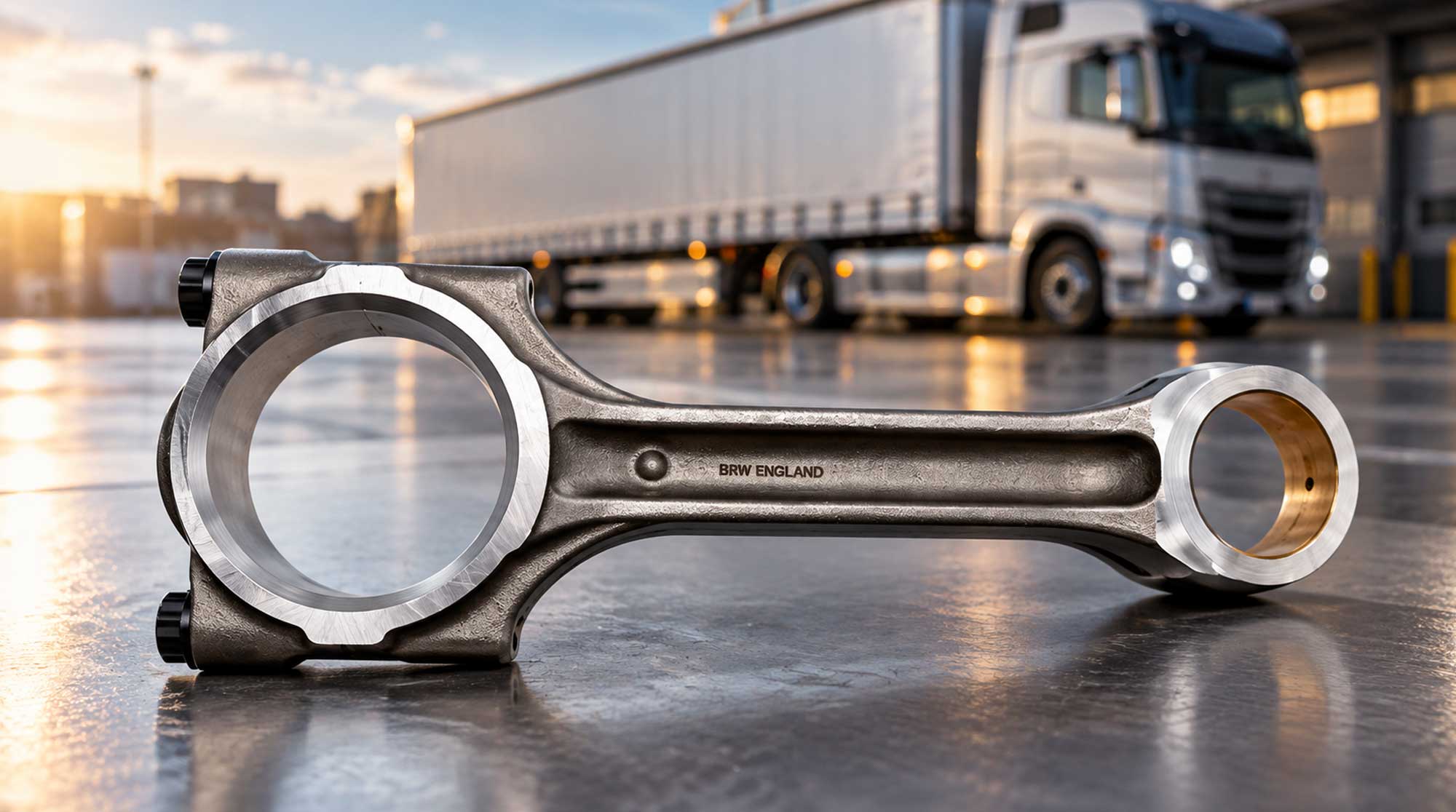
The connecting rod may be one of the engine's most heavily loaded components, but its role is remarkably simple: connecting the piston to the crankshaft and transferring power efficiently. In commercial vehicles, heavy-duty trucks, construction equipment and industrial engines, that simple connection has to withstand demanding loads continuously.
FROM COMBUSTION TO MOTION
Inside a conventional engine, combustion generates force at the piston. The connecting rod passes that force to the crankshaft, turning the piston's reciprocating movement into the crankshaft's rotational motion. It is more than a physical link. It is a critical part of the engine's power-transfer mechanism.
In heavy-duty applications, where engines may run under high loads for extended periods, the rod has to keep its structural integrity and dimensional accuracy throughout the operating cycle.
STRENGTH UNDER LOAD
Every combustion cycle sends substantial force through the connecting rod, which makes strength fundamental to its performance.
BRW Connecting Rods are manufactured to meet demanding OEM-standard requirements, with a focus on strength, durability and reliable performance under high-load and continuous operating conditions. For vehicles and equipment that spend long hours working under demanding conditions, dependable component performance is essential to keeping the engine running.
PRECISION MATTERS
Strength alone is not enough. The rod must fit accurately within the engine assembly and maintain the correct relationship between the piston and the crankshaft.
BRW Connecting Rods are designed with an emphasis on dimensional accuracy and consistent fitment, supporting proper engine balance and smooth power transmission. That precision matters most in heavy-duty engines, where continuous operation puts sustained demands on the whole rotating assembly.
BUILT FOR HEAVY-DUTY APPLICATIONS
BRW Connecting Rods are designed for a wide range of applications, including:
- Commercial vehicles
- Heavy-duty trucks
- Construction equipment
- Industrial applications
They are intended for demanding, continuous-duty operating environments, with durable construction designed to support long service life.
THE POWER LINK
A connecting rod does not generate power. It enables the engine to transfer it.
From the piston to the crankshaft, it forms one of the essential mechanical links in the engine, carrying combustion forces and helping turn them into usable rotational power. That makes its strength, precision and dependable fitment important not only to the component itself but to the performance of the engine assembly around it.
PRODUCT AT A GLANCE
BRW Connecting Rods
Built for the load. Made to fit.
- Strength: manufactured to meet demanding OEM-standard requirements for high-load, continuous operation
- Precision: designed for dimensional accuracy and consistent fitment
- Applications: commercial vehicles, heavy-duty trucks, construction equipment and industrial engines
emBRWace Perspective
Engines are judged by what they deliver: power, torque, efficiency. Far less attention goes to the parts that carry that output from one stage to the next. The connecting rod sits in that load path, between the force of combustion and the rotation of the crankshaft, so whatever the engine achieves has to pass through it.
Heavy-duty engineering rests on parts like this: unseen, rarely discussed, and fundamental.
Thought to Take Away
A small link can carry a big responsibility: connecting combustion to motion.
BRW Connecting Rods. OEM-standard engineering for demanding engines.