Reading Time: 4 Minutes
For commercial fleets, the move to lower-carbon transport is not a single technology switch. It is a sequence of decisions shaped by vehicle life, duty cycle, energy cost, infrastructure and capital.
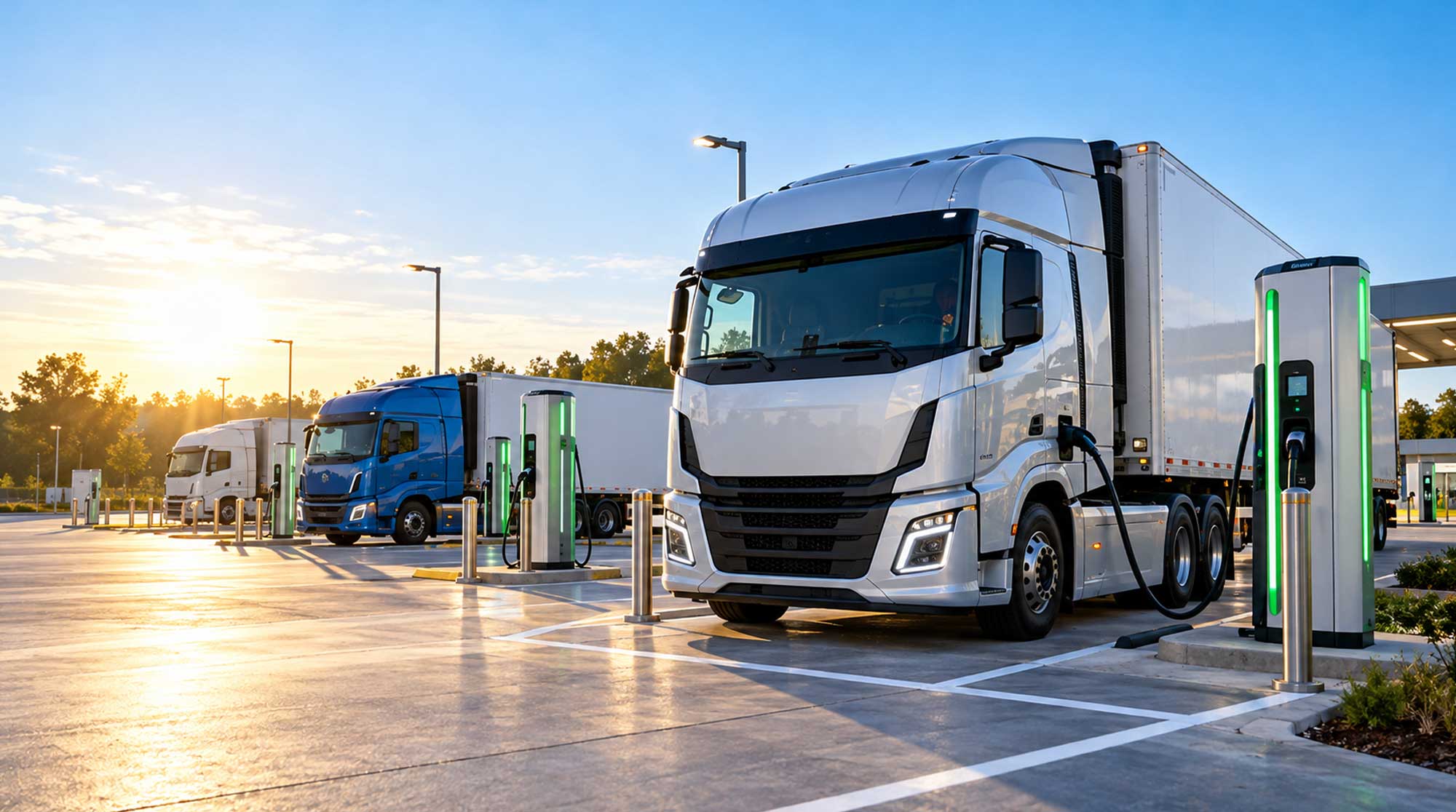
Battery-electric trucks are moving fast into mainstream consideration, yet the infrastructure to support them at scale is still being built. The European Alternative Fuels Observatory's April 2026 dataset counted 373 operational heavy-duty charging locations meeting the 350 kW criterion, with 2,405 recharging points between them, across 21 countries.
For a fleet operating today, that raises a practical question: what happens between the diesel truck already in service and the zero-emission truck that may one day replace it? This is where liquid biofuels enter the equation. HVO and biodiesel do not remove the need for electrification. They offer another route through the transition, particularly where existing vehicles, infrastructure and operating patterns make a rapid switch difficult.
WHY THIS MATTERS
Fleet decarbonisation is no longer a simple choice between diesel and electric. As charging infrastructure scales at different speeds across markets, liquid biofuels can give some operators a lower-disruption pathway, which makes the economics and timing of the transition as important as the technology itself.
THE TRANSITION
A truck is an asset that cannot be replaced overnight. It may stay productive for many years, with its route, payload, utilisation, maintenance programme and refuelling arrangements already settled. Swapping it for a battery-electric model can mean more than buying a different truck: depot charging, grid upgrades, route planning and changes to operating schedules may follow.
Liquid biofuels approach the problem differently. The International Energy Agency has described biofuels as particularly important for trucking, shipping and aviation, where few other low-carbon options exist. Its Renewables 2024 report found that liquid biofuels account for the most growth in renewable transport fuel use to 2030, because they are compatible with the existing vehicle fleet with minimal modifications. They can work with the fleet that exists while the fleet of the future is being built.
THE HVO ADVANTAGE
Hydrotreated vegetable oil is a paraffinic diesel fuel made by treating renewable feedstocks, such as vegetable oils, waste oils and animal fats, with hydrogen. For fleets, the attraction is straightforward: where the vehicle manufacturer approves it, HVO can be used at high concentrations, even neat, without the fundamental powertrain change that comes with battery-electric propulsion. Scania, for example, has approved HVO for its Euro 5 and Euro 6 engines since 2015, provided the fuel meets the European specification for paraffinic diesel, now EN 15940.
So "drop-in" should not mean putting it into every diesel vehicle without checking. It means that, for an approved vehicle and a compliant fuel, the transition can be far less disruptive than replacing the powertrain.
THE CARBON QUESTION
This is where the biofuel story becomes more complicated, and more interesting. There is no single lifecycle-emissions figure for HVO or biodiesel. The EU's Renewable Energy Directive (RED II) assigns very different default greenhouse-gas savings to different feedstocks and production routes. HVO made from waste cooking oil carries a default saving of 83%, and biodiesel from the same feedstock 84%. HVO from rapeseed carries 47%. Palm-oil routes can deliver far less, with defaults ranging from 20% to 49% depending on how the oil is produced.
Those are default values, set deliberately on the cautious side, and producers can declare actual figures instead. For fleet operators the lesson is plain: "biofuel" is not a sufficient sustainability specification. The relevant question is the verified lifecycle carbon intensity of the fuel being bought, which will matter more as fleets move from reporting fuel consumption to reporting carbon performance.
TWO DIFFERENT FUELS
HVO and biodiesel are often discussed together, but they are not the same fuel. HVO is a hydrotreated paraffinic fuel that can, where approved, be used at up to 100%. Biodiesel, commonly FAME (fatty acid methyl ester), is chemically different and is generally used within defined blending limits, or in vehicles specifically approved for higher concentrations. Fuel selection should therefore begin with the manufacturer's approval and the applicable fuel standard, not with the word "biofuel".
THE PRICE
There is an important limit to the HVO proposition. It is generally more expensive per litre than conventional diesel, although the premium varies considerably with market, taxation, feedstock, certification, supply and purchasing arrangements. So the cost case cannot rest on fuel price alone. It has to weigh vehicle replacement cost, fuel consumption, maintenance, infrastructure investment, downtime, utilisation, financing, carbon costs and incentives, and residual value. That is where the argument becomes more nuanced.
ELECTRIC'S TCO TEST
The latest European evidence makes it impossible to present biofuels as a universal cost winner. An analysis published on 28 September by Transport & Environment, a Brussels-based environmental advocacy group, found battery-electric trucks already had a lower five-year total cost of ownership than diesel in six of nine major EU markets, which together account for 46% of new heavy-truck sales in the EU. For trucks bought in 2026, it estimated five-year savings of up to €100,000 in the Netherlands, €85,000 in Germany and €69,000 in Denmark.
Two caveats matter. The analysis models long-haul trucks over a first five-year ownership period, and T&E said this year's diesel price spike, linked to the Iran conflict, strengthened the case for electrification. Even so, the finding changes the question. It is no longer simply whether electric trucks will become competitive. In some markets and duty cycles, they already are. That does not make the case for biofuels irrelevant. It makes it more specific: where does the bridge still make commercial sense?
THE INFRASTRUCTURE GAP
Charging availability remains the other variable. The 373 locations in Europe's April dataset are a start, and the European Commission's Clean Transport Corridor Initiative is working to fast-track at least 400 truck charging locations along two major freight corridors. Transport ministers endorsed the first roadmaps on 8 June, and the Commission intends to extend the approach to all main corridors during 2026.
The scale-up needed is large. A study by Fraunhofer ISI and the International Council on Clean Transportation, published in September, estimates that under a moderate electrification scenario, electric trucks in Europe could need around 100 TWh of electricity a year by 2035. Depot charging would account for more than 70–80% of that charging energy in most countries and scenarios. The transition is not simply about producing more electric trucks. It is about building the energy system around them.
A GLOBAL TRANSITION
The biofuel story is bigger than Europe, and the pathway differs by market. The IEA's Renewables 2024 outlook expects biofuels' share of liquid transport fuel demand to rise from 5.6% in 2023 to 6.4% in 2030, while warning that renewable fuel uptake would need to nearly double to be on track for net zero.
In one market, battery-electric trucks may already offer the strongest cost case. In another, charging may be insufficient. In another, biodiesel mandates or established liquid-fuel networks may make biofuels the practical option. A single fleet may end up running diesel, HVO, biodiesel, battery-electric and eventually hydrogen vehicles, according to application. There is no single transition timetable.
THE BRIDGE
This is perhaps the most important distinction. Biofuels should not be presented as a way of avoiding the transition. They can be one way of managing it. HVO can allow an approved diesel fleet to reduce lifecycle emissions without waiting for a full vehicle replacement cycle. Biodiesel can offer another renewable-fuel route where the engines, fuel standards and supply chains exist. Electric trucks can progressively take over the applications where their cost and operating requirements make sense.
The fleet transitions in stages, not because technology has failed to arrive, but because fleet economics rarely move at the speed of technology.
THE NEXT CALCULATION
The traditional fleet sum was simple: purchase price, plus fuel, maintenance and depreciation. The next is more complicated: vehicle, plus energy, infrastructure, utilisation, carbon, financing and timing. That last variable may matter most.
A fleet operator choosing HVO today is not necessarily choosing it over electric forever. The operator may simply be choosing a fuel that works with today's assets while tomorrow's infrastructure and vehicle economics mature. That makes the transition less about choosing a winner and more about choosing the right sequence.
emBRWace Perspective
The freight transition is unlikely to follow one universal path. The best solution for an urban delivery fleet may not suit a long-haul tractor, and a depot with abundant grid capacity faces a different equation from one with electrical-infrastructure constraints.
That is why the most useful question for fleet operators may not be which technology wins. It may be which combination of technologies delivers the lowest-risk transition for the work this fleet actually performs. HVO and biodiesel have a place in that calculation. So does electricity. The emerging fleet strategy is less about choosing one fuel and more about knowing when each makes economic sense.
Thought to Take Away
The road to lower-carbon freight may not be one leap. It may be a bridge built one fleet decision at a time.
By the Numbers
373
operational European heavy-duty charging locations met the 350 kW criterion in April 2026, with 2,405 recharging points between them.
83% and 84%
are the default RED II greenhouse-gas savings for HVO and biodiesel made from waste cooking oil.
100 TWh
is the annual European electric-truck charging demand projected for 2035 in the Fraunhofer ISI and ICCT moderate scenario.
6 of 9
major EU truck markets are where T&E found battery-electric trucks already cheaper than diesel over five years.
Sources: European Alternative Fuels Observatory, April 2026 heavy-duty vehicle charging data; Transport & Environment, electric truck total-cost-of-ownership analysis (28 September 2026) and Reuters coverage; Fraunhofer ISI and ICCT study on European electric-truck charging demand (September 2026); European Commission, Clean Transport Corridor Initiative; IEA, Renewables 2024 and Tracking Clean Energy Progress; Directive (EU) 2018/2001 (RED II), Annex V; Scania HVO approval announcements