On 19 October 1924, racing lost one of its boldest pioneers.
Back in history, at Brooklands, where speed was measured in courage as much as miles per hour, a gigantic engine began to roar. Its six cylinders displaced an astonishing 23 litres, and its sound announced the arrival of a machine unlike anything the circuit had seen before.
Behind this extraordinary creation stood Louis Vorow Zborowski, the British racing driver and automotive enthusiast whose imagination helped produce the legendary Chitty Bang Bang cars. He was wealthy, mechanically gifted and fascinated by the limits of speed. His ambition was not simply to race existing machines, but to build something extraordinary.
The Thunder at Brooklands
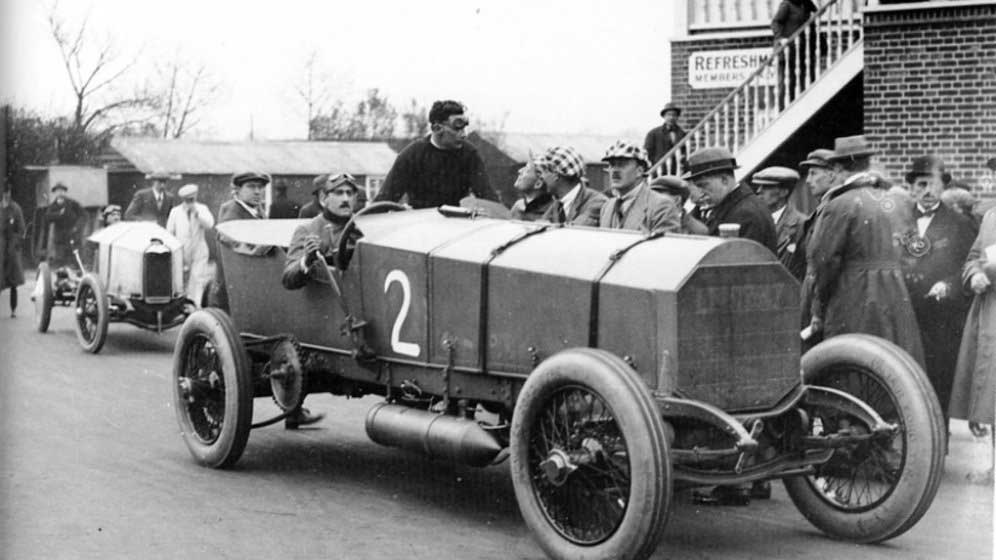
In 1920, Zborowski’s first Chitty Bang Bang appeared at Brooklands, the famous banked racing circuit in Surrey. Its immense 23-litre, six-cylinder Maybach aero-engine had been designed for aircraft applications. Mounted in a modified Mercedes chassis, it transformed the car into a spectacular experiment in power and speed.
The machine was developed with the help of Captain Clive Gallop, an engineer and racing driver who worked alongside Zborowski at his Higham Park estate in Kent. Their partnership combined engineering expertise with a willingness to challenge conventional thinking.
The first car was followed by further creations, including Chitty 2 and Chitty 3, each reflecting Zborowski’s appetite for mechanical extremes. These were not merely extravagant toys. They competed at Brooklands, attracted enormous attention and helped establish him as one of the circuit’s most distinctive personalities.
His interests extended beyond his own machines. He competed internationally, drove Aston Martins and supported the struggling Aston Martin company financially. His ambitions reached the highest level of motor racing, where the leading manufacturers fielded purpose-built Grand Prix cars.
A Dream Beyond Limits
Zborowski’s fascination with immense engines reflected an era when automotive engineering was still exploring the boundaries between road cars, racing machines and aircraft technology. Aero-engined cars offered extraordinary power, but they also demanded careful engineering and considerable courage from those who drove them.
His projects were not without setbacks. The cars required development, repair and refinement, and their sheer size made them challenging machines. Yet their audacity captured the spirit of early motorsport, when determined individuals could still make a dramatic mark alongside established manufacturers.
By 1924, Zborowski had earned a place in the Mercedes works team. He was preparing to compete at the highest level, carrying the experience of Brooklands into the fiercely contested world of Grand Prix racing.
The Final Lap
On 19 October 1924, Zborowski lined up for the Italian Grand Prix at Monza in a Mercedes. During the race, his car left the track and struck a tree. He was killed instantly, aged just 29.
His death ended a career that had combined private ingenuity with international racing ambition. The young driver who had once brought enormous aero-engined machines to Brooklands had reached the pinnacle of Grand Prix competition, only to lose his life in the sport he loved.
A Legend that Lives On
Zborowski’s cars outlasted their creator in the public imagination. Their name and spirit helped inspire Ian Fleming’s children’s book Chitty-Chitty-Bang-Bang, later adapted into the celebrated 1968 musical film. The fictional flying car was not a direct copy of any one of Zborowski’s machines, but the connection carried the romance of his motoring adventures to generations who had never heard the engines roar at Brooklands.
His legacy is a reminder that automotive progress has often been driven by people willing to imagine beyond the accepted limits. Zborowski combined resources, mechanical curiosity and competitive ambition to create machines that became part of motoring folklore.
He died young, but his name remains attached to an unforgettable chapter in the history of speed.