Reading Time: 4 Minutes
The path beneath our feet has one job: to get us from one place to another. Cities around the world are now asking whether it can do more.
Picture a cycle lane producing solar power beneath its surface, or a covered cycling highway generating electricity above the riders' heads. A pavement that helps charge an e-bike. A walkway that turns footsteps into small amounts of electrical energy.
The technologies differ, and so does the scale. But they share one intriguing proposition: what if mobility infrastructure could also become energy infrastructure?
THE PATH IS NO LONGER JUST A PATH
Urban infrastructure takes up enormous amounts of space: roads, cycleways, walkways, plazas, mobility hubs. Traditionally, all of it has been designed around movement, access and safety, while energy infrastructure has lived elsewhere, on rooftops, beside roads or on dedicated land.
That separation is starting to look less inevitable. Projects in the Netherlands, South Korea, Hungary, the UK and India suggest that infrastructure built for mobility could take on further jobs: generating electricity, providing shade, supporting charging, powering lighting, collecting data.
The idea is simple. Infrastructure need not merely occupy space. It can produce value from the space it already occupies.
WHY THIS MATTERS
Cities have to move more people while managing pressure on land, energy and the environment. At the same time, cycling, walking and micromobility are becoming ever more tied to electric power. So instead of building mobility and energy infrastructure separately, could some of it eventually be designed together?
The answer is not yet straightforward. Solar-integrated surfaces face engineering, maintenance and economic challenges. Kinetic systems squeeze small amounts of energy from each movement. Conventional solar installations can often generate electricity more efficiently.
But the point is not to replace them. It is to make mobility infrastructure work harder.
THE NETHERLANDS PUTS SOLAR UNDER THE WHEELS
The Netherlands staged one of the earliest high-profile demonstrations with SolaRoad, which places photovoltaic cells inside a cycle-path surface, protected by a transparent, load-bearing and skid-resistant layer. The logic is neat: the path already exists, so why not let the surface earn its keep?
The engineering is harder. The surface must endure weather, dirt, mechanical loads and continuous cycling while still letting enough sunlight reach the cells. In November 2015, it was announced that the path had produced 9,800 kWh of electricity over a year. The lesson is bigger than any single figure: a surface designed for movement can also be designed for generation.
SOUTH KOREA PUTS SOLAR ABOVE THE CYCLIST
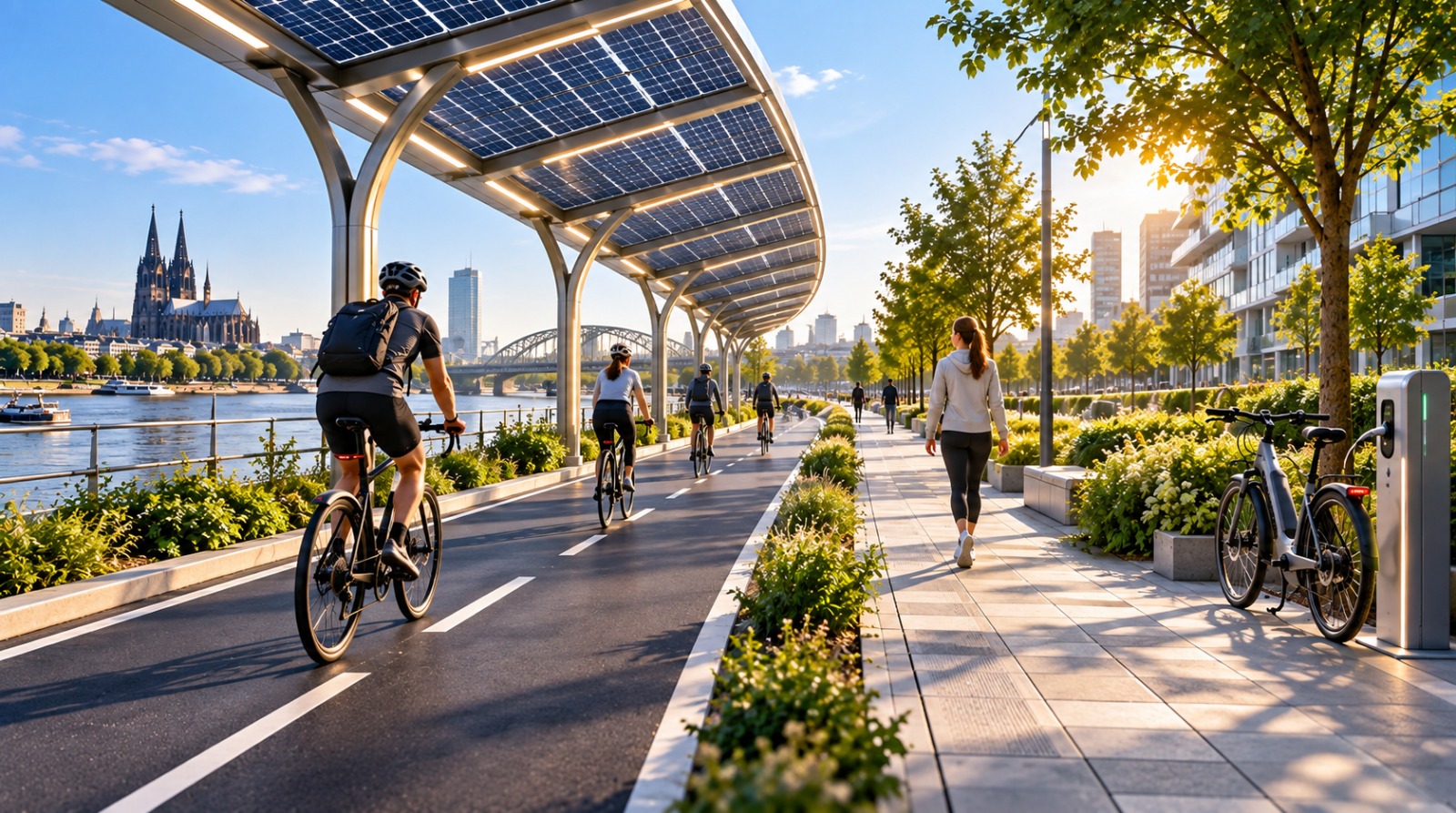
South Korea approaches the idea from the other direction, with panels forming a roof over the route rather than lying beneath it. The best-documented example links Daejeon and Sejong, where a cycle path of about nine kilometres has had a solar-panel roof over roughly 4.8 kilometres of it since 2014. Some 7,502 panels produce an annual average of about 2,200 MWh, which the country's land ministry equates to the needs of roughly 600 households.
The structure does two jobs at once. It shades and shelters the rider while it generates energy, which matters in hot climates. The route stops being merely a corridor for movement and becomes a corridor with an energy-generating roof.
HUNGARY TURNS PAVEMENT INTO A CHARGING POINT
Hungary's PLATIO takes the idea down to the scale of the pavement itself. Its modular solar pavers combine photovoltaic generation with uses such as charging for e-bikes and e-scooters.
That points to a different kind of energy infrastructure: power generated close to where a mobility service needs it, rather than fed from a distant installation. Imagine a mobility hub with solar paving, bicycle parking, charging points, lighting and seating. The pavement is no longer something people merely walk across. It is part of the system.
THE UK TURNS FOOTSTEPS INTO ENERGY
The UK adds another ingredient: human movement. Pavegen's kinetic flooring converts footsteps into small amounts of electrical energy. A single step contributes very little, but where large numbers of people pass continuously, the accumulated energy can run applications such as lighting and interactive displays. Pavegen has also explored pairing kinetic generation with solar through its Solar+ approach.
The suggestion is that a mobility space need not rely on one energy source. The movement within it can become part of its energy story.
INDIA BUILDS A SOLAR ROOF OVER THE JOURNEY
Hyderabad scales the solar canopy up dramatically. Its Healthway cycling track runs for 23 kilometres alongside the Outer Ring Road, and 16,000 solar panels, with a stated 16 MW of generating capacity, light the track at night and shelter riders from sun and rain.
The roof protects the cyclists, the panels produce the electricity and the track provides the corridor. Three functions share one piece of infrastructure.
FIVE PATHS. ONE IDEA.
The technologies, scales and energy yields all differ, and the examples should not be treated as interchangeable. The Netherlands puts generation beneath the wheels. South Korea puts it above the cyclist. Hungary builds it into modular paving and charging. The UK finds it in the footstep. India spreads it across a long cycling corridor.
One emerging question connects them: could the future city build mobility and energy infrastructure together rather than separately?
THE ENERGY NETWORK COULD BECOME LOCAL
There is another possibility hiding in these experiments. Electric mobility increasingly needs power close to where people move: e-bikes and e-scooters to charge, streets to light, sensors to run.
A cycle track could become an energy corridor, a mobility hub a charging and energy node, a pedestrian plaza a site of small-scale generation. The result would be less a conventional power station than something distributed, with energy generated closer to where mobility happens. The path becomes more than a route. It becomes a node.
BUT THERE IS A REALITY CHECK
The idea is compelling. The engineering is harder.
A mobility surface faces dirt, water, vibration, impacts, wear, temperature swings and constant use. Solar surfaces also need sunlight, and shading, orientation and maintenance all affect output. The economics are demanding too: a conventional solar roof or ground-mounted array may generate electricity more efficiently and cheaply than photovoltaics built into a surface.
One comparison of SolaRoad's trial data with nearby rooftop systems found the rooftops producing roughly twice as much per square metre. Kinetic energy has its own limit, because one footstep yields little and the value depends on footfall and on what is being powered.
So, the question is not simply whether a path can generate energy. It is whether it can generate enough useful value to justify the infrastructure required. That is where the next generation of projects will have to prove themselves.
THE PATH OF THE FUTURE MAY DO MORE
The most interesting prospect may not be a solar cycle path or a kinetic walkway on its own, but multifunctional infrastructure: a corridor offering movement, energy, shelter, charging, lighting, information and connectivity. It would be an active part of the urban system, not a passive surface beneath it.
That changes the design question. Instead of asking what a road, path or walkway is built for, planners could ask: what else could this infrastructure do?
emBRWace Perspective
Mobility infrastructure has long been designed around one question: how do we move people from here to there? The next generation may ask several more. Can the journey generate energy? Can the infrastructure provide shelter, support charging, power local services, join a connected urban system?
The smartest mobility infrastructure may ultimately be the kind that does more than carry the journey.
emBRWace Explains
Solar-integrated mobility infrastructure: Mobility infrastructure that incorporates photovoltaic technology to generate electricity alongside its primary transport function.
Solar pavement: Paving that incorporates photovoltaic modules to generate electricity from surfaces normally used for walking, cycling or public space.
Kinetic pavement: Flooring or paving that converts the mechanical energy of human movement into electrical energy.
Microgrid: A local energy system that can connect generation, storage and electricity demand within a defined area.
Thought to Take Away
Tomorrow's path may not simply take us somewhere. It may help power the place we are going to.
Sources: ABC News coverage of the Daejeon to Sejong solar cycle path; Prasar Bharati (News on AIR) coverage of Hyderabad's Healthway solar-roof cycling track; public coverage of the SolaRoad trial results; project information on PLATIO (Hungary) and Pavegen (UK)