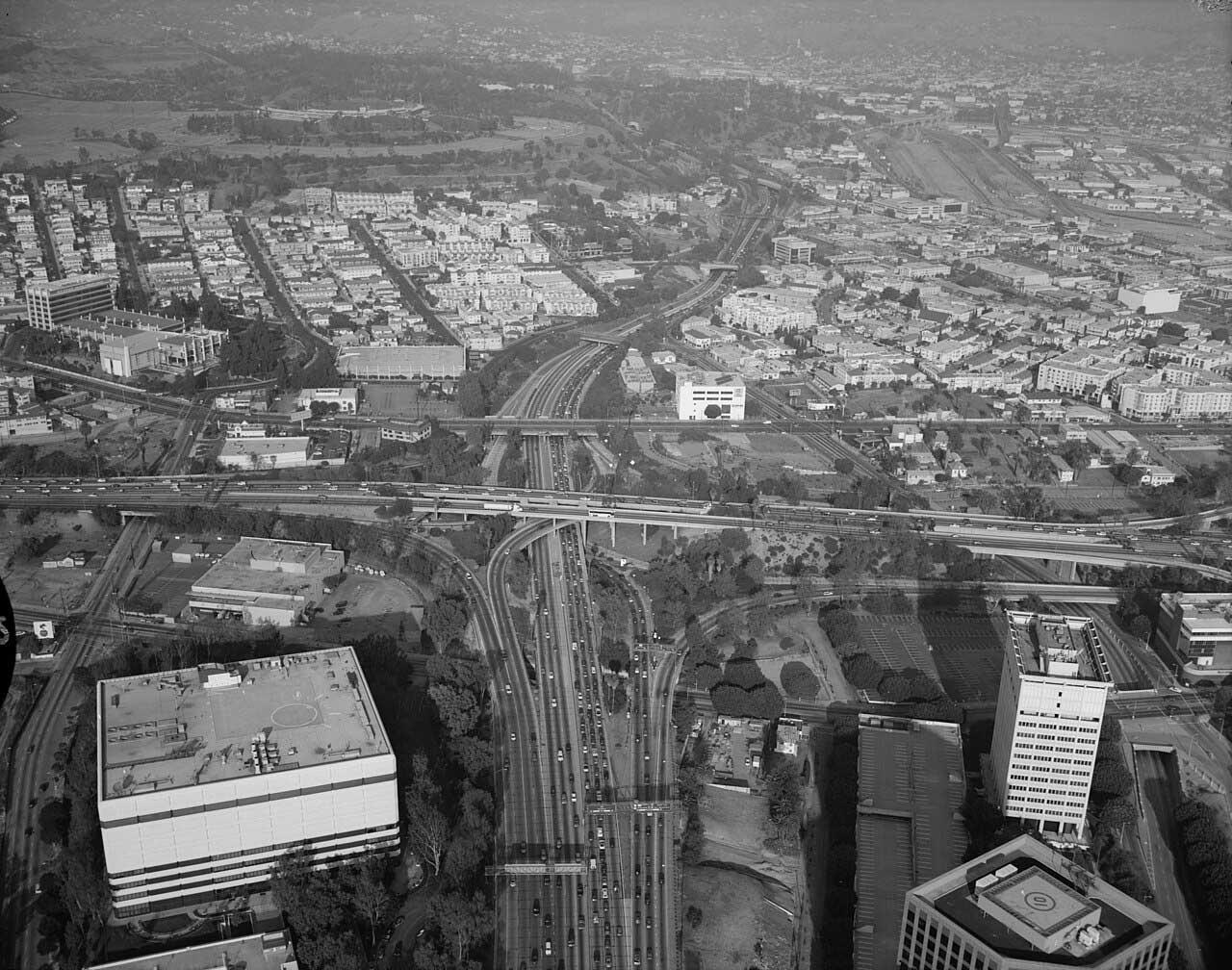
On 22 September 1953, Los Angeles opened the Four-Level Interchange to full traffic, creating the world’s first operational stack interchange. Linking US 101 with State Route 110, the landmark structure brought four levels of reinforced-concrete roadways together, allowing traffic to move between freeways without conventional crossing movements.
The interchange had actually been structurally completed in 1949, but could not be fully used until the connecting freeways were completed. Its stacked configuration offered a space-efficient alternative to the sprawling cloverleaf, particularly important in densely developed downtown Los Angeles.
At the time, the $5.5-million project was the most expensive half-mile of highway ever built. Its 32 lanes initially carried traffic in eight directions, establishing a new model for high-capacity urban freeway design.
The Four-Level became a prototype for stack interchanges worldwide, making it an important milestone in the infrastructure evolution of modern mobility.