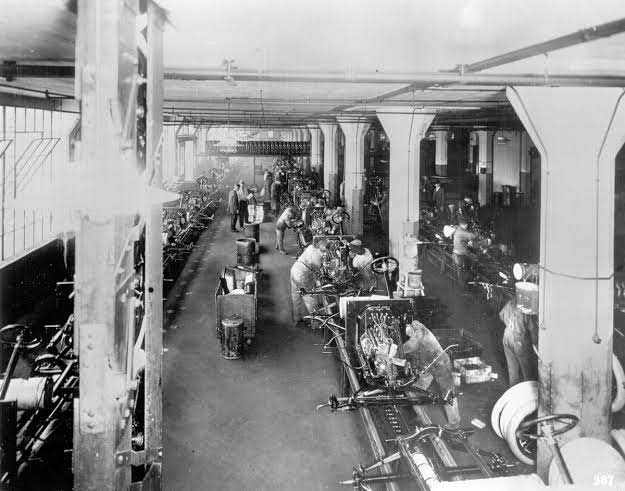
On 7 October 1913, Ford Motor Company introduced a continuously moving assembly system for Model T chassis at its Highland Park plant in Michigan, marking a decisive turning point in industrial manufacturing. Rather than workers moving around a stationary vehicle, the chassis was drawn along a line while workers performed specialised tasks at fixed positions.
The breakthrough had been developing for months. In April 1913, Ford engineers had experimented with a moving line for flywheel magnetos, dividing the work into 29 operations performed by 29 workers. The approach reduced magneto assembly from around 20 minutes to 13 minutes initially, eventually reaching five minutes. Ford then applied the principle progressively to engines, transmissions and chassis assembly.
On 7 October, the early chassis line used a rope and windlass to pull the vehicle across the factory floor. The process reduced assembly time from approximately 12½ hours to 5 hours 50 minutes. Further refinement, including powered chain-driven conveyors and more precise division of labour, ultimately reduced Model T assembly to about 93 minutes by early 1914.
The consequences extended far beyond Ford. Higher productivity enabled substantial price reductions, helping transform the automobile from an expensive product into an increasingly accessible form of mass mobility. Highland Park became a defining model for modern mass production, influencing manufacturing industries around the world.