Reading Time: 4 Minutes
When something fails in a truck’s air brake system, one valve decides whether the damage stays in one circuit or spreads to all of them. It rarely gets noticed, but it is built for the day something goes wrong.
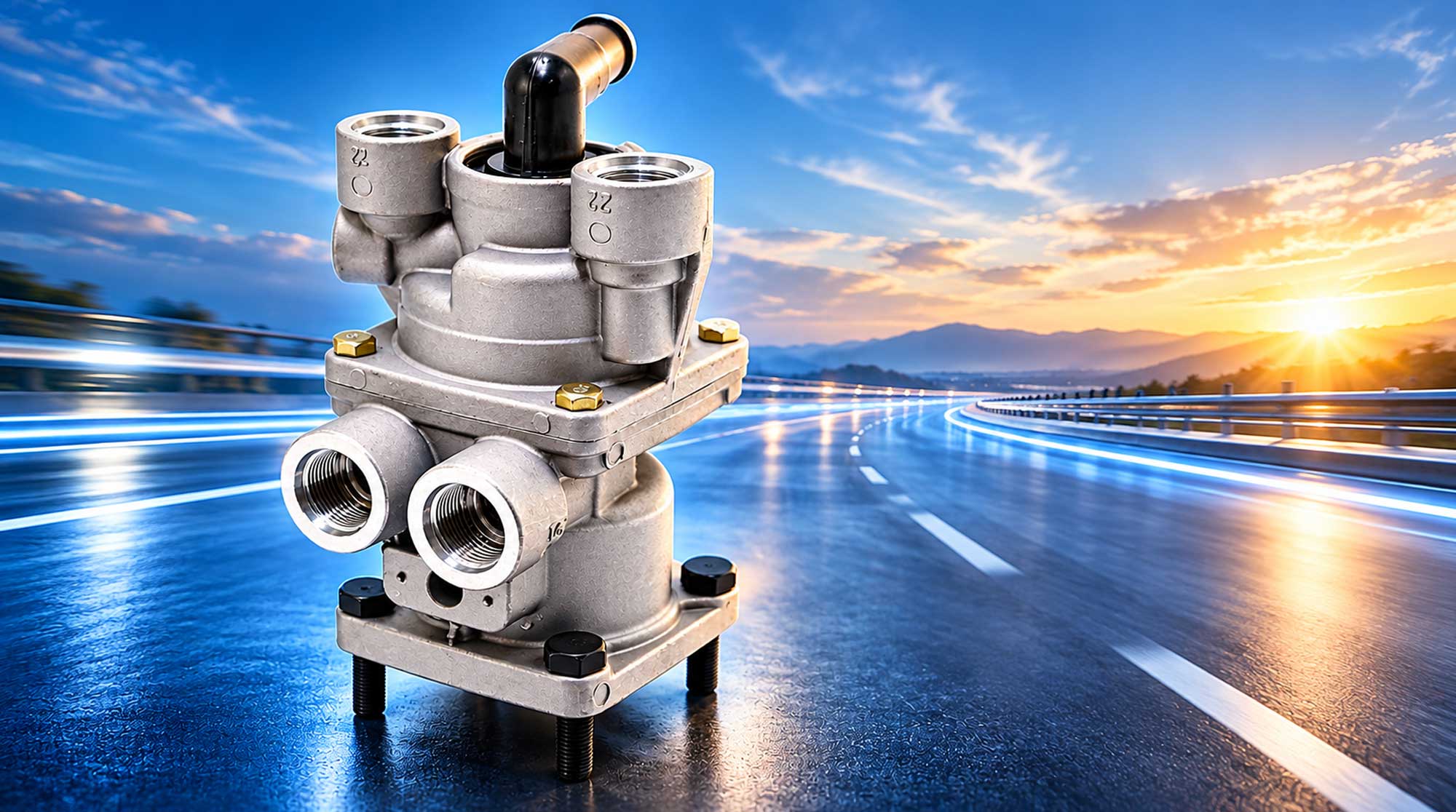
The multi-circuit protection valve is a critical part of the pneumatic braking system in heavy-duty trucks, buses and other commercial vehicles. It distributes compressed air from the vehicle’s air supply to several independent circuits and protects them against pressure loss when one of the others develops a leak or fails.
In a heavy vehicle, that separation matters. Dependable braking is essential because of the vehicle’s weight, load capacity and demanding working conditions.
WHERE THE VALVE FITS
Compressed air starts at the air compressor, is stored in reservoirs and is distributed through a network of pneumatic components to operate the brakes. The protection valve sits in that network and divides the supply between the circuits. Depending on the vehicle, these may include the front axle brakes, rear axle brakes, parking brake, trailer supply and auxiliary pneumatic equipment.
It also decides the order of filling. When the compressor runs on a system with no pressure, the two service brake circuits are supplied first, while the parking brake and auxiliary consumers wait their turn. That makes it impossible to drive off with too little brake pressure. Simplified, the path runs:
AIR COMPRESSOR → PROTECTION VALVE → SERVICE BRAKE CIRCUITS → PARKING AND AUXILIARY CIRCUITS
HOW IT KEEPS A FAILURE LOCAL
Each circuit is connected through its own overflow valve, which opens at a set pressure and closes at a lower one. If a leak is small enough for the compressor to compensate, nothing happens in the valve at all.
The valve earns its keep when the leak is larger. If more air escapes than the compressor can replace, pressure falls until the faulty circuit’s valve reaches its closing pressure and shuts. The faulty circuit keeps draining, but the intact circuits stay at the closing pressure and can still be refilled by the compressor. That is how braking capability is preserved in the circuits that are unaffected.
The numbers are system-specific. One published technical sheet for a four-circuit valve lists an opening pressure of 7.0 bar and a dynamic closing pressure of 6.7 bar, as an illustration, and the precise values vary from one system to another. The recovery is slow by design. A compressor delivers only about 200 to 400 litres of air a minute, so restoring full pressure after a major leak takes time.
BUILT FOR THE WORKING DAY
A protection valve cycles with the compressor all day, every day. It has to cope with continuous operation, vibration, temperature variation and repeated pressure cycles, and its internal mechanisms respond to changes in air pressure to regulate supply between the connected circuits. The pressures are not small. US air systems typically charge to a governor cut-out of around 125 psi, about 8.6 bar.
Properly working, the valve contributes to stable pneumatic operation, efficient air management and the preservation of braking capability in unaffected circuits when a failure occurs.
THE SAFETY NET AROUND IT
The protection valve is one layer of a larger safety system, and the layers work together. In the US, FMVSS 121 sets two benchmarks that show what the valve is protecting. A low-air warning, visual and audible, must sound before service reservoir pressure falls below 60 psi (about 4.1 bar). If pressure keeps falling, the spring brakes must apply automatically between 20 and 45 psi (roughly 1.4 to 3.1 bar). Requirements differ by market, so operators should check the rules that apply to them.
The driver’s instruction does not change. Even if the vehicle still seems to slow down normally, one of the two circuits may have failed and the remaining one is at risk, so the vehicle should be brought to a controlled stop.
WHEN THE SYSTEM STARTS TO SPEAK
Air-system problems tend to show in how the vehicle behaves: a low-pressure warning that appears or keeps returning, slower than normal pressure build-up, audible air leaks, a circuit that will not charge or a parking brake that will not release. Routine checks give useful reference points. In the US, pressure in a dual air system should build from 85 to 100 psi within 45 seconds at fast idle, and with the engine stopped and brakes released, it should not drop by more than 2 psi in a minute on a single vehicle or 3 psi on a combination vehicle.
None of these symptoms points automatically at the protection valve. Leaking brake chamber diaphragms, loose fittings and failed seals in other valves can all cause excessive air loss, and the compressor, dryer or governor can affect build-up. A qualified technician should trace the actual cause before anything is replaced.
THE RIGHT VALVE FOR THE APPLICATION
Fitment matters. Protection valves come in different configurations to suit different braking architectures, and their opening and closing pressures are matched to the system. Correct selection, installation and maintenance are essential to ensure compatibility with the vehicle’s braking architecture and compliance with the manufacturer’s specifications.
The valve is widely used in heavy-duty trucks and tractor units, long-distance transport vehicles, buses and coaches, construction and industrial vehicles with pneumatic brakes, and trailer-equipped vehicles with multi-circuit air supply, where the manufacturer specifies it.
emBRWace Perspective
In a safety-critical system, the most important components are often the ones that do their work only when something goes wrong. A protection valve is invisible in normal operation, and its value shows only when a leak tests it.
For fleet teams, that argues for treating air-system health as a continuing discipline, not a reaction to a warning light. Regular checks, systematic diagnosis and correctly specified parts keep that safety net ready.
Braking reliability is built from many circuits. This valve keeps them independent.
emBRWace Explains
Multi-circuit protection valve
A pneumatic valve that distributes compressed air to several independent circuits and protects them against pressure loss when one circuit leaks or fails.
Opening pressure
The pressure at which a circuit’s valve opens to let air flow in.
Closing pressure
The lower pressure at which a circuit’s valve closes, so the pressure in the other circuits is retained.
Pneumatic circuit
A separately supplied branch of the air system, such as the front axle brakes, rear axle brakes, parking brake, trailer supply or auxiliary equipment.
Spring brake
A parking and emergency brake held off by air pressure and applied by a spring when pressure falls.
Thought to Take Away
One leak should never be allowed to take the whole braking system with it.