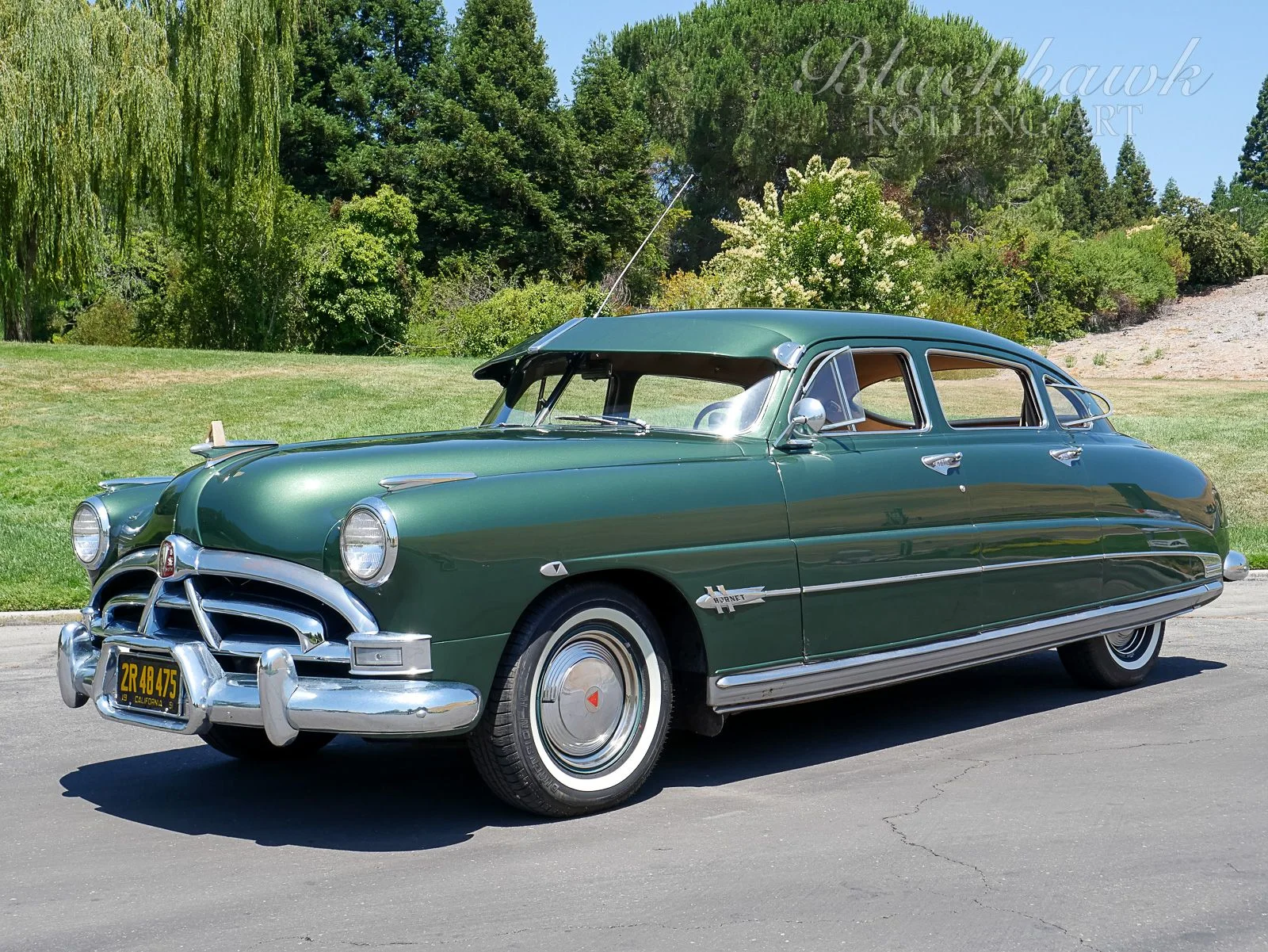
On 16 October 1950, Hudson’s Hornet emerged as a bold new contender for the 1951 model year, combining innovative chassis engineering with a powerful straight-six engine that would soon challenge America’s stock-car racing establishment.
A Step Ahead
The Hornet’s secret lay beneath its body. Hudson’s innovative step-down design, introduced in 1948, positioned the passenger compartment within the perimeter frame, creating a lower centre of gravity and a more stable, road-hugging car. Passengers literally stepped down into the cabin, while the design delivered impressive handling for a full-sized American automobile.Power came from a 308-cubic-inch (5.0-litre) flathead inline-six producing 145 horsepower in its original configuration. With substantial torque and a reputation for durability, the engine gave the Hornet a distinctive advantage against many rivals powered by larger V8s. Hudson’s optional Twin H-Power induction system, introduced in 1952, further enhanced performance.
The Track Takes Notice
The Hornet quickly translated its engineering strengths into racing success. In 1951, Marshall Teague drove it to victory at the Daytona Beach and Road Course. The following year, Hudson won 27 of 34 NASCAR Grand National races, establishing the Fabulous Hudson Hornet as a dominant force in American stock-car racing.Drivers including Teague and Herb Thomas helped build its legend. The Hornet continued to win races through 1953 and 1954, demonstrating that intelligent engineering, balanced handling and reliable power could overcome formidable competition.
Its success was especially remarkable in an era when manufacturers were investing heavily in V8 engines and increasingly powerful production cars. The Hornet showed that outright performance was not simply a matter of cylinder count or horsepower; chassis design and the ability to put power effectively to the road mattered just as much.
From Track to Screen
Hudson’s fortunes eventually declined as competition intensified and the American automotive industry consolidated. Following the 1954 merger that created American Motors Corporation, the original step-down Hornet gave way to redesigned models based on Nash architecture.Yet its reputation endured far beyond its production years. Pixar’s Cars introduced the legend to a new generation through Doc Hudson, the wise former racing champion inspired by the Fabulous Hudson Hornet.
The Hornet’s legacy rests on more than its victories. It demonstrated how a bold engineering concept could transform a family-sized car into a racing force — and secure its place in automotive history.