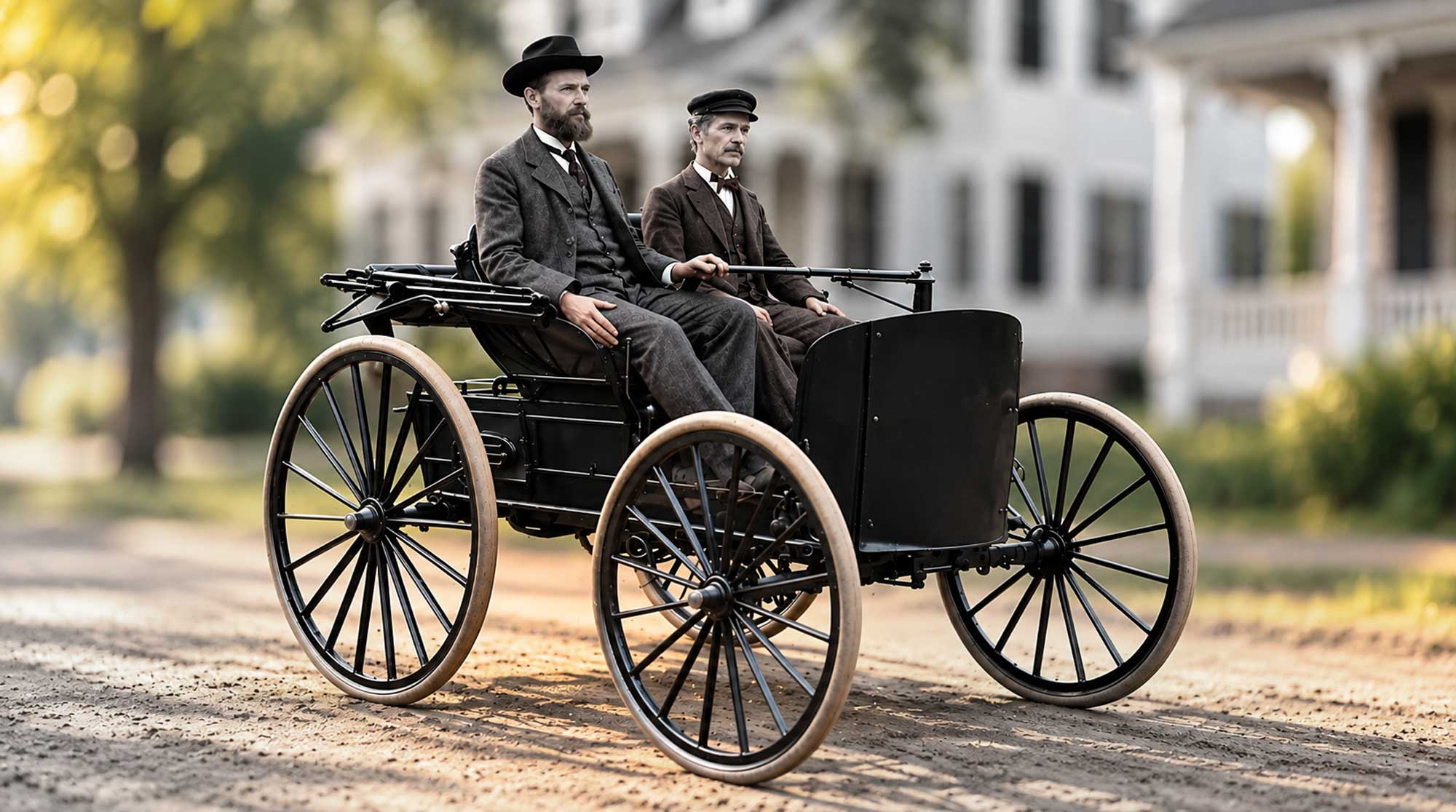
Born on 8 October 1869 in Washburn, Illinois, James Frank Duryea became one of America’s earliest automobile pioneers. Together with his elder brother Charles, he helped develop a practical petrol-powered road vehicle in Springfield, Massachusetts, during the early 1890s.
The brothers’ first Duryea was based on a modified horse-drawn carriage and fitted with a gasoline engine. Frank, the practical engineer and builder, conducted the vehicle’s road tests in September 1893. The Smithsonian describes the machine as one of the earliest American-made automobiles; importantly, it survives today in the Smithsonian collection as a tangible reminder of America’s formative automotive experiments.
Frank’s engineering contribution became even more significant with the second Duryea, which he developed into a more capable machine. On 28 November 1895, he drove it to victory in the Chicago Times-Herald race, covering approximately 54 miles through snow and defeating the other finishers, including an imported Benz. It was widely recognised as the first major automobile race in the United States.
The brothers and their financial backers established the Duryea Motor Wagon Company in 1895–96. The Smithsonian identifies it as the first American company to manufacture and sell automobiles, while Frank served as chief engineer responsible for design and production.
In 1896, the company produced thirteen essentially identical cars — an early example of American automotive production at scale.
Frank Duryea’s legacy lies not simply in building an early automobile, but in helping move American motoring from experimental invention towards engineering, competition and commercial production.