Reading Time: 4 Minutes
Editorial Standfirst
What if a vehicle could be checked for its real-world emissions without being pulled off the road? Remote sensing is making that possible—using light, sensors and data to measure exhaust as vehicles pass, revealing how fleets actually perform beyond the laboratory.
THE TEST THAT COMES TO THE ROAD
A vehicle can meet an emissions standard in a laboratory and still behave differently once it enters everyday traffic. Real-world driving brings different speeds, loads, temperatures, driving patterns, vehicle ages and operating conditions. For commercial vehicles, high utilisation adds another dimension.
That creates a fundamental question:
How do we know what a vehicle is actually emitting on the road?
Remote sensing offers one answer.
Instead of bringing the vehicle to a test facility, the measurement system goes to the vehicle.
MEASURING WITHOUT TOUCHING THE VEHICLE
The principle is surprisingly simple.
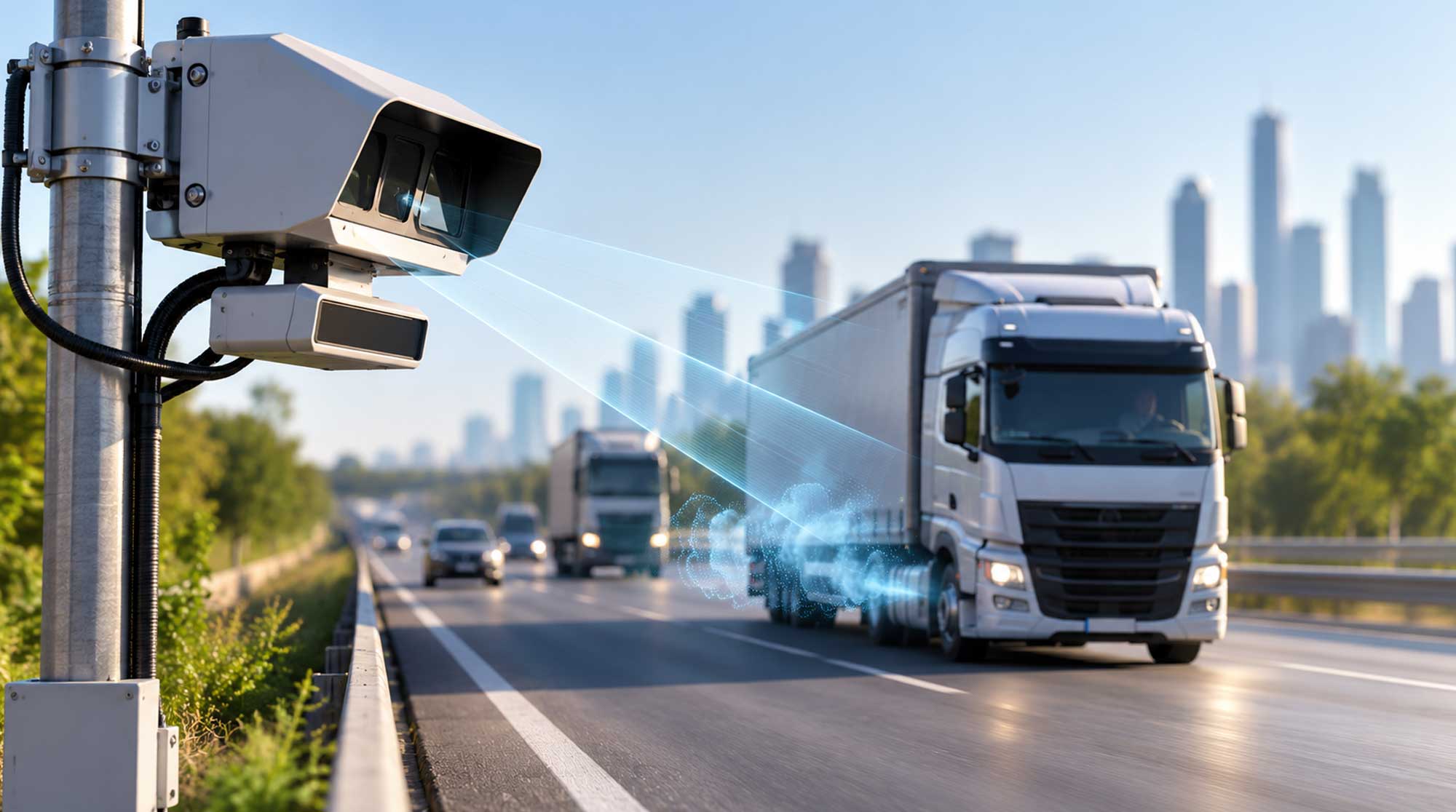
A vehicle passes a roadside monitoring point. A beam of light is directed through the exhaust plume, and sensors analyse how that light is absorbed by different gases.
This is absorption spectroscopy.
Modern roadside remote-sensing systems can measure a passing vehicle's exhaust in less than a second, estimating pollutants including nitrogen oxides, carbon monoxide, hydrocarbons, carbon dioxide and sulphur dioxide. Particulate matter can also be estimated indirectly through plume opacity.
Cameras and other sensors can simultaneously identify the vehicle and capture information needed to connect the emission measurement with its characteristics. The result is a snapshot of real-world emissions in real-world conditions.
FROM ONE VEHICLE TO AN ENTIRE FLEET
This is where remote sensing becomes much more powerful. A single measurement tells us something about one vehicle. Thousands of measurements can reveal a pattern.
The TRUE Initiative (The Real Urban Emissions Initiative) is a partnership of the FIA Foundation and the International Council on Clean Transportation (ICCT) that collects and analyses real-world vehicle-emissions data to help cities understand their vehicle fleets and develop cleaner-transport policies. Its work uses remote sensing among other measurement approaches.
Its Delhi–Gurugram campaign measured around 112,000 vehicles between December 2022 and April 2023. The analysis found important differences between laboratory limits and real-world emissions for some vehicle groups, including high-use commercial vehicles.
At that scale, the question changes.
It is no longer simply:
“How clean is this vehicle?”
It becomes:
“What is this fleet really contributing to the city's air?”
FINDING THE HIGH EMITTERS
One of the most important applications is identifying vehicles that emit disproportionately high levels of pollutants. This matters because emissions are not necessarily distributed evenly across a fleet.
The TRUE Initiative's research in cities around the world has shown how real-world measurements can reveal which vehicle groups contribute disproportionately to pollution. In Jakarta, for example, buses, heavy-duty trucks and light-duty trucks recorded the highest median nitrogen oxide emissions among the vehicle categories measured in the study.
That creates a powerful policy possibility:
Measure → Identify → Target → Act
Instead of treating every vehicle in the same way, authorities can use real-world evidence to focus inspection, maintenance or other interventions where they are likely to have the greatest impact.
WHEN EMISSIONS DATA BECOMES INTELLIGENCE
Collecting measurements is only the beginning.
The greater opportunity emerges when large volumes of real-world emissions data can be examined together. A single roadside reading may tell us what one vehicle emitted at one particular moment. A large dataset can reveal relationships between emissions and factors such as vehicle age, fuel type, emission standard, operating conditions and vehicle category.
This is where advanced data analysis and machine-learning techniques can become useful.
Instead of examining every measurement individually, analytical systems can help identify patterns, anomalies and groups of vehicles that warrant closer attention. As datasets grow, these techniques can support faster and more targeted interpretation of real-world fleet performance.
The important distinction is that AI does not replace the measurement itself. The sensor captures the evidence. The data provides the record. Advanced analytics helps reveal the pattern. And policymakers, fleet operators and other stakeholders decide what action should follow. The shift is therefore not simply from sensors to AI. It is from measurement to intelligence.
THE COMMERCIAL VEHICLE CONNECTION
For commercial vehicles, this matters particularly because trucks and other heavy-duty vehicles can accumulate substantial mileage and fuel use, while their emissions performance can be affected by operating conditions, maintenance, deterioration and malfunction. Remote sensing therefore opens another window into fleet health.
A fleet operator could eventually gain a clearer picture not only of fuel consumption and uptime, but also of how vehicles are performing from an emissions perspective under actual operating conditions. This connects sustainability with something every fleet understands: performance.
WHEN ROAD DATA STARTS SHAPING CITY POLICY
The real value of remote sensing emerges when individual measurements become part of a wider picture of urban mobility. Repeated roadside measurements can show where high-emitting vehicle groups are concentrated, how different categories of vehicles perform and where interventions may have the greatest effect. That information can then support decisions on emission standards, inspection programmes, fleet monitoring and clean-transport measures.
The TRUE Initiative says its real-world emissions database now contains more than 75 million vehicle records from five continents, with its data and analysis supporting cities in developing measures such as clean transportation zones, fuel and emission standards, inspection programmes and fleet monitoring.
Recent campaigns in places including Delhi, Johannesburg and São Paulo show how remote sensing is being used to build increasingly detailed pictures of real-world vehicle emissions. In São Paulo, for example, a 2024 campaign collected more than 323,000 measurements across the metropolitan area.
The implication is significant. The roadside is becoming more than a place where vehicles travel. It is becoming a source of environmental intelligence.
FROM TESTING VEHICLES TO UNDERSTANDING THE ROAD
Traditional emissions testing asks:
Does this vehicle meet the required standard?
Remote sensing adds another question:
How is the vehicle actually performing when it is moving through the real world?
That distinction could become increasingly important as cities seek cleaner air and policymakers look for ways to identify the vehicles and fleets where intervention can have the greatest effect. The future of emissions management may therefore become less about testing a limited number of vehicles at fixed intervals—and more about continuously learning from the vehicles already on the road.
The emBRWace Perspective
The road is no longer just where vehicles operate. Increasingly, it is becoming where their environmental performance can be measured, understood and acted upon.
emBRWace Explains
1.What is remote sensing?
A non-intrusive method of measuring vehicle emissions during normal on-road operation.
2.What does it measure?
Depending on the system, pollutants including NOx, CO, hydrocarbons, CO₂ and SO₂; particulate matter can be estimated indirectly.
3.Why is it important?
It provides real-world evidence that can reveal differences between laboratory performance and actual on-road emissions.
4.Why does it matter to fleets?
It can help identify high-emitting vehicles and support more targeted inspection, maintenance and fleet-management decisions.
Thought to Take Away
The next generation of emissions control may not simply test more vehicles. It may learn more from the vehicles already on the road.
Sources: Climate & Clean Air Coalition; TRUE Initiative / FIA Foundation; International Council on Clean Transportation.