Reading Time: 4 Minutes
The next battery breakthrough may not come from replacing an entire chemistry. It may come from improving the materials that help a battery perform.
Graphene is not necessarily the next battery chemistry. Its greater potential may lie in improving existing batteries while opening new pathways for faster charging, better thermal management and advanced energy storage.
A MATERIAL THAT COULD MAKE BATTERIES BETTER
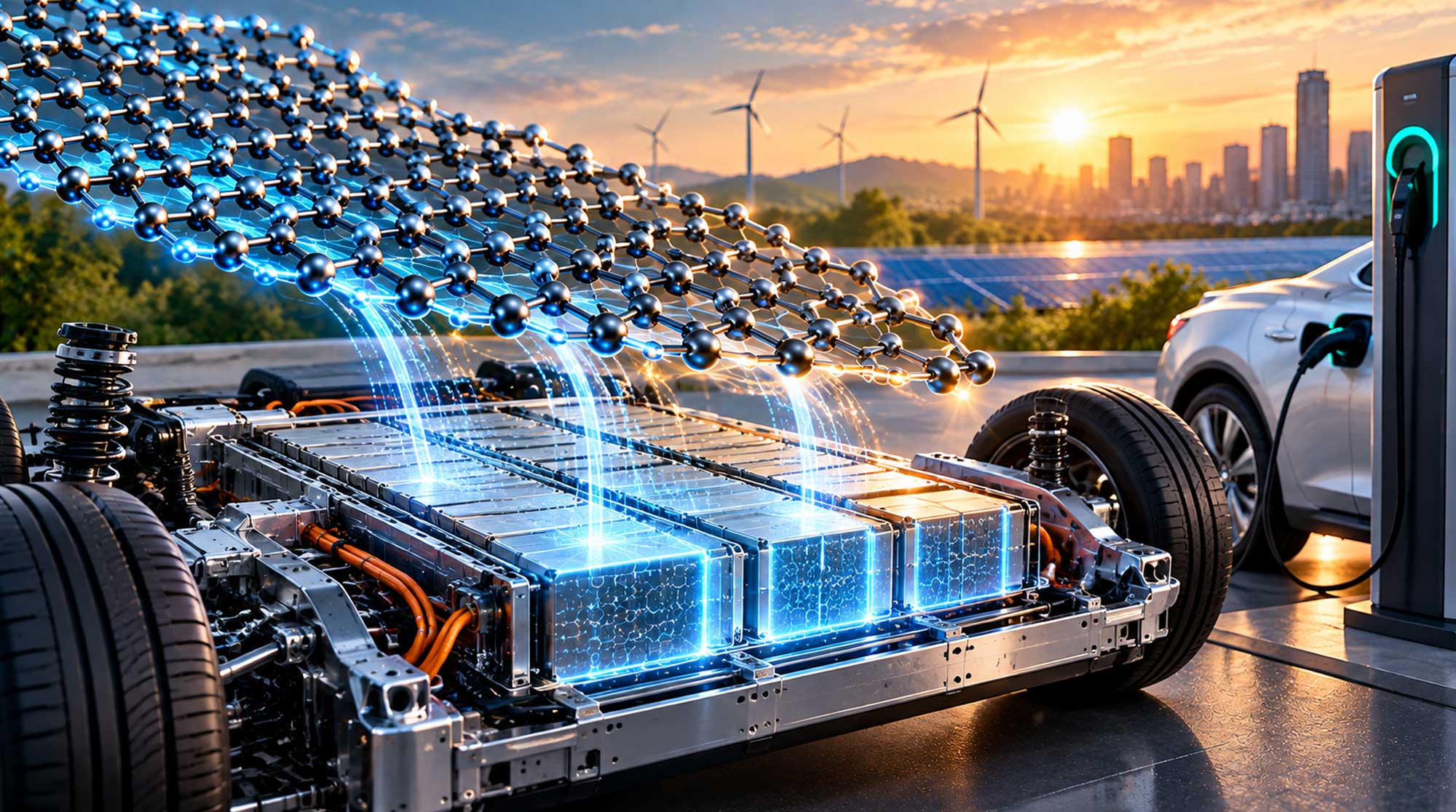
Graphene, a single atomic layer of carbon, combines high electrical conductivity with distinctive mechanical and thermal properties, and researchers are exploring it in electrodes, thermal management and next-generation energy storage. Its role needs careful distinction. It can act as a conductive additive, a structural framework inside an electrode or part of a thermal-management material, and it is also being investigated in alternative chemistries and supercapacitors.
For electric mobility, that distinction matters. Better conductivity or heat distribution does not automatically mean longer range, shorter charging stops or improved safety. Those outcomes depend on the whole cell, the battery management system and the conditions in which it operates.
WHY THIS MATTERS
Battery performance shapes vehicle range, charging time, operating costs and service life. For electric buses and trucks, charging delays and battery degradation translate directly into lost productive hours. If graphene-based materials deliver measurable gains without prohibitive costs, they could help manufacturers advance existing battery platforms while developing new storage technologies.
ALUMINIUM-ION CELLS REACH CUSTOMER TESTING
The most advanced example comes from Australia. Graphene Manufacturing Group (GMG), working under a joint development agreement with Rio Tinto, with the Battery Innovation Center of Indiana building the cells, is developing graphene aluminium-ion cells that use no lithium. On 21 October, GMG said it had begun supplying roughly 1.5 Ah pouch cells, designed for six-minute charging, to potential customers in sectors including defence and heavy mobile equipment. It expects to send more than 100 before the end of the year. The cells are pre-commercial samples, not for use in commercial products.
The laboratory numbers are striking, because fast charging and long life rarely arrive together. Data from the Battery Innovation Center, as at 7 October, showed the cells completing 1,000 six-minute charge and discharge cycles at 7C with no performance reduction. Separately, GMG reported a specific energy of 58 Wh/kg at a 10C charge, up 48% on its previous update, and 94% energy efficiency at that rate, against 64% for a lithium titanate cell tested alongside. That comparison is revealing: lithium titanate is a fast-charging specialist, not a mainstream electric-vehicle cell.
These are company-reported laboratory figures, and GMG itself says results may differ in customer testing. The technology sits at technology readiness level 4, which means validated in the laboratory. Automotive-scale energy density, pack integration, long-term durability, manufacturing economics and commercial deployment are all still to be shown.
SILICON AND GRAPHENE TARGET HIGHER ENERGY DENSITY
Silicon can store far more lithium per unit mass than graphite, which is why it keeps appearing in plans for higher-energy lithium-ion batteries. The catch is that it swells significantly as it charges, creating mechanical stress, electrode damage and faster degradation. Graphene-based frameworks may help hold the electrode together, maintaining electrical contact as the silicon expands and contracts through repeated cycles.
The idea has a way to go from laboratory to production line. A March 2026 review of silicon/graphite anodes in Advanced Energy Materials notes that such blends already appear in commercial cells, while expansion, fracture and pulverisation remain the main failure modes designers must overcome. Graphene–silicon composites are a further step along that road. Commercial success will turn on durable full-cell performance, consistent manufacturing, volumetric energy density and cost.
GRAPHENE HELPS BATTERIES SHED HEAT
Heat is a critical concern in electric-vehicle batteries, especially during rapid charging. Excess or uneven temperatures accelerate degradation and complicate pack design. Researchers are adding graphene nanoplatelets to phase-change materials, which absorb and redistribute battery heat.
A study in the Journal of Energy Storage in July 2026 reported that, at 1.25C charging, an optimised graphene-enhanced material cut the maximum cell temperature from 51.6°C to 28.1°C, and from 67.2°C to 41.7°C during 2.5C discharge. Those are results from a specific tested configuration. They do not show equivalent cooling in production packs, or that graphene alone makes a battery safer. The commercial picture is also early: one 2026 review in Batteries puts graphene-based composite phase-change materials at technology readiness level 3 to 4, costing US$50 to US$200 a kilogram, and 8 to 12 years from production. Full-system validation remains essential.
INDIA’S RESEARCH TURNS TO SUPERCAPACITORS
In January 2026, researchers at India’s International Advanced Research Centre for Powder Metallurgy and New Materials (ARCI) reported a supercapacitor built around a dual-functional porous graphene carbon nanocomposite electrode. According to India’s Department of Science and Technology, it operates at 3.4 volts, above the 2.5 to 3.0 volt range of conventional devices, stores 33% more energy than conventional carbon-based devices, reaches a power density of up to 17,000 W/kg and retains 96% of its performance after 15,000 charge–discharge cycles.
Supercapacitors deliver and absorb power quickly, which makes them useful for short bursts of high power. In suitable hybrid systems, they could complement batteries during acceleration and regenerative braking. This is progress in graphene-based supercapacitor design. It is not evidence of a new graphene traction battery or a production-ready electric-vehicle system, and practical integration, system-level performance and commercial viability still need evaluation.
THE COMMERCIAL REALITY
Graphene’s properties alone cannot make a commercial success. Manufacturers must show consistent production quality, scalable manufacturing, compatibility with existing processes and reliable performance over realistic duty cycles. The decisive measures are pack-level energy density, fast-charging durability, service life, thermal behaviour and total cost, judged against established battery technologies under comparable test conditions.
A laboratory result establishes scientific potential. Commercial value arrives only when that result becomes a repeatable advantage in a complete energy-storage system.
emBRWace Perspective
Graphene’s most credible opportunity may not be to replace today’s batteries, but to help them evolve.
The four developments point in different directions: strengthening lithium-ion electrodes, exploring an alternative chemistry, managing heat and complementing batteries with high-power supercapacitors. Each offers potential, and each needs its own engineering and commercial validation.
For the mobility industry, the question is not whether graphene has exceptional properties. It is where those properties produce a meaningful, measurable and economically viable improvement.
emBRWace Explains
Will graphene make EVs charge faster?
Potentially, in specific battery designs. Improved conductivity may support faster charging, but the complete cell chemistry, thermal management and charging system determine the rates that can be achieved.
Will it increase driving range?
Graphene–silicon composites may help raise energy density. Any range improvement must be demonstrated in complete battery cells and vehicle packs.
Will graphene make batteries safer?
Graphene-based thermal materials may improve heat distribution in certain designs. They do not eliminate thermal runaway or other battery hazards.
Are graphene batteries ready for mass-market EVs?
Not as a universal technology. Individual applications are at different stages, from laboratory research to early customer evaluation, and automotive-scale validation and commercial viability remain essential.
Thought to Take Away
Graphene’s real breakthrough will be measured not by what it promises in the laboratory, but by what it delivers on the road. The future belongs not to the most hyped material, but to the one that proves its value in real-world performance.
Sources: Graphene Manufacturing Group announcements (8 and 21 October 2026); Battery Innovation Center of Indiana test data as reported by GMG; “Advanced phase change materials for safe battery thermal management in electric vehicles”, Journal of Energy Storage (20 July 2026); “Safety–Performance Trade-Offs of Phase-Change Materials in Battery Thermal Management”, Batteries (2026); “Beyond Imperfect Match: Silicon/Graphite Hybrid Anodes for High-Energy-Density Lithium-Ion Batteries”, Advanced Energy Materials (March 2026); India’s Department of Science and Technology and ARCI announcement on the PGCN supercapacitor (January 2026)