Reading Time: 4 Minutes
WHY THIS MATTERS
- Level 4 technology is progressing from controlled trials towards commercial freight operations, particularly on defined, repeatable routes.
- Redundant steering, braking, computing and power systems are becoming fundamental to operating without a driver ready to take control.
- Range, charging, route planning and vehicle utilisation increasingly have to be considered as parts of the same freight cycle.
- Autonomous software developers, truck manufacturers, infrastructure providers and fleet operators must move from individual technology solutions towards integrated, production-ready freight systems.
THE ROUTE COMES FIRST
One of the most important lessons emerging from Level 4 development is that autonomy does not have to begin everywhere.
SAE Level 4 automation operates within a defined operational design domain—the conditions under which the automated driving system is designed to perform the driving task without relying on a human driver. Aurora, for example, describes its Level 4 system in terms of specified road and weather conditions rather than unrestricted operation everywhere. That makes predictable freight corridors particularly attractive.
Routes can be mapped and validated. Transfer hubs can be planned. Maintenance and energy requirements can be organised around known locations. The same operating conditions can be encountered repeatedly, allowing autonomy to scale within a controlled environment before expanding into more complex ones. Aurora says its commercial network now includes 10 driverless routes across the U.S. Sun Belt, illustrating how corridor-based expansion is becoming a practical route to deployment.
The question therefore changes from:
Can an autonomous truck drive everywhere?
to:
Where can autonomy create commercial value within conditions it is engineered to handle?
That distinction may prove fundamental to the way Level 4 freight develops.
BUILDING THE AUTONOMY-READY TRUCK
Autonomous software alone cannot create a commercially viable Level 4 truck. The physical vehicle has to support it. A human driver can recognise a mechanical or control problem and react. Once the driver is removed from the cab, the vehicle architecture itself has to provide alternative ways of dealing with critical failures. That is why redundancy has become central to autonomous-truck engineering.
Steering, braking, computing, communications and power supply cannot simply be treated as conventional vehicle functions when the automated system depends upon them to maintain control. Aurora's current autonomous trucks, for example, incorporate redundancy in critical systems including braking, steering and power distribution. If one critical system develops a problem, another is designed to support safe operation.
The principle is straightforward but profound. For Level 4, redundancy is not an additional safety feature. It becomes part of the vehicle architecture. That means the autonomous truck has to be engineered differently from a conventional vehicle onto which self-driving software has simply been added.
THE MILLION-MILE CHALLENGE
There is another large gap between demonstrating autonomy and commercialising it. A prototype proves that technology can work. A commercial truck has to keep working.
Heavy-duty vehicles accumulate mileage rapidly and operate through vibration, temperature changes, weather and long duty cycles. Autonomous hardware—including sensors, computers and associated electronics—has to survive that same working environment.
Aurora's second-generation commercial hardware kit is engineered for one million miles of operation, with the company positioning durability and uptime as essential elements of commercial scale.
Pony.ai's fourth-generation autonomous truck platform, developed with manufacturing partners including SANY, takes a similar production-oriented approach. The company says it uses automotive-grade components and is designed for a 20,000-hour service life supporting up to one million kilometres of freight operation. Its first two Gen-4 models are based on battery-electric platforms and were designed for thousand-unit-scale production beginning in 2026.
These numbers tell us something larger than component longevity. Autonomous technology is beginning to be judged by the standards of the commercial-vehicle industry.
Not merely:
Does it work?
But:
Can it survive the working life expected of a truck?
WHEN CHARGING BECOMES PART OF AUTONOMY
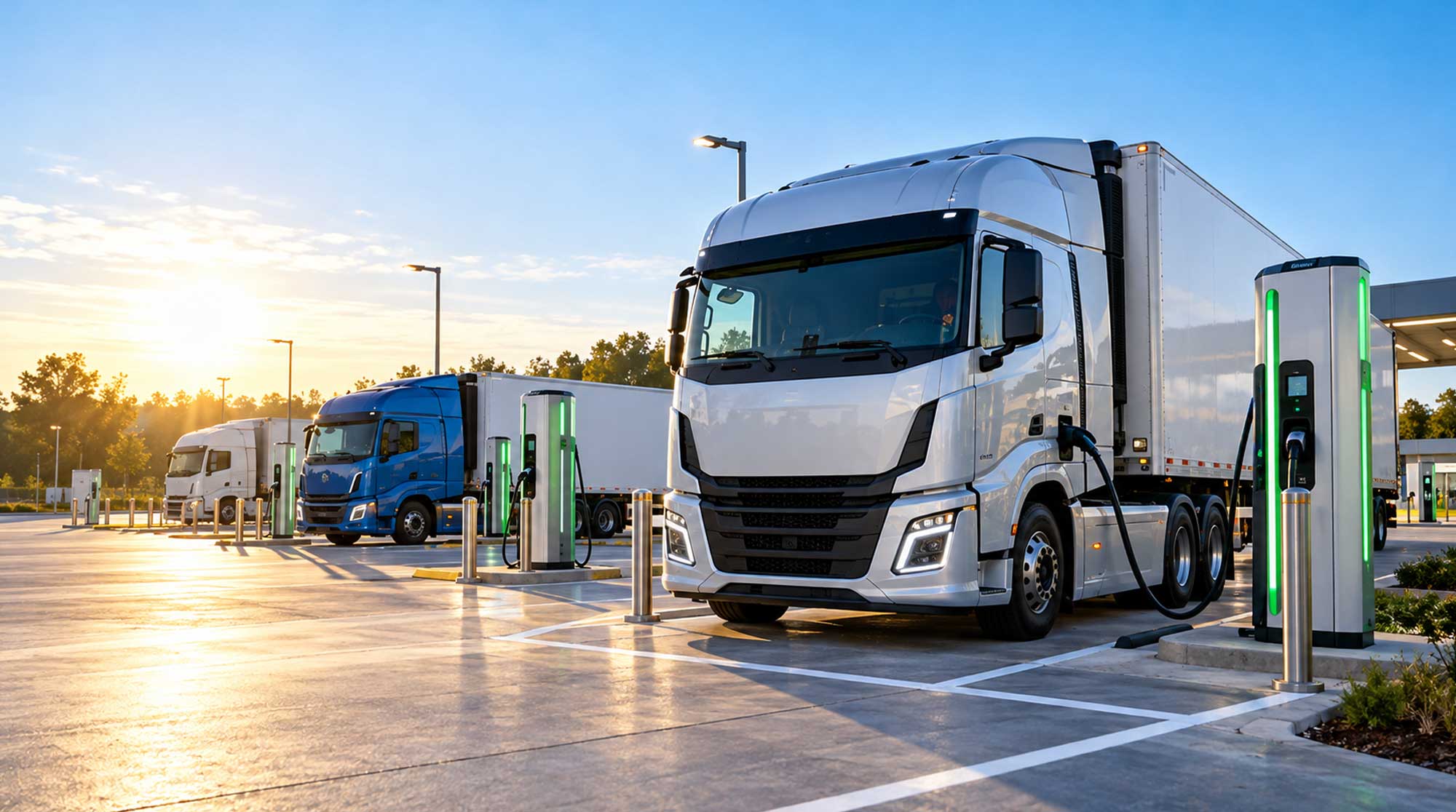
Electric propulsion introduces another operational variable: time. An autonomous truck cannot maximise utilisation if significant portions of its operating cycle are spent waiting for energy. Battery capacity, route length, charging availability and turnaround time therefore have to be considered alongside autonomous operation.
For autonomous freight, the essential question is not simply how quickly a truck can charge, but whether its energy cycle can be integrated seamlessly into the freight schedule. The vehicle arrives at the hub, replenishes its energy and returns to service with as little interruption as possible. Charging therefore becomes part of the autonomous operating cycle.
ONE DRIVER, FOUR FOLLOWERS
Not every pathway towards freight automation requires the human to disappear from every truck immediately. Platooning offers another architecture. Under a 1+4 model, for example, one human-driven lead vehicle can operate with four automated followers. The concept concentrates direct human control in the lead vehicle while extending automation across the rest of the convoy.
The significance lies not merely in moving several trucks together. It changes how human expertise is distributed across the freight operation. Instead of placing one driver behind every wheel, automation potentially allows human judgement to be concentrated where it adds the greatest value.
Platooning should not, however, be confused with fully driverless Level 4 operation. It represents a different approach to freight automation and may provide a transitional model for applications where removing the driver completely is not yet commercially or operationally practical. That illustrates an important point: Autonomous freight may not develop along a single technological path.
FROM SOFTWARE TO PRODUCTION
Perhaps the clearest evidence of the industry's changing direction is the growing partnership between autonomous-technology developers and established truck manufacturers. The August 2026 collaboration between DAF Trucks and Einride provides a particularly timely example.
The companies plan to integrate Einride Driver into DAF's electric truck platform, working with Dutch research organisation TNO to define and test the interfaces required for safe, scalable autonomous operation. Initial interface testing and validation are scheduled during 2026, followed by integration and commissioning of the autonomous-driving software in 2027.
The significance goes beyond another technology partnership. It shifts the challenge from:
Can autonomous software control a truck?
to:
Can autonomy be integrated into a production vehicle platform and ultimately scaled?
That requires expertise extending far beyond artificial intelligence. The autonomy developer brings perception, decision-making, software and system intelligence. The truck manufacturer brings vehicle engineering, validation, production expertise and industrial scale. And independent engineering and regulatory expertise helps connect those two worlds.
DAF describes the initiative explicitly as a step towards large-scale commercialisation of SAE Level 4 autonomous electric freight. That is where the next phase becomes particularly interesting.
THE INDUSTRIALISATION QUESTION
The move towards production-scale autonomy is visible elsewhere too. Aurora's current driverless trucks already carry customer freight without a person behind the wheel, but its longer-term scaling strategy extends into industrial manufacturing. Its partnership with Continental is intended to industrialise autonomous hardware and fallback systems for integration into autonomous-ready trucks.
This represents an important transition. Early autonomous vehicles were often characterised by specialised hardware, expensive components and extensive engineering support. Commercial trucking demands something different. Components have to become automotive-grade, manufacturable, serviceable and cost-effective. Autonomy therefore has to cross the same difficult bridge as any other major vehicle technology: from engineering achievement to industrial product. And that bridge may prove every bit as important as the autonomous-driving software itself.
THE NEW AUTONOMY STACK
Put these developments together and the autonomous electric truck begins to look very different from the experimental robotruck. At vehicle level, electric propulsion, drive-by-wire controls, redundant safety systems, sensors and computing have to operate together. Above them sits the intelligence layer: perception, mapping, decision-making and vehicle control. Around the vehicle sits another layer consisting of logistics hubs, communications, energy supply, maintenance and remote operational support.
And surrounding all of it are manufacturing, regulation and commercial economics. The technology trend is therefore not any single component. It is the integration of the complete stack. A brilliant autonomous-driving system attached to a vehicle that cannot provide the necessary redundancy is insufficient. A highly capable electric truck without the right operating environment is insufficient And an impressive prototype that cannot be manufactured, maintained or economically deployed remains a prototype.
WHAT ACTUALLY HAS TO SCALE?
This may be the most important question facing autonomous trucking. A demonstration can prove that a vehicle can complete a journey without a driver. Commercialisation requires considerably more.
The technology has to operate safely within its intended domain. Hardware has to withstand commercial mileage. Vehicle systems need appropriate redundancy. Energy requirements have to fit the duty cycle. The product must be manufacturable and serviceable. Regulators must be satisfied. And fleet operators must see a compelling business case.
These challenges cannot be solved independently. A more capable autonomous system has limited commercial value if the vehicle spends too much time unavailable. A durable truck cannot deliver driverless freight if its operating domain cannot be safely expanded. And technological capability alone cannot create a market if the economics do not work. The industry is therefore moving from the technology-proof stage towards the system-engineering stage.
The question is no longer merely:
Can the truck drive itself?
It is:
Can the entire freight operation work reliably and economically without requiring a human behind every wheel?
That is a much harder test. And it is the one that will determine how far Level 4 trucking ultimately scales.
THE COMMERCIALISATION EQUATION
Several technologies are beginning to converge around that objective. Autonomy can reduce dependence on continuous human driving. Electrification changes the truck's energy architecture. Redundancy enables critical systems to tolerate faults. Hub-to-hub operation reduces environmental complexity. Charging integration protects utilisation. Industrial partnerships provide a route from specialist technology towards repeatable production.
None is sufficient on its own. Together, however, they create the possibility of something much more consequential: a repeatable autonomous freight service. That—not the novelty of an empty driver's seat—is the real technology trend.
MOBILITY ANSWERS
1.What exactly is SAE Level 4?
Level 4, or High Driving Automation, means the automated driving system can perform the complete driving task without human intervention within its defined operational design domain. It does not mean that the vehicle can necessarily drive autonomously everywhere, in every weather condition or on every road.
2.Why is hub-to-hub operation so important?
It limits autonomy to more predictable operating environments. Routes can be mapped and validated repeatedly, while charging, maintenance and transfer operations can be concentrated at known locations. This can make commercial deployment more manageable than attempting unrestricted autonomous operation from the outset.
3.Why does a Level 4 truck need redundancy?
Without a driver immediately available to compensate for a critical failure, the vehicle needs alternative systems capable of maintaining safe operation or reaching a safe state. That is why braking, steering and power redundancy feature prominently in autonomous-ready truck platforms.
4.Why does million-mile durability matter?
Commercial trucks are high-utilisation assets. Sensors, computing systems and autonomous-driving hardware therefore have to withstand years of intensive operation rather than simply demonstrate technical capability. Aurora's latest commercial hardware is engineered around a one-million-mile service life.
5.Does electrification make autonomous trucking easier?
Not automatically. Electric drivetrains can integrate well with electronically controlled vehicle architectures, but battery range, charging availability and turnaround time introduce their own operational requirements. The two technologies have to be engineered as part of the same duty cycle.
6.Is platooning the same as Level 4 autonomous trucking?
No. Platooning can involve a human-driven lead vehicle with automated followers, whereas Level 4 describes an automated driving system capable of performing the driving task without human intervention within its defined operating domain.
7.What is the biggest barrier to commercialisation?
There is no single barrier. Safety assurance, hardware reliability, manufacturing scale, regulation, infrastructure, serviceability and economics all have to mature together.
BY THE NUMBERS
1 MILLION MILES
The design life of Aurora's second-generation commercial autonomous-driving hardware.
1 MILLION KILOMETRES
The freight-operation design target for Pony.ai's Gen-4 autonomous truck platform.
20,000 HOURS
The stated service-life target for Pony.ai's fourth-generation autonomous-truck system.
10 ROUTES
Aurora's current commercial driverless network across the U.S. Sun Belt.
6+ MILLION MILES
Aurora's cumulative commercial miles through June 30, 2026, according to its Q2 shareholder letter.
2027
The planned year for integration and commissioning of Einride's autonomous-driving software on the DAF platform following initial interface testing in 2026.
emBRWace PERSPECTIVE
Autonomous electric trucking is often presented as two technologies arriving at the same time: electrification and autonomous driving.
The deeper transformation is their convergence with everything around the vehicle. Electric trucks require carefully planned energy replenishment. Autonomous trucks require clearly defined operating domains. Both depend increasingly on electronic architectures, software, connectivity and intelligent fleet management. And both ultimately have to satisfy the unforgiving economics of commercial transport.
That is why the emerging competition may not simply be between one autonomous-driving system and another. It may increasingly be between complete autonomous freight architectures. The advantage could belong to those capable of connecting the vehicle, autonomous intelligence, energy, infrastructure, manufacturing and freight operation into one commercially coherent system. The autonomous truck of the future may therefore be less a standalone vehicle than a coordinated freight platform.
THOUGHT TO TAKE AWAY
The real breakthrough in autonomous trucking will not be a truck that can drive itself. It will be a freight system that can operate commercially without putting a human behind every wheel.
RESEARCH SOURCES:
- DAF Trucks / Einride — 2026 collaboration to integrate Einride Driver into DAF's electric vehicle platform, including the 2026–27 development timetable and large-scale Level 4 commercialisation objective.
- Aurora Innovation — Commercial driverless operations, autonomous-truck redundancy, route expansion and million-mile hardware durability.
- Pony.ai / SANY — Fourth-generation autonomous truck programme, automotive-grade hardware and commercial durability targets.
Aurora / Continental — Industrialisation and production-scale autonomous hardware strategy.