Reading Time: 3 Minutes
WHY THIS MATTERS
- Truck parking is an operational issue, not simply a convenience issue.
- Real-time availability information can turn parking from a last-minute search into a planned journey decision.
- Around 20,000 truck parking spaces are reportedly missing along German motorways, highlighting the scale of the underlying infrastructure challenge.
- Connected-truck services are expanding beyond vehicle diagnostics to incorporate information about the wider transport environment, bringing parking, charging, routing and other journey variables into the digital ecosystem.
- The broader opportunity is journey intelligence: combining vehicle, driver, infrastructure and route data to make long-haul operations more predictable and efficient.
A long-haul journey does not end when the driver needs to stop.
Finding somewhere suitable to park can become a race against time, particularly at night when demand rises and available spaces become scarce. In Germany, the shortage of truck parking spaces along motorways remains a significant infrastructure challenge. Mercedes-Benz Trucks cites an ADAC estimate of around 20,000 missing truck parking spaces on German motorways.
The problem has traditionally been managed through experience, route planning and, ultimately, searching for a space after the need has already arisen. Connected technology offers another possibility.
FROM PARKING SEARCH TO PARKING INTELLIGENCE
Mercedes-Benz Trucks is expanding its Truck Remote App with a new parking feature that provides information on available truck parking spaces and their occupancy status.
At launch, approximately 2,000 public truck parking facilities along Germany's federal motorways are integrated into the service. The company says the underlying information combines parking-location and capacity data with vehicle-position data derived from infrastructure and toll systems to estimate available capacity. Expansion to Austria is underway, with further European countries planned progressively.
For drivers, the practical benefit is straightforward: parking can be considered before reaching the point where a stop becomes urgent. That can reduce time spent searching, make journey planning more predictable and potentially reduce the stress associated with finding a suitable stopping location.
THE CONNECTED TRUCK EXTENDS BEYOND THE CAB
The new function is significant because it illustrates an important evolution in connected commercial vehicles. The truck is no longer simply generating information about itself. The digital ecosystem around it is increasingly becoming part of the driving experience.
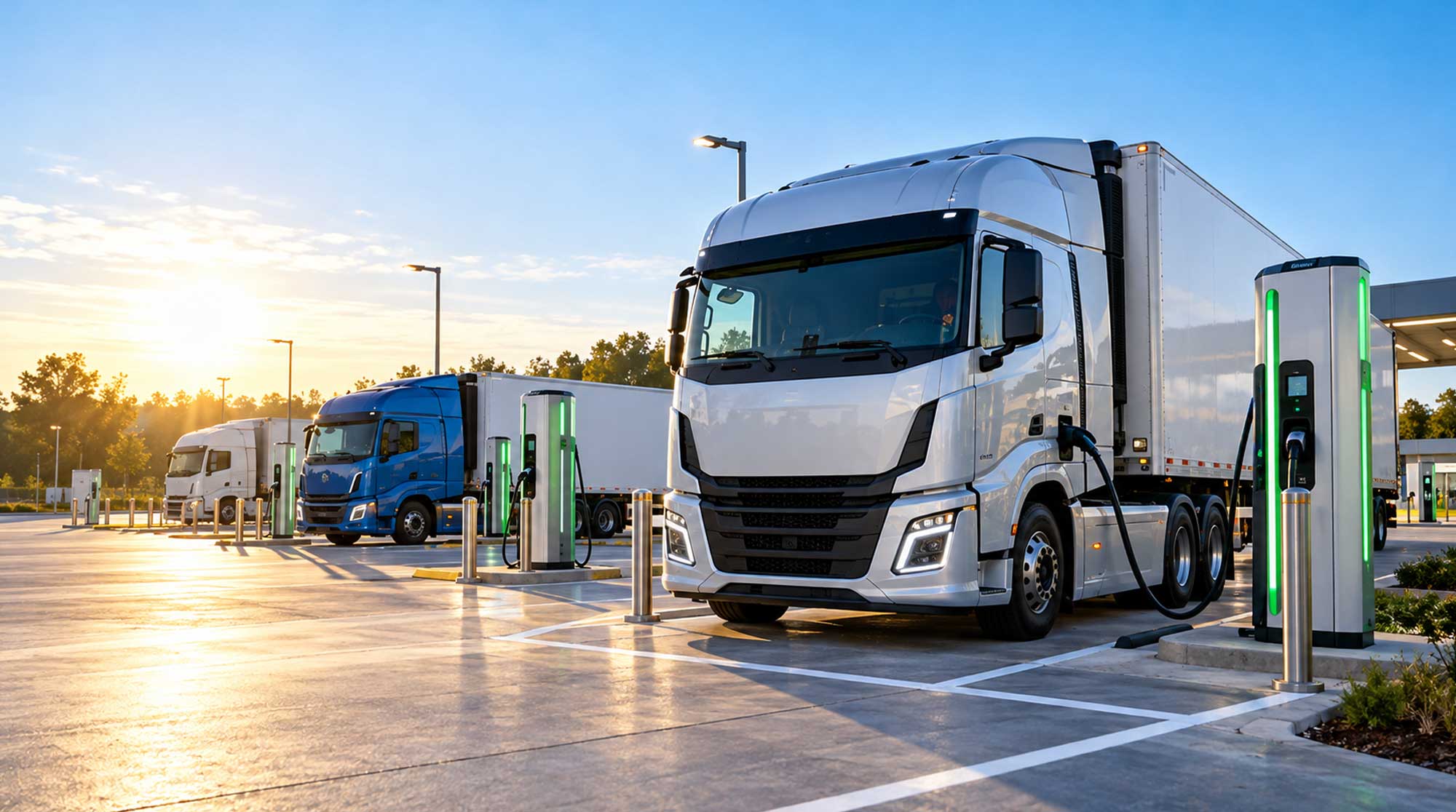
The Truck Remote App already provides access to vehicle information such as mileage, tyre pressure and compressed-air supply, while allowing users to monitor locking systems, doors and windows remotely. For the battery-electric eActros 600, the app additionally provides battery state of charge, remaining range, charging status and charging progress, alongside map information covering charging stations, fuel stations, parking facilities and Mercedes-Benz Trucks service partners.
Parking intelligence therefore becomes another layer in an expanding connected-truck ecosystem.
FROM ROUTE PLANNING TO JOURNEY INTELLIGENCE
The larger significance lies beyond the parking space itself.
Modern fleet operations increasingly depend on combining information from the vehicle, driver, route and infrastructure. Parking availability is one more variable that can influence journey efficiency and driver experience.
As connected infrastructure becomes richer, the next step could be increasingly predictive journey planning — bringing together traffic, charging, refuelling, parking, weather, delivery schedules and vehicle condition in a single operational picture. The destination may not simply be a truck that knows where it is. It may be a truck that increasingly understands what it needs next.
emBRWace PERSPECTIVE
The parking problem demonstrates an important truth about digital transformation in road freight. Not every breakthrough requires a new vehicle. Sometimes, intelligence applied to an existing operational problem can deliver immediate value.
By bringing parking availability into the driver's digital environment, Mercedes-Benz Trucks is turning an uncertain part of the long-haul journey into a more informed decision.
The future of connected trucking may ultimately be measured not by how much information a vehicle can generate, but by how effectively that information helps people make better decisions.
THOUGHT TO TAKE AWAY
The connected truck is evolving from a vehicle that reports its condition into a mobility platform that helps anticipate the journey ahead.
MOBILITY ANSWERS
The question behind the technology
1.What does the new parking function actually do?
It allows users of the Mercedes-Benz Truck Remote App to search for truck parking facilities and view information about their occupancy, helping drivers identify potential stopping locations before they arrive.
2.How extensive is the initial parking database?
The service is planned to initially cover approximately 2,000 public truck parking facilities along Germany's federal motorways, with Austria next and further European markets planned.
3.Why is truck-parking intelligence important?
A shortage of suitable parking can make it difficult for drivers to plan stops around legally required rest periods. Giving drivers better information in advance can make journey planning more predictable and reduce unnecessary searching.
4.Does the system guarantee a parking space?
No. Availability information helps drivers make better decisions, but it should not be interpreted as a guaranteed reservation. Actual availability can change as vehicles arrive and depart.
5.Could this become part of wider fleet intelligence?
Potentially. Parking is one element of a larger connected journey. Combining parking availability with routing, traffic, charging, vehicle status, weather and delivery schedules could eventually enable much more sophisticated journey planning.