Reading Time: 4 Minutes
One road-rail platform, many missions: from keeping a city's tram network clear to shunting loads of up to 1,000 tonnes. At InnoTrans 2026, the Unimog U 423 made the case that the real special vehicle is the platform, not the attachment.
A vehicle that maintains a city's tram network. A machine that can shunt rail loads of up to 1,000 tonnes. A platform that carries specialist equipment for infrastructure work.
They look like three different machines. At their core, they are different configurations of the Unimog U 423, which moves between road and rail and takes on very different roles. Its versatility begins with the platform itself.
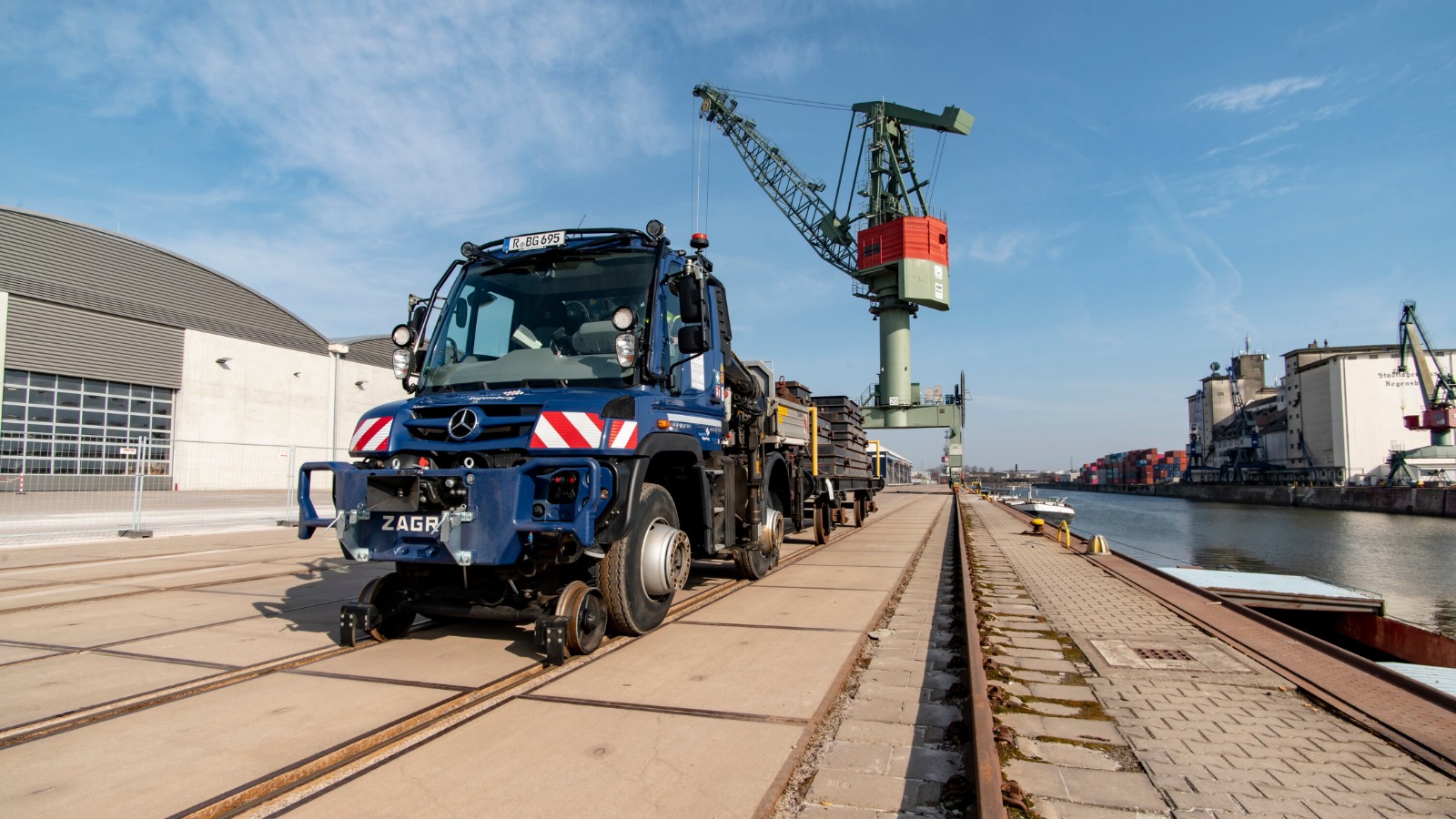
At InnoTrans 2026 in Berlin, Daimler Truck and its partners Zwiehoff and ZAGRO showed four Unimogs for rail use, and a new Unimog was handed over to the Munich operators. The Munich vehicle is set up for year-round tram-network maintenance, while separate U 423s from ZAGRO and Zwiehoff are configured for rail-road shunting, each able to move trailing loads of up to 1,000 metric tonnes.
Two missions. Different configurations. One idea: a platform designed to operate across worlds. It shows what a special vehicle can be when versatility is engineered into its architecture.
WHEN ONE PLATFORM TAKES DIFFERENT FORMS
Neither the Munich vehicle nor the shunters are simply conventional trucks with an attachment added afterwards. The Unimog's attachment and body-mounting areas, together with its mechanical, electrical and hydraulic interfaces, make it suited to a wide range of rail maintenance and repair tasks.
The attachment changes the job. The platform makes the change possible. That is the idea behind ONE VEHICLE. MANY WORLDS.
WHY THIS MATTERS
Specialist vehicles work in environments where a conventional truck cannot simply stand in for a dedicated machine. Rail networks need shunting, maintenance, cleaning, vegetation management and infrastructure support. Municipal operators face seasonal workloads. Industrial sites may need a vehicle that moves between road and rail.
The U 423 offers one answer: build flexibility into the vehicle itself, so operators can configure a platform around different tasks instead of buying a machine permanently defined by one role. The wider implication is that specialist mobility may increasingly depend on vehicles that adapt to changing missions, environments and equipment. The U 423 makes the case plainly, because its configurations span tram maintenance in Munich and heavy rail shunting at 1,000 tonnes.
THE MUNICH MISSION
Munich shows the Unimog as a mobile infrastructure platform. The vehicle handed to Stadtwerke München and Münchner Verkehrsgesellschaft is one of four new Unimogs for maintaining and cleaning the tram network, with two replacing older Unimogs and two strengthening the fleet. Built on the U 423 chassis, they carry special bodies from Henne Nutzfahrzeuge, among them a spreader, clearing blade, mower, vacuum unit and crane, along with a two-way system from Zwiehoff that allows quick placement on the track and flexible use on road and rail.
The fleet was bought chiefly for winter clearing and gritting and for cutting back bushes and shrubs in summer. But it can work all year round, cleaning stops, supporting construction sites and handling crane work. The operator's control centre can monitor each vehicle remotely, and Munich's operators describe the purchase as a first step in their strategy for a more resilient tram.
The point is not the number of attachments. It is the utilisation philosophy: one vehicle stays productive across seasons, infrastructure problems and operating requirements.
THEN COMES THE SHUNTING JOB
Now the story moves into a very different world. ZAGRO's U 423 at InnoTrans is configured for rail-road shunting, and the question changes from what the vehicle can carry to how a road-based vehicle can move a 1,000-tonne rail load.
The answer begins with traction. The Unimog drives on the rails through its own wheels, while a rail-guidance system keeps it aligned. Its torque-converter clutch, permanent all-wheel drive, compact axles and wheel drive together deliver the high tractive force. The numbers are striking: the carrier is a Euro VI four-cylinder diesel producing 170 kW (231 hp).
The rails guide it. The tyres drive it. In shunting, the aim is not only to generate force, but to control it.
MOVING IS ONLY HALF THE JOB
A shunting vehicle must also control what it moves. The Zwiehoff U 423 at InnoTrans pairs its rail guidance with a Knorr wagon braking system and also handles trailing loads of up to 1,000 metric tonnes.
That makes it more than a powerful tractor on rails. It becomes part of the wider railway operating system. Traction moves the load, braking helps control it and rail guidance keeps the vehicle on the track.
THE VEHICLE THAT DOESN'T HAVE TO STAY ON RAIL
A conventional shunting locomotive is fundamentally a railway machine. The road-rail Unimog can switch quickly between rail and road. It can travel to its worksite by road, transfer to the track and return to the road when the task is done:
ROAD → RAIL → ROAD
No second vehicle is needed to carry it between sites. For operators working across dispersed locations, that flexibility can be a real operational advantage.
FROM SHUNTING TO INFRASTRUCTURE
At InnoTrans, ZAGRO also showed a customer U 423 with a Palfinger rail-road crane and a MULAG mower for work along railway lines, with cameras helping the operator move from road to rail, even in tight spaces.
This vehicle is not asked to pull 1,000 tonnes. It is asked to bring specialist equipment to the worksite and operate it there, just as the Munich vehicles do for winter clearing, vegetation cutting, stop cleaning, construction-site support and crane work.
So, the story is bigger than the 1,000-tonne figure. The platform can move railway vehicles, maintain infrastructure, clean tracks, manage vegetation and carry specialist equipment. That is where MANY WORLDS becomes tangible.
THE PLATFORM IS THE REAL SPECIAL VEHICLE
The Unimog's most interesting feature may not be its engine, its road-rail equipment or even its shunting capability. It is the architecture that allows them to exist: attachment areas, body-mounting options, and mechanical, electrical and hydraulic interfaces. Together they create a platform around which specialist machines can be built.
The vehicle need not be permanently defined by one job. The job can change around the vehicle.
THE BIGGER MOBILITY QUESTION
As infrastructure operators look for better asset utilisation, could specialist mobility increasingly favour platforms that cross traditional categories? Road and rail. Transport and maintenance. Vehicle and machine. Seasonal and year-round work.
The answer will depend on the application, the operating environment and the economics. But the principle is compelling: a special vehicle need not be specialised for one task. It can be specialised for the ability to perform many.
emBRWace Perspective
The Munich and ZAGRO U 423 configurations reveal two very different worlds built on the same underlying platform. One maintains a city's tram infrastructure. The other shunts heavy rail loads. Their value comes not simply from what each vehicle does, but from what the platform allows operators to make it do.
The future of the special vehicle may belong to platforms that do not choose one world, but are engineered to work across several.
emBRWace Explains
Road-rail vehicle: A vehicle designed to operate on both conventional roads and railway tracks. In the Unimog configuration, dedicated rail-guidance equipment positions the vehicle on the track while its own tyres provide traction.
Shunting: The movement and positioning of railway vehicles within yards, sidings, terminals or industrial rail facilities.
Implement carrier: A vehicle designed around the ability to operate different specialist equipment through integrated interfaces.
Road-rail technology: Technology that lets a vehicle move between conventional road operation and rail-bound work, extending its operating range beyond a single transport environment.
Thought to Take Away
One platform can become many machines when the architecture is designed for possibility.
Sources: Daimler Truck press material on the Unimog at InnoTrans 2026; Mercedes-Benz Special Trucks technical information on the Unimog U 423 road-rail configurations; Stadtwerke München and Münchner Verkehrsgesellschaft media release, 23 September 2026