Reading Time: 4 Minutes
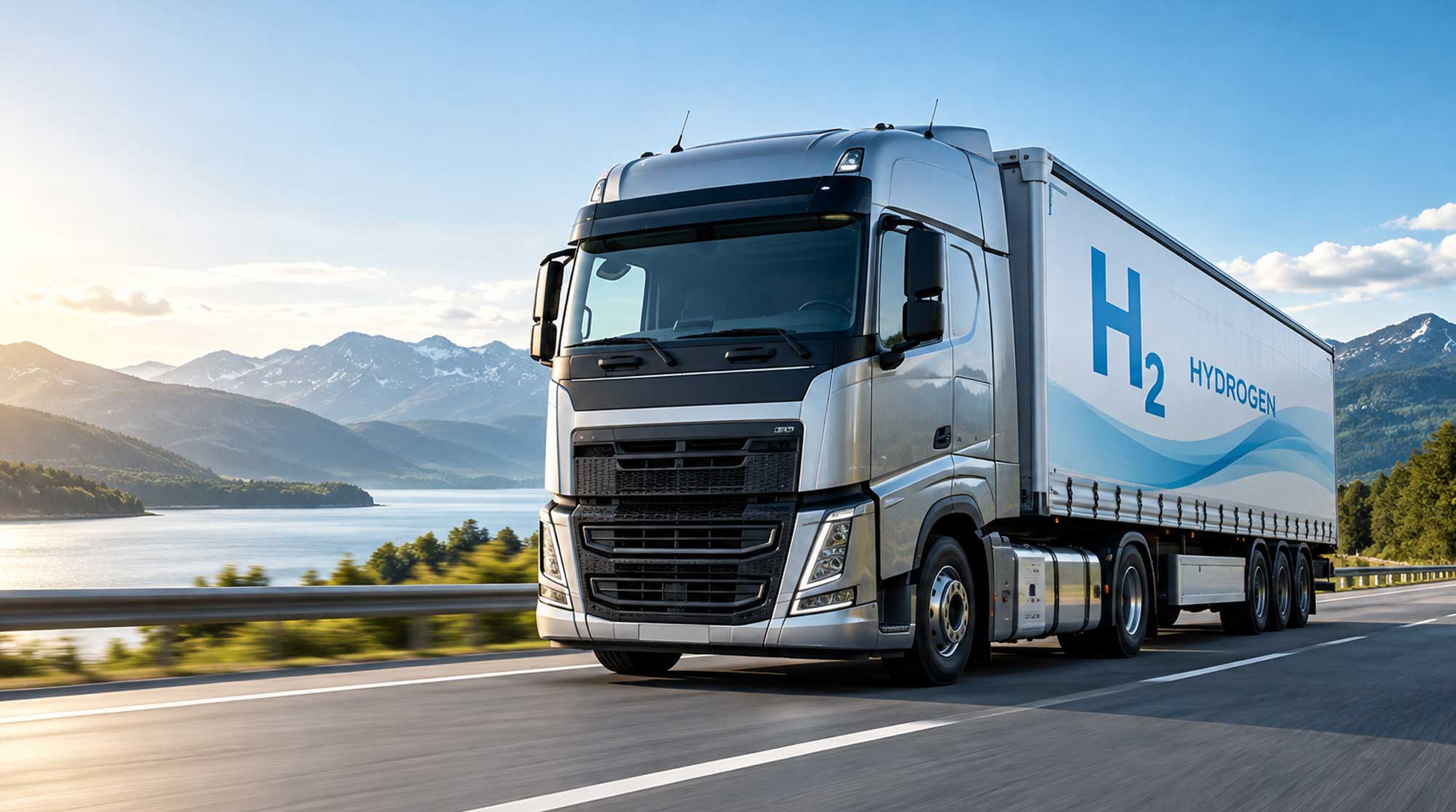
Hydrogen is giving the internal combustion engine a new role in heavy freight, as manufacturers explore whether a familiar powertrain can adapt to a radically different fuel.
For more than a century, the internal combustion engine has been one of the defining technologies of road freight. It has powered trucks across continents, moved enormous loads and adapted repeatedly to changing demands. As the industry turns to lower-carbon propulsion, the conventional ICE has looked increasingly like a technology approaching the end of its working life.
Now something unexpected is happening. Rather than abandoning the combustion engine, several manufacturers and engine specialists are testing whether it can run on a radically different fuel: hydrogen.
The idea has moved beyond the laboratory. Volvo began on-road trials of heavy trucks with hydrogen combustion engines in April, with a commercial launch planned before 2030. Daimler Truck has partnered with KEYOU on a hydrogen combustion truck scheduled for market launch in 2027. Cummins is developing both 15-litre and 6.7-litre hydrogen engines. The ICE, it seems, may have another chapter to write.
A DIFFERENT FUEL, A DIFFERENT ENGINE STORY
At first glance, hydrogen ICE sounds simple: take an internal combustion engine and swap diesel for hydrogen. The reality is considerably more complex. Hydrogen burns very differently from diesel, so it needs specialised approaches to fuel injection, ignition, air management and combustion control.
The routes taken so far differ. Volvo uses High Pressure Direct Injection (HPDI), in which a small amount of ignition fuel is injected at high pressure to start compression ignition before the hydrogen is added. The company says this gives higher efficiency, lower fuel consumption and more power than conventional hydrogen combustion, and points to HPDI experience in more than 10,000 gas-powered trucks. Cummins is taking a spark-ignited route, building dedicated hydrogen versions of its fuel-agnostic engine platforms. KEYOU's first truck uses a converted version of Daimler's 12.8-litre engine, delivering up to 350 kW and a range of up to 650 km on 350-bar hydrogen, with around 80% of the base engine unchanged, according to KEYOU.
So, the proposition is not simply diesel without the diesel. It is a new combustion system built around hydrogen.
WHY THIS MATTERS
Heavy freight does not have a single operating pattern, and its transition away from fossil fuels may not have a single powertrain solution. Hydrogen ICE is emerging as another route, particularly where payload, range, refuelling time and existing engine expertise remain important.
Its success will depend on more than the engine. Hydrogen supply, infrastructure, emissions control and total operating cost will determine whether this new avatar of the ICE can move from customer trials to commercial scale.
WHY HEAVY FREIGHT IS PAYING ATTENTION
Long-haul trucks can spend much of their working lives on the road. Payload matters, refuelling time matters and route flexibility matters. For some operators, stopping for long periods to recharge a very large battery may not fit the economics or the operating pattern of the business.
A hydrogen combustion truck keeps the basic concept of generating mechanical power directly in an engine, with hydrogen as the energy carrier. Volvo says such trucks will suit longer distances and regions where charging infrastructure is limited, and Daimler Truck describes hydrogen combustion as a cost-efficient option for payload-intensive work on existing vehicle platforms.
That does not make H₂-ICE the universal answer. It makes it another option in a powertrain landscape that is becoming more diverse.
WHAT CHANGES INSIDE THE ENGINE
An engine can look familiar and still be very different inside. Hydrogen burns rapidly and has different ignition and flame characteristics from liquid fuels, so engineers must manage combustion closely to deliver the required power, efficiency, durability and drivability. Fuel injection, air–fuel management and thermal behaviour all need tight control across loads and operating conditions.
The result is an engineering compromise: keep the strengths of a familiar heavy-duty architecture while redesigning the parts that hydrogen fundamentally changes.
THE NOx QUESTION
One misconception is worth removing early: hydrogen combustion does not mean an engine with no exhaust emissions. Because hydrogen burns at high temperatures in the presence of air, nitrogen oxides (NOx) can still form. The challenge moves from carbon to combustion-related pollutants.
The research suggests it is manageable. When optimised for ultra-lean operation, hydrogen engines can meet the most stringent current emissions standards, although the occasional richer running needed for good drivability makes advanced after-treatment essential. A demonstration engine from Southwest Research Institute's H2-ICE consortium reduced NOx to 0.008 g/hp-hr with aged catalysts, against a 2027 US EPA limit of 0.035. The point for fleets is that hydrogen's carbon-free chemistry does not remove the need for sophisticated emissions engineering, and that matters more as regulations tighten.
THE INDIA TEST
The technology is not being developed only in Europe and North America. India has made hydrogen road transport part of its National Green Hydrogen Mission, and the programme has moved from policy towards vehicle trials. In July 2026, the government said it had awarded 12 pilot projects to deploy 70 hydrogen-powered vehicles, made up of 27 buses and 43 trucks, with 16 refuelling stations across 21 routes. The mix includes fuel-cell and H₂-ICE vehicles, and a reported breakdown puts 31 of the 70 in the H₂-ICE category, 29 of them trucks.
The significance is not that hydrogen trucks are now mainstream in India. They are not. It is that the technology is being tested under real conditions: operators must report on vehicle performance, fuel consumption, safety and utilisation, to help assess techno-economic viability. That is the stage at which a technology begins moving from concept to evidence.
THE ENGINE IS NOT THE WHOLE STORY
Judging hydrogen ICE purely as an engine technology would be a mistake. Hydrogen has to be produced, transported, stored and dispensed. Stations must be where trucks actually operate. The fuel must be priced so fleets can compete, and it must be produced in ways that deliver the intended environmental benefit.
That is why Europe's push now focuses on the whole ecosystem. At IAA Transportation in September, Volvo Group, Daimler Truck, Toyota, Bosch, Air Liquide, TotalEnergies, TEAL Mobility and MB Energy unveiled plans to scale hydrogen trucking together, starting in Germany and aiming for 2030, with stations capable of serving up to 100 trucks a day. Their stated aim is competitive fuel pricing and total cost of ownership.
The message is clear: a hydrogen truck cannot scale without a hydrogen system around it.
A NEW PLACE FOR THE ICE
The future of commercial mobility is unlikely to be defined by one universal powertrain. Battery-electric trucks are developing quickly, particularly where routes are predictable and charging is accessible. Fuel-cell trucks offer another way of turning hydrogen into electric power for long distances. Hydrogen combustion adds a third path, keeping a mechanical powertrain familiar to much of the industry. Daimler Truck now pursues all three, and says hydrogen combustion offers higher robustness and lower system complexity than fuel cells.
That suggests a more useful question than "which technology will win?" The better question may be: which technology works best for which job?
THE NEW AVATAR OF THE ICE
The internal combustion engine is not returning in its old form. It is being asked to change. Hydrogen gives engineers the chance to keep much of a highly developed heavy-duty architecture, with its mechanical familiarity, power delivery, service ecosystem and compatibility with established platforms, while removing fossil carbon from the fuel. Volvo notes that its approach can deliver net-zero CO₂ well-to-wheel only when green hydrogen is combined with renewable HVO as the ignition fuel.
The opportunity comes with conditions. Hydrogen must be available, the infrastructure must grow, the economics must work, NOx must be controlled and the hydrogen itself must deliver a credible climate benefit. For heavy freight, those questions matter more than the novelty of the technology.
The future of the ICE may not depend on whether it can survive the energy transition unchanged. It may depend on whether it can change enough to remain useful within it.
emBRWace Perspective
Hydrogen ICE is not a rejection of electrification. It is evidence that the heavy-duty powertrain transition is becoming more application-specific.
The most important development may therefore not be the return of the combustion engine itself, but the emergence of a wider principle in commercial mobility: different freight missions may require different pathways to decarbonisation.
emBRWace Explains
H₂-ICE
- A hydrogen internal combustion engine: an engine that burns hydrogen to produce mechanical power, rather than using it to generate electricity as a fuel cell does.
- High Pressure Direct Injection (HPDI)
- A system in which a small amount of ignition fuel is injected at high pressure to start compression ignition, before hydrogen or another gaseous fuel is injected directly into the cylinder.
NOx
- Nitrogen oxides, pollutants that can form when fuel burns at high temperature in air, even when the fuel contains no carbon.
- Fuel-cell electric truck
- A truck that converts hydrogen into electricity in a fuel cell to drive electric motors, instead of burning it in an engine.
Thought to Take Away
The ICE may be changing its fuel, its technology and its role, but the real test will be whether hydrogen can make that new avatar commercially useful on the road.
Sources: Volvo Trucks press release on hydrogen combustion on-road testing (1 April 2026); Daimler Truck press release and coverage on the Daimler Truck and KEYOU partnership (July 2026); Cummins hydrogen engine information; India's Ministry of New and Renewable Energy reply in the Lok Sabha and coverage of the National Green Hydrogen Mission pilot projects (July 2026); Volvo Group press release on the European hydrogen mobility initiative (IAA Transportation, 15 September 2026); Southwest Research Institute H2-ICE consortium demonstration; SAE technical papers on hydrogen engine after-treatment