Reading Time: 3 Minutes
From backhoe loaders and excavators to telehandlers and industrial machinery, modern construction equipment depends on more than engine power. Electronic control units, work lights, electro-hydraulic solenoids, cab heating and air conditioning, wipers and telemetry all need a dependable electrical supply.
THE UNSUNG SOURCE OF ELECTRICAL POWER
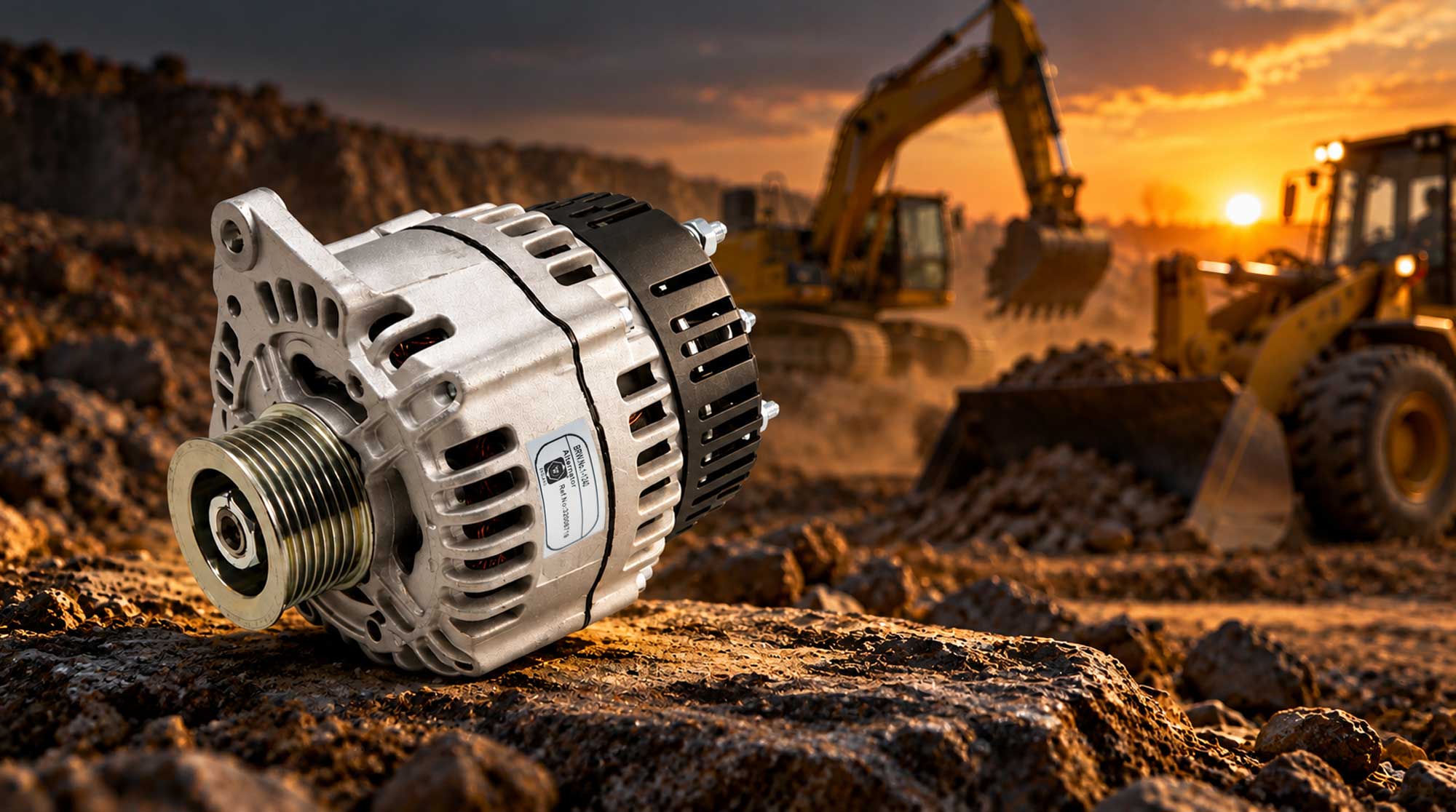
The alternator sits at the centre of that supply. Driven by the engine, it converts mechanical energy into electrical energy, replenishing the battery while feeding the systems that are running while the machine works.
It rarely gets the credit that the engine or hydraulics do. Yet without it, a machine’s electrical systems would be running on borrowed time.
INSIDE THE ALTERNATOR
The process begins with the rotor, which spins inside the stationary stator windings to generate alternating current (AC). A diode rectifier then converts that into direct current (DC), which the machine’s electrical network can use.
An internal voltage regulator helps keep the output stable as engine speed and electrical demand change. Around it, the bearings, drive pulley and cooling assembly support continuous operation, managing mechanical loads, vibration and heat.
Depending on the machine and its electrical requirements, typical systems operate at 12 or 24 volts, with alternator output varying according to equipment specification.
BUILT FOR DEMANDING CONDITIONS
Construction equipment works amid dust, mud, moisture, vibration and high ambient temperatures. An alternator intended for those surroundings therefore needs appropriate sealing, durable bearings, protected electrical connections and effective heat dissipation.
SIGNS WORTH A CLOSER LOOK
The condition of the alternator, its wiring and its drive belt all matter to reliable charging and electrical operation. A charging warning, dimming lights, or a battery that repeatedly loses charge while the engine is running may indicate a fault. Any of these calls for professional diagnosis, because the cause may lie in the alternator, the wiring or the belt.
MORE THAN A BATTERY CHARGER
An alternator does more than charge a battery. It supports the electrical systems that let modern machinery operate safely and efficiently. Correct specification, suitable fitment and timely maintenance help protect equipment availability and reduce the risk of avoidable interruptions.
Product at a Glance
BRW Alternators for JCB Equipment
Power for every system on the machine.
BRW No.: 1-1240, OEM No.: 320/ 08719
Applications: backhoe loaders, excavators, telehandlers and industrial machinery
Electrical systems: suited to 12 V and 24 V machines, with output according to equipment specification
emBRWace Perspective
Construction equipment is usually judged by what it digs, lifts or moves. Increasingly, it is also defined by what it controls: electronic control units, solenoids, telemetry and climate systems that all depend on a steady supply of electricity.
The alternator is the quiet link between the engine’s mechanical work and everything electronic on the machine. When it does its job, nothing happens. That is exactly the point.
Thought to Take Away
Dependable electrical power is what keeps heavy equipment ready for the next job.
BRW Alternators. Premium, OEM-standard aftermarket parts for heavy construction equipment.