Reading Time: 4 Minutes
A clutch system sits between the engine and transmission, controlling the transfer of mechanical power so that a vehicle can start, change gears and stop without switching off the engine.
In a commercial vehicle, it does much more than connect and disconnect two rotating systems. It repeatedly manages substantial torque, heat, vibration and load while letting power reach the driven wheels in a controlled way.
The clutch is where engine power meets drivability.
WHERE THE CLUTCH FITS
The clutch works between the engine and the gearbox. When it is engaged, engine power passes through it into the transmission and on to the driven wheels. When it is disengaged, that connection is temporarily interrupted, so the engine can keep running while the driver selects a gear or brings the vehicle to a stop.
Simplified, the path runs:
ENGINE → CLUTCH → TRANSMISSION → DRIVEN WHEELS
The principle is simple. The challenge is performing it repeatedly, smoothly and reliably.
THE SYSTEM BEHIND THE PEDAL
A clutch is not a single part. It is a group of interconnected components working together.
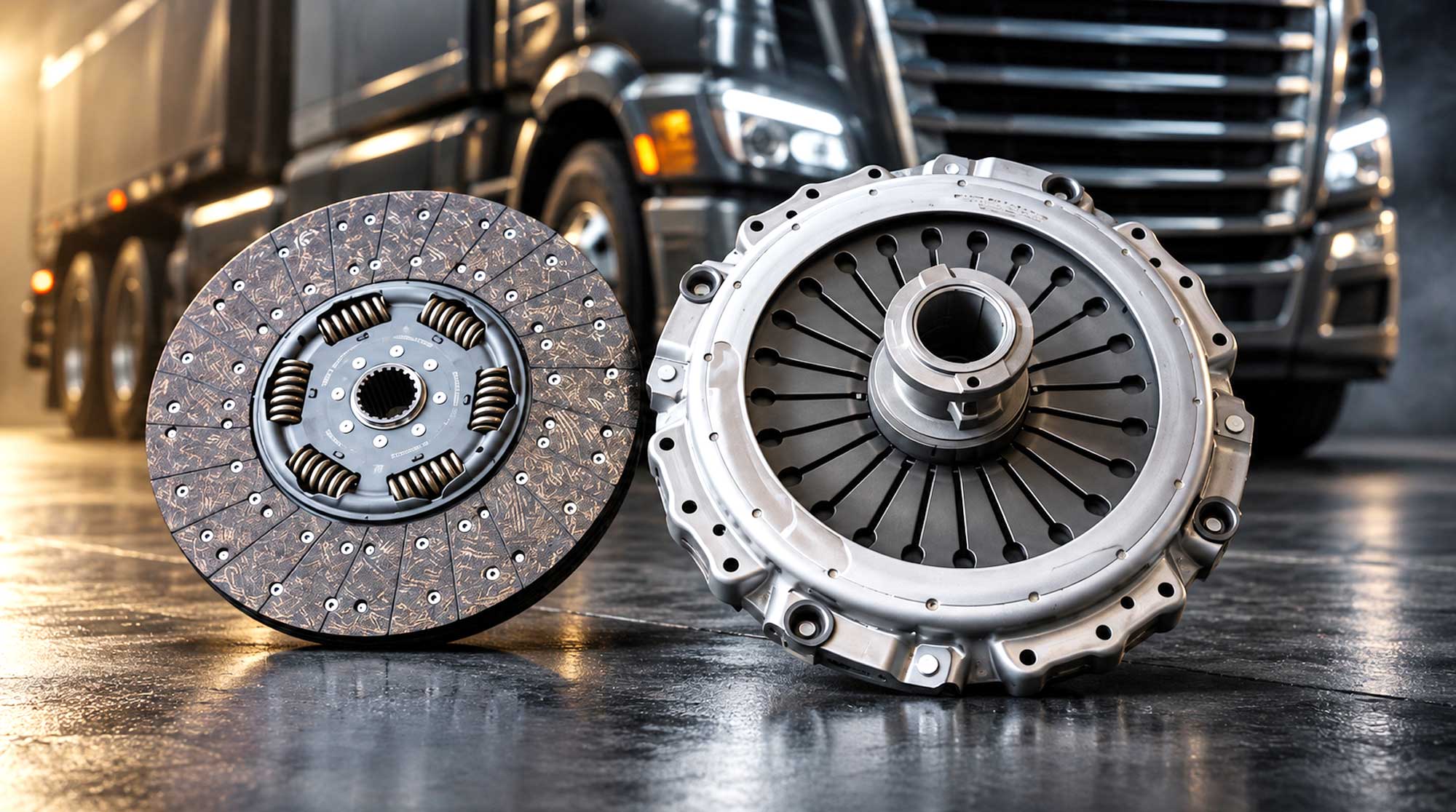
Clutch disc:
The friction element that transfers engine torque to the transmission input shaft. Its friction lining has to give controlled engagement while withstanding heat and load.
Pressure plate:
Applies the clamping force that holds the disc against the flywheel, so engine power can be transmitted.
Flywheel:
Mounted to the engine crankshaft, it provides the rotating surface the disc is clamped against and helps keep engine rotation smooth.
Release bearing:
Lets the stationary release mechanism operate the rotating pressure-plate mechanism when the pedal is pressed.
Clutch fork:
Passes movement from the release mechanism to the release bearing.
Clutch cover:
Houses the pressure plate and associated components, and is mounted securely to the flywheel.
Pilot bearing or bushing:
Where fitted, supports and guides the transmission input shaft.
Behind all of this sits the actuation system, which can be mechanical, hydraulic, pneumatic or electronically controlled, depending on the vehicle's design.
WHEN THE CLUTCH ENGAGES
With the pedal released, the pressure plate clamps the clutch disc against the flywheel, and engine rotation passes through the disc to the transmission input shaft. Power flows.
Press the pedal and the release mechanism moves the release bearing against the pressure plate. The clamping force falls, the disc separates from the flywheel and engine power is temporarily disconnected from the transmission. The driver can select or change gear while the engine carries on running.
THE MOMENT BETWEEN POWER AND MOTION
Pulling away is where controlled engagement matters most. The disc initially slips against the flywheel, letting engine speed and transmission speed synchronise progressively. As engagement continues, the relative movement falls. Once the clutch is fully engaged, it transfers torque with minimal relative movement.
That controlled transition is fundamental to smooth acceleration.
WHY HEAVY-DUTY CLUTCHES WORK HARDER
In trucks, buses, commercial vehicles and construction equipment, clutch systems operate under demanding conditions: significant torque, high heat, vibration, frequent gear changes, heavy loads and repeated engagement and disengagement. A heavy-duty clutch therefore needs reliable torque transmission, controlled engagement, resistance to wear and effective heat management.
When the system performs properly, it supports smooth operation, efficient power transmission and controlled acceleration, and helps reduce drivetrain shock. Its condition can also influence the service life of related components such as the transmission, flywheel and driveline.
WHEN THE CLUTCH STARTS TO SPEAK
Clutch problems do not always announce themselves in the same way. Common symptoms include:
- Slipping under load: the clutch may struggle to transmit engine torque effectively.
- Difficulty selecting or changing gears: the clutch may not be disengaging correctly.
- Judder or vibration: engagement may no longer be smooth.
- Excessive pedal effort: the actuation system or related components may need attention.
- Abnormal noise: unusual sounds during clutch operation can point to a problem within the system.
- Delayed or incomplete engagement: the clutch may not be transferring power as expected.
- Burning smell: excessive friction can generate heat.
Reduced torque transmission: engine power may not be passing through the drivetrain as effectively as it should.
None of these should automatically be blamed on the clutch disc alone. Possible causes include worn friction linings, pressure-plate damage, release-bearing wear, actuation problems, flywheel irregularities or incorrect clutch adjustment. A qualified technician should establish the actual cause.
The symptom tells you something is wrong. The system tells you where to look.
THE FLEET MAINTENANCE CONNECTION
For a commercial vehicle, clutch performance is directly tied to drivability, power delivery, gear shifting and drivetrain reliability. That makes the clutch system more than a group of components tucked between engine and gearbox. It is a working interface between power and movement.
When it operates correctly, substantial mechanical power can be transferred repeatedly while engagement and disengagement stay controlled. When performance deteriorates, the effects can extend beyond the clutch and influence other drivetrain components.
For fleet operators, unusual clutch behaviour is therefore not simply a driver-comfort issue. It is a signal worth investigating.
ONE SYSTEM. MANY RESPONSIBILITIES.
A clutch system has one fundamental job: to control the connection between engine and transmission. That simple description hides a good deal of engineering. It must:
CONNECT. DISCONNECT. SYNCHRONISE. TRANSFER TORQUE. MANAGE HEAT. CONTROL ENGAGEMENT.
And it must do so again and again under demanding commercial-vehicle conditions. That is why it pays to understand the clutch as a system, not simply as a disc or a pressure plate.
emBRWace Perspective
The clutch is often experienced through one small action: the movement of a pedal. Behind that movement is an entire system managing the transfer of engine power. For commercial vehicles, that controlled connection bears directly on drivability, power delivery and drivetrain reliability.
The clutch may sit between the engine and transmission, but its influence travels through the entire drivetrain.
emBRWace Explains
Clutch system
The group of components that controls the connection between the engine and transmission and manages the transfer of engine torque.
Clutch engagement
The process of clamping the clutch disc against the flywheel so engine power can be transmitted to the transmission.
Clutch disengagement
The process of separating the clutch disc from the flywheel so engine power is temporarily disconnected from the transmission.
Clutch slipping
A condition in which the clutch does not transmit engine torque effectively, allowing excessive relative movement between the clutch disc and flywheel.
Clutch actuation
The mechanism used to operate the clutch, which may be mechanical, hydraulic, pneumatic or electronically controlled, depending on vehicle design.
Thought to Take Away
The clutch is more than a connection between engine and transmission. It is the control point where power becomes movement.