Reading Time: 4 Minutes
Short-haul duties, prolonged idling and interrupted regeneration can turn an emissions-control system into an expensive maintenance challenge.
THE TECHNOLOGY BEHIND CLEANER EXHAUST
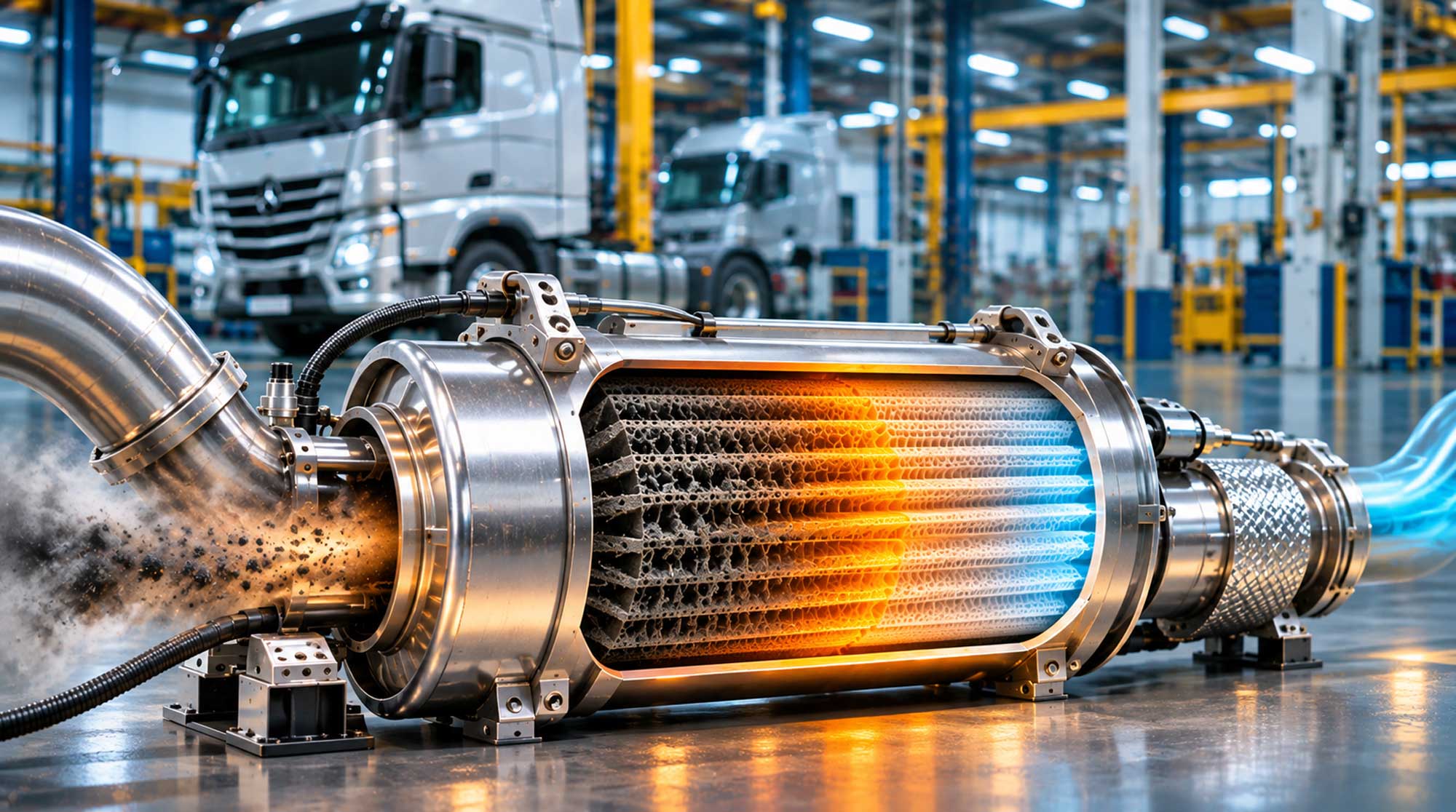
Modern heavy-duty diesel trucks rely on exhaust aftertreatment to control harmful emissions. A key component is the diesel particulate filter (DPF), which traps soot and other particulate matter before exhaust gases leave the vehicle.
Inside, a porous ceramic structure captures the particles while letting the gases pass. The effect is dramatic. Euro VI introduced a particle number limit for heavy-duty engines, and the International Council on Clean Transportation reports that a DPF removes more than 98% of particulate mass and more than 99% of particle number. The price of that performance is that the filter fills, and as it fills, resistance to exhaust flow rises. Without effective regeneration, excessive backpressure can affect engine performance, fuel consumption and vehicle availability.
WHY THIS MATTERS
For fleet operators, DPF maintenance is about more than emissions compliance. Unresolved faults can mean repeated workshop visits, delivery delays, reduced engine power and expensive repairs. Understanding the system helps operators tell routine maintenance from faults that need professional attention.
INSIDE THE DPF SYSTEM
The filter does not work alone. Several components monitor, control or support it, and configurations vary by manufacturer, engine and emissions standard.
Diesel particulate filter: The principal filtration component. Its ceramic substrate captures soot, while non-combustible ash gradually accumulates.
Diesel oxidation catalyst (DOC): Oxidises certain exhaust pollutants and, in many systems, helps create the conditions needed for regeneration.
Differential pressure sensor: Measures the pressure difference across the filter. Its readings help the control system assess restriction and estimate soot loading.
Exhaust gas temperature sensors: Monitor exhaust temperatures to support regeneration control and protect components from excessive heat.
Fuel doser or exhaust fuel injector: Where fitted, introduces fuel into the exhaust to generate heat for active regeneration.
Engine control unit (ECU). Processes sensor information, manages relevant engine functions and controls regeneration strategies.
Housing, clamps, gaskets and seals: Secure the assembly and contain exhaust gases. Leaks or damaged joints can compromise system performance.
NOx sensors, selective catalytic reduction (SCR) equipment and AdBlue dosing components may also form part of the wider aftertreatment system, but they support nitrogen oxide control rather than soot filtration.
HOW REGENERATION KEEPS THE FILTER CLEAR
Regeneration raises the temperature inside the filter to oxidise accumulated soot. Depending on the vehicle, it happens in three ways.
Passive regeneration uses exhaust temperatures generated during normal operation. It works when the exhaust is hot enough, in a window of roughly 250 to 450°C, with nitrogen dioxide helping the soot burn.
Active regeneration uses engine-management strategies or additional heat input to reach higher temperatures. Burning soot with oxygen alone generally needs more than about 550°C, which diesel exhaust seldom reaches unaided.
Parked regeneration is initiated while the vehicle is stationary, where the system supports it and the prescribed conditions are met.
Each method depends on heat, and that is why duty cycle matters. A truck that rarely sustains the right exhaust temperatures will struggle to clear its filter.
SOOT, ASH AND THE FILTER’S LIFE
Regeneration does not remove everything. Soot can be oxidised, but mineral ash, which comes largely from burnt lubricating oil, remains. Over time the ash layer thickens, restricts flow and can shade the filter’s catalytic coating, reducing its ability to regenerate passively. Backpressure rises, active regenerations become more frequent and fuel efficiency suffers.
Eventually the filter needs professional cleaning or replacement. The intervals are long but finite. When US rules brought DPFs to heavy trucks in 2007, the Environmental Protection Agency required them to run 150,000 miles, about 240,000 km, between ash-cleaning services, and many systems are designed to be serviced at 100,000 to 125,000 miles.
WHEN PROBLEMS BEGIN
Frequent regeneration requests, warning lights, reduced engine performance and abnormal pressure readings can all point to developing trouble. Short journeys, prolonged idling and interrupted regeneration are the usual culprits, because they stop the exhaust reaching suitable temperatures.
A warning does not automatically mean the DPF has failed. Faulty sensors, blocked pressure lines, exhaust leaks, injector problems and underlying engine faults can all produce similar symptoms. The essential distinction is between excessive soot loading, accumulated ash and a fault preventing effective regeneration, because each calls for a different response.
THE MAINTENANCE RESPONSE
A structured approach saves time and money.
Check the warnings: Record dashboard messages and diagnostic fault codes before clearing anything.
Assess the evidence: Compare pressure readings, temperature-sensor data and regeneration history with manufacturer specifications.
Investigate the cause: Inspect the relevant sensors, pressure lines, exhaust integrity and any engine systems that may be producing excess soot.
Select the remedy: Perform an approved regeneration where suitable, or arrange professional filter cleaning or replacement where required.
Verify the repair: Confirm that the underlying fault is resolved and that the system is operating within the manufacturer’s specified parameters.
Forced regeneration is not a universal fix. Excessive soot loading, physical damage or unresolved faults can make it ineffective or unsafe, and at the upper end of the temperature range there is a risk of uncontrolled soot burning and rapid heat release. It involves high exhaust temperatures and requires proper safety precautions.
THE COST OF GETTING IT WRONG
Delay has a price. Renault Trucks estimates that postponing DPF maintenance by a year can cost €400 to €500 in extra fuel for a truck covering 120,000 km a year, alongside the risk of power loss and of exceeding legal emission limits. Euro VI also strengthened anti-tampering rules, and using non-approved filters or removing the filter altogether is illegal. The sound economics lie in diagnosing early and servicing on schedule.
emBRWace Perspective
A DPF cannot be maintained in isolation from the engine and its operating environment. Driver awareness, suitable operating practices, accurate diagnostics and planned servicing all contribute to reliability.
The objective is not simply to respond to a warning light. It is to identify the cause early, prevent avoidable downtime and protect the wider aftertreatment system.
emBRWace Explains
DPF
A filter that captures particulate matter from diesel exhaust.
Soot
Carbon-rich particles produced during diesel combustion, which suitable regeneration conditions can oxidise.
Ash
Non-combustible residue that builds up over time and generally has to be removed physically.
Regeneration
A process that raises filter temperature to oxidise accumulated soot.
Backpressure
Resistance to exhaust flow. Excessive backpressure can indicate restriction and affect engine performance.
SCR (selective catalytic reduction)
A technology that reduces nitrogen oxide emissions, commonly using AdBlue.
AdBlue
An aqueous urea solution used in compatible SCR systems to help convert nitrogen oxides into nitrogen and water.
- Thought to Take Away
- Burn the soot. Remove the ash. Diagnose the cause.
Sources: International Council on Clean Transportation, Euro VI emission-control technology overview; US patent literature and academic studies on DPF regeneration temperatures; Trucknews, “Countdown to ‘07” (US EPA DPF service requirements); Renault Trucks particulate filter maintenance guidance; DINEX technical articles on DPF ash and cleaning