Reading Time: 4 Minutes
From uneven highways to demanding worksites, shock absorbers help heavy vehicles maintain composure, stability and consistent suspension performance under load.
Every commercial vehicle meets forces that challenge its suspension. Potholes, uneven surfaces, speed changes, heavy payloads and repeated wheel movements all generate vibrations that travel through the suspension and chassis, and managing them is essential to stability, driver comfort and operational reliability.
That is the shock absorber’s job. Often called a damper, it controls the oscillations of the suspension springs. The springs absorb and store the energy from road impacts, but left alone they would keep bouncing. The shock absorber regulates their movement, so a bump becomes a single controlled motion instead of a series of them.
INSIDE THE SHOCK ABSORBER
A conventional hydraulic shock absorber works on a simple but precisely controlled principle. Inside a cylindrical housing, a piston moves through hydraulic fluid as the suspension compresses and extends. Calibrated passages and valves in the piston regulate how oil moves between internal chambers, and the resistance created by that restricted flow turns the mechanical energy of suspension movement into heat, which is then dissipated.
Two movements define its work. On the compression stroke, as a wheel meets an obstruction and rises, the shock absorber resists the suspension’s compression. On the rebound stroke, as the wheel drops and the suspension returns towards its normal position, it controls the extension and prevents excessive bouncing. Together they regulate suspension movement across changing road conditions.
In heavy vehicles the scale is larger. Truck and trailer shock absorbers can hold up to a litre of oil, and suspension-manufacturer guidance notes that a typical heavy-vehicle unit has to lose more than 10% of that volume before its damping is affected. Repeated impacts, substantial axle loads and demanding environments place continuous demands on the unit, and consistent damping reduces unnecessary movement throughout the suspension assembly.
WHY PERFORMANCE MATTERS
A shock absorber does far more than improve comfort. Its condition affects four things.
- Stability and handling. Effective damping controls body movement, pitching and bouncing, which supports predictable behaviour on uneven surfaces and road undulations.
- Tyre-to-road contact. By controlling suspension oscillation, shock absorbers help keep tyres in consistent contact with the road, which matters for steering response, traction and braking.
- Component protection. Uncontrolled suspension movement raises stress on associated components. Proper damping limits it.
- Driver comfort. Continuous vibration and repeated jolts make long-distance driving physically demanding. Effective damping creates a smoother working environment.
For commercial operators, these add up to one objective: keeping vehicles stable, serviceable and productive throughout their operating cycles.
RECOGNISING THE WARNING SIGNS
Shock absorber deterioration develops gradually, which makes routine inspection especially important for fleets. Maintenance teams should watch for:
- Excessive bouncing or repeated oscillation after road irregularities
- Increased pitching, body movement or reduced stability in normal driving
- Visible hydraulic fluid leakage from the shock absorber
- Damaged, loose or worn mounting bushes and attachment points
- Abnormal tyre wear or changes in handling that may point to wider suspension problems
The hardest call is oil on the body. A light film of fluid does not necessarily mean failure. The rod seal relies on a thin film of oil for lubrication, and when the internal oil is hot, a little is exposed as the shock compresses, evaporates and condenses on the cooler body. This is normal misting, and the Australian National Heavy Vehicle Regulator’s inspection manual states that it is not considered leaking. A leaking unit looks different: clear streams of oil running from the upper seal down the body, sometimes dripping. The same manual lists shock absorbers that are missing, loose, inoperative or leaking, and mountings or bushes that are not secure or are damaged, as inspection failures.
Truck manufacturers advise inspecting when the vehicle is dry, and not straight after driving in wet weather or a wash, because water can disguise or imitate oil. Suspension-manufacturer guidance also cautions against checking heavy-vehicle shock absorbers by hand, since the force a person can apply is nothing like the loads they see in service. Inspection should cover the body, mounting points, bushes and surrounding suspension components, and any replacement must follow the vehicle manufacturer’s specifications.
PRODUCT AT A GLANCE
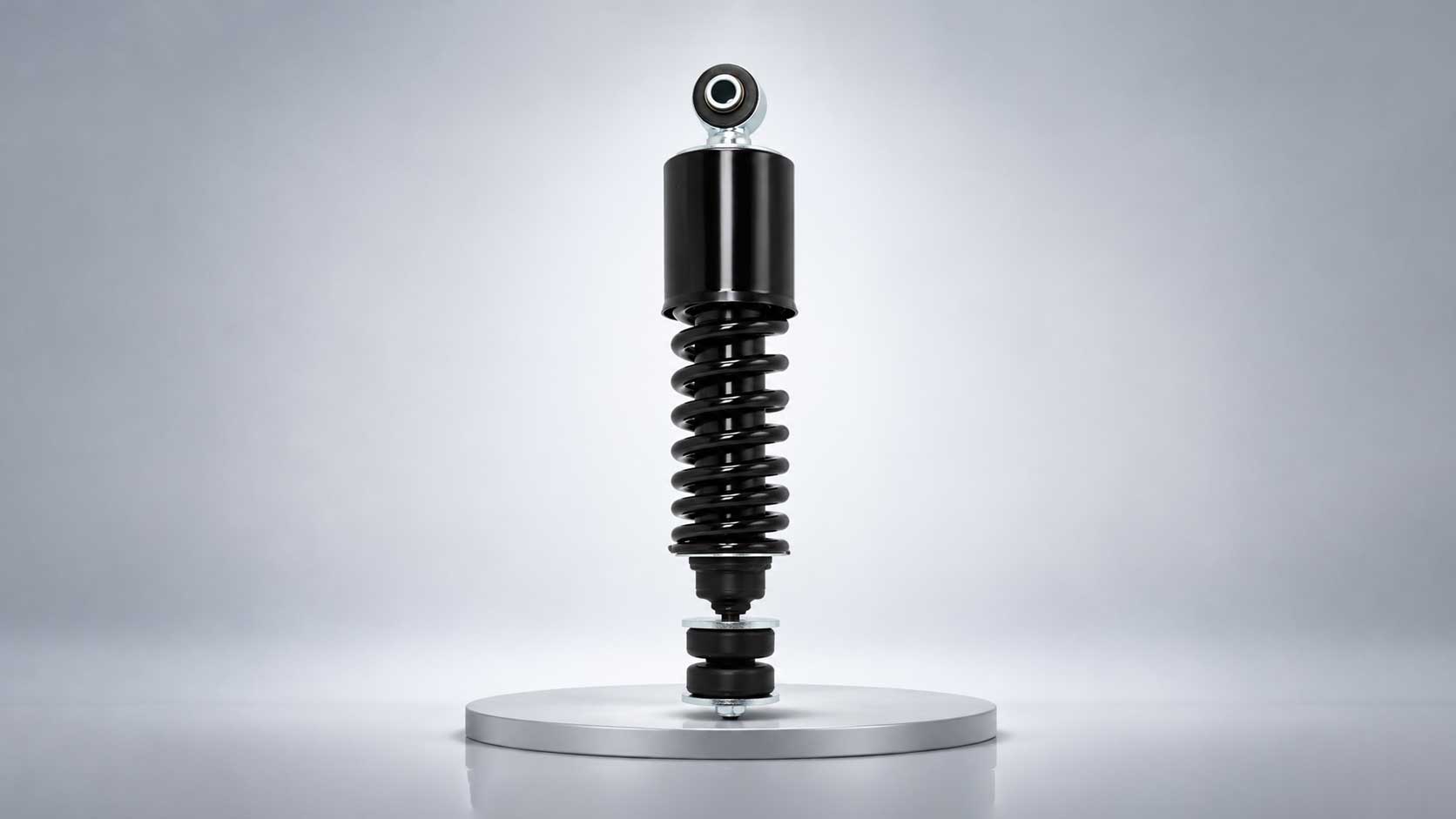
BRW Shock Absorber
Control for every journey.
BRW part number: 20373
OEM references: 81417226012 / 81417226009
Vehicle application: MAN
Intended use: highway transport, uneven roads, construction sites and other challenging conditions
Built for: continuous vibration, heavy loads and the everyday demands of commercial transport; designed to reduce unwanted vehicle movement and unnecessary stress on associated suspension components
Before you order: check the BRW part number and OEM references against the vehicle’s model, configuration and parts catalogue
As an aftermarket replacement, BRW Shock Absorber 20373 addresses an essential maintenance need: restoring suspension damping performance and helping commercial vehicles stay reliable.
emBRWace Perspective
In commercial transport, suspension performance is not simply a matter of comfort. It belongs to a wider equation of vehicle control, road safety, component longevity and fleet productivity.
A shock absorber may look like a small component on a heavy vehicle, but its contribution is significant. Recognising wear early, telling normal misting from real leakage, choosing the correct replacement and maintaining the whole suspension assembly are the habits of responsible fleet management.
emBRWace Explains
Shock absorber (damper)
A hydraulic component that controls the movement of the suspension springs, preventing prolonged bouncing.
Damping
The resistance a shock absorber creates by forcing oil through calibrated passages and valves, converting suspension movement into heat.
Compression stroke
The movement as the wheel rises and the suspension compresses.
Rebound stroke
The movement as the wheel drops and the suspension returns towards its normal position.
Misting
A thin film of oil on the shock body caused by the rod seal’s lubricating oil evaporating and condensing. It is normal and does not indicate a leak.
OEM reference number
The original manufacturer’s identification number for a part, used to confirm that a replacement matches the component it replaces.
Thought to Take Away
The best ride is not the softest one. It is the one that stays under control.