Reading Time: 4 Minutes
What if electric trucks could replenish their batteries without stopping to charge? Dynamic Wireless Power Transfer is turning that possibility into a real-world technology, with potentially significant implications for the efficiency, economics and future design of commercial transport.
THE NEXT FRONTIER IN ELECTRIC MOBILITY
One of the biggest challenges facing electric commercial vehicles is not simply how far they can travel, but how efficiently they can remain in operation.
For long-distance trucks, buses and high-utilisation delivery fleets, time spent charging is time spent off the road. Operators must balance range, battery size, charging schedules and vehicle availability, often making difficult trade-offs between performance and productivity.
Dynamic Wireless Power Transfer (DWPT) proposes a different solution.
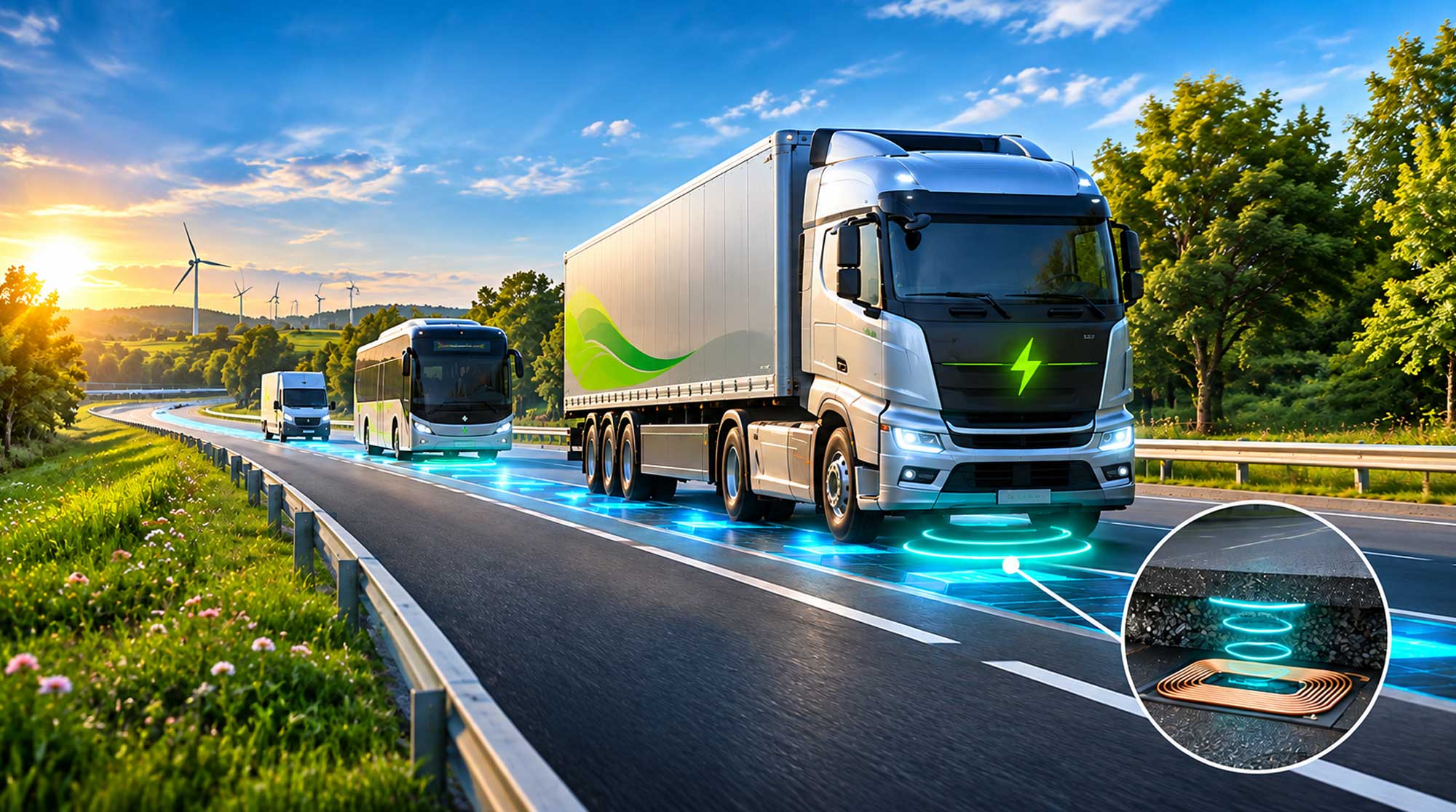
Rather than requiring vehicles to stop and recharge, the technology enables compatible electric vehicles to receive power while in motion through charging infrastructure embedded beneath the road surface. The concept shifts charging from a destination-based activity to an integrated part of the journey itself.
If deployed at scale, DWPT could fundamentally reshape the relationship between vehicles, batteries and transport infrastructure.
WHY THIS MATTERS
Heavy-duty electrification is often constrained by four interconnected factors: battery capacity, vehicle weight, charging time and operating range.
Larger batteries can extend range, but they also add cost, weight and material requirements. Charging infrastructure addresses part of the challenge, yet lengthy charging stops remain a practical consideration for fleet operators.
DWPT offers an alternative approach. By supplying energy along designated road sections, vehicles could depend less on carrying large onboard energy reserves and more on accessing power en route.
The implications are significant. Smaller batteries could free up payload capacity, improved vehicle utilisation could enhance productivity, and electrified freight corridors could make battery-electric transport more practical for long-haul operations.
The question becomes less about how much energy a vehicle can carry and more about how effectively it can access energy while moving.
THE TECHNOLOGY BENEATH THE ROAD
At its core, DWPT relies on electromagnetic induction.
Beneath the road surface, transmitter coils connected to the electrical grid generate electromagnetic fields. Compatible vehicles are equipped with receiver coils mounted underneath the chassis. As the vehicle passes over an electrified section of road, energy is transferred wirelessly from the infrastructure to the vehicle's electrical system.
Importantly, the road is not permanently energised. Individual segments activate only when an authorised vehicle approaches, helping improve both safety and energy efficiency. The process can continue seamlessly as vehicles move between successive charging sections, allowing energy transfer without cables, connectors or stationary charging stops.
WHY COMMERCIAL MOBILITY STANDS TO GAIN
Commercial transport is widely viewed as one of the most promising applications for DWPT.
Smaller Batteries, Greater Payload Potential
If vehicles can access energy during a journey, certain operating profiles may require smaller battery packs. Reducing battery weight could increase available payload capacity, an important commercial consideration in freight transport.
Improved Fleet Utilisation
Every charging stop reduces productive operating time. Dynamic charging could minimise downtime and allow vehicles to remain on the road for longer periods.
Extended Operating Range
Electrified highways and freight corridors could supplement onboard battery power during longer journeys, reducing dependence on depot-based or destination charging.
New Infrastructure Economics
Instead of concentrating investment solely in high-power charging hubs, operators and governments could develop strategically electrified routes serving high-frequency freight and passenger corridors.
FROM PILOT PROJECTS TO REAL-WORLD ROADS
Although still at an early stage of development, DWPT is progressing beyond laboratory environments.
In Sweden, the Smartroad Gotland project demonstrated wireless charging on a 1.65-kilometre public road section, delivering continuous power to heavy vehicles travelling at motorway speeds.
France has also moved the technology closer to real-world deployment. Trials on the A10 motorway near Paris tested dynamic wireless charging under live traffic conditions, with reported power transfer levels exceeding those achieved in many conventional charging scenarios.
Meanwhile, in Italy, IVECO and the A35 Brebemi motorway operator have begun exploring practical commercial applications through specially equipped electric vehicles capable of both static and dynamic wireless charging.
Taken together, these projects suggest that the technology is steadily transitioning from experimental testing towards operational evaluation.
BY THE NUMBERS
| Project / Measurement | Key Figure |
|---|---|
| Smartroad Gotland electrified road | 1.65 km |
| Smartroad Gotland continuous truck charging | 100 kW |
| France A10 pilot section | 1.5 km |
| France A10 peak power transfer | 300+ kW |
| France A10 average power under optimal conditions | 200+ kW |
Figures reflect reported project demonstration results.
THE ROAD AHEAD
Despite its promise, substantial challenges remain.
Embedding charging infrastructure beneath roads requires significant capital investment, reliable grid connectivity, specialised construction and long-term maintenance. Commercial viability will ultimately depend on traffic density, energy costs, utilisation rates and the scale of network deployment. Industry-wide standardisation will also be essential. Vehicle manufacturers, infrastructure developers and policymakers must establish compatible technical standards that allow vehicles to operate seamlessly across different regions and transport corridors.
DWPT is therefore unlikely to replace conventional charging entirely. Depot charging, static wireless charging and high-power charging stations will continue to play important roles within a broader charging ecosystem. Instead, the technology's strongest potential may lie in complementing existing infrastructure where continuous vehicle utilisation and predictable traffic volumes justify the investment.
emBRWace PERSPECTIVE
Dynamic Wireless Power Transfer is about more than charging. It challenges a fundamental assumption of electric mobility: that vehicles must carry all the energy they need before a journey begins. If successfully deployed, electrified road corridors could become part of the energy network itself, delivering benefits across:
- Vehicle Engineering – Smaller battery packs and lighter vehicle designs.
- Freight Economics – Improved payload capacity and vehicle utilisation.
- Infrastructure Investment – New opportunities for electrified freight corridors.
- Energy Management – Closer integration with smart grids and renewable energy.
- Fleet Operations – More flexible charging and route-planning strategies.
The strongest business case is likely to emerge along high-frequency freight and public transport routes, where predictable traffic volumes can justify the infrastructure investment.
Whether DWPT becomes a mainstream solution or a specialised one remains to be seen. What is clear is that it offers a new way of thinking about mobility infrastructure, one where roads do more than move vehicles.
They help power them.
emBRWace Explains
What is Dynamic Wireless Power Transfer (DWPT)?
DWPT is a wireless charging technology that enables compatible electric vehicles to receive power while moving over electrified road sections.
How does wireless charging work on roads?
Embedded transmitter coils beneath the road transfer energy wirelessly to receiver units installed beneath compatible vehicles.
Why is DWPT important for commercial transport?
It could reduce charging downtime, improve vehicle utilisation and potentially allow smaller batteries in heavy-duty vehicles.
Is the technology already being used?
Pilot projects in Sweden, France and Italy are demonstrating its technical feasibility under real-world conditions.
Will wireless charging roads replace traditional charging stations?
Unlikely. DWPT is expected to complement depot charging, static wireless charging and conventional fast-charging infrastructure.
THOUGHT TO TAKE AWAY
The future of electric freight may not be determined by battery size alone. By transforming roads into active participants in the energy ecosystem, Dynamic Wireless Power Transfer could redefine how commercial vehicles are designed, powered and operated.
Tomorrow's highways may do more than connect destinations. They may help power the journey itself.
NEXT READ
Explore more emerging technologies and innovations shaping the future of commercial mobility in the Electric Track series on emBRWace.