Reading Time: 4 Minutes
The world’s shipping disruptions are opening a new frontier in the Arctic. But can a shorter route deliver cheaper, safer and more dependable global trade?
For decades, the Northern Sea Route along Russia’s Arctic coastline was a marginal option in international shipping. Now geopolitical conflict, sanctions and instability across established maritime corridors are giving it renewed commercial importance. By mid-October, Russia had shipped about 20 million barrels of oil to Asia along the route this season, nearly 50% more than in the whole of 2025, according to Reuters. In August, a Chinese operator launched the first scheduled weekly container service through the Arctic to Europe.
The surge raises a bigger question: could the Arctic become a credible alternative to established maritime corridors, or is its growing importance simply a response to an extraordinary period of disruption?
WHEN ESTABLISHED ROUTES BECOME LIABILITIES
Global trade depends on maritime corridors that move enormous volumes of cargo reliably and competitively. When conflict threatens them, the consequences reach well beyond shipping companies: energy prices rise, delivery schedules become uncertain and supply chains absorb extra costs. The Red Sea crisis has disrupted traffic through the Suez Canal, instability around the Strait of Hormuz has exposed the vulnerability of critical energy shipments, and sanctions following Russia’s war against Ukraine have added another layer of complexity. Traders told Reuters that disruptions via Suez, Hormuz and the Black Sea made the Arctic more attractive this year, while tanker freight rates reached record highs.
Against that backdrop, the Northern Sea Route stands out for its geography. Running along Russia’s Arctic coast between the Atlantic and Pacific approaches, it can be 30% to 40% shorter than the Suez route for some journeys between East Asia and northern Europe. Sea Legend, the Chinese operator behind the new container service, estimates the Ningbo–Felixstowe voyage at about 20 days, against 35 to 40 via Suez.
WHY THIS MATTERS
For logistics operators, alternative corridors are becoming strategic assets. But distance alone does not determine commercial value. Reliability, insurance, infrastructure, operating costs and geopolitical exposure ultimately decide which routes get used.
THE ARCTIC’S COMMERCIAL PROPOSITION
The route’s obvious attraction is shorter sailing distance for selected journeys. Russia’s position, and its investment in icebreakers, Arctic ports and supporting infrastructure, give it a significant advantage in developing the corridor, and its energy exporters have strong incentives to keep access to overseas buyers.
The numbers show where the real demand lies. According to a September 2026 analysis by the Carnegie Endowment for International Peace, commercial oil shipments through the Arctic reached 13 million barrels in 2025, up from 2.2 million in 2019, as exporters chose a route free of inspections and detentions. Total cargo on the route was 37 million tonnes, down 2.3% on the year and well short of the 80 million tonnes a 2018 presidential order had targeted for 2024. Carnegie also noted that the record 103 transit passages in 2025, voyages between Asia and Europe, carried only 3.2 million tonnes, less than 9% of the total. Most of the traffic is Russian energy, not global trade.
Arctic navigation also adds cost. Ice-class vessels, icebreaker assistance with high tariffs, specialised equipment, trained crews and extra insurance all increase the price of a voyage. And there is a fundamental difference between energy and boxes. Tankers and bulk carriers can sometimes work to flexible schedules, but container shipping depends on predictable timetables, established ports and reliable connections to road and rail. Sea Legend plans eight sailings in this year’s short navigation window, a limited operation next to established Asia–Europe services.
A shorter voyage does not necessarily mean cheaper freight.
ENERGY SECURITY VERSUS ENVIRONMENTAL EXPOSURE
The Arctic’s growing importance also reflects the changing geography of energy security. For Russia, the route is another channel for exporting oil to Asian buyers. China is currently the only recipient: twelve tankers carried more than ten million barrels there in the first eight months of 2026, according to Reuters. For importing nations, alternative supply routes can reduce dependence on individual chokepoints.
But the route is not geopolitically neutral. It runs along Russia’s coastline, under Russian regulatory oversight and with heavy dependence on Russian infrastructure. Sanctions compliance adds further complications, and the wider growth of shadow-fleet tanker operations has increased scrutiny of vessel ownership, insurance and maritime practices.
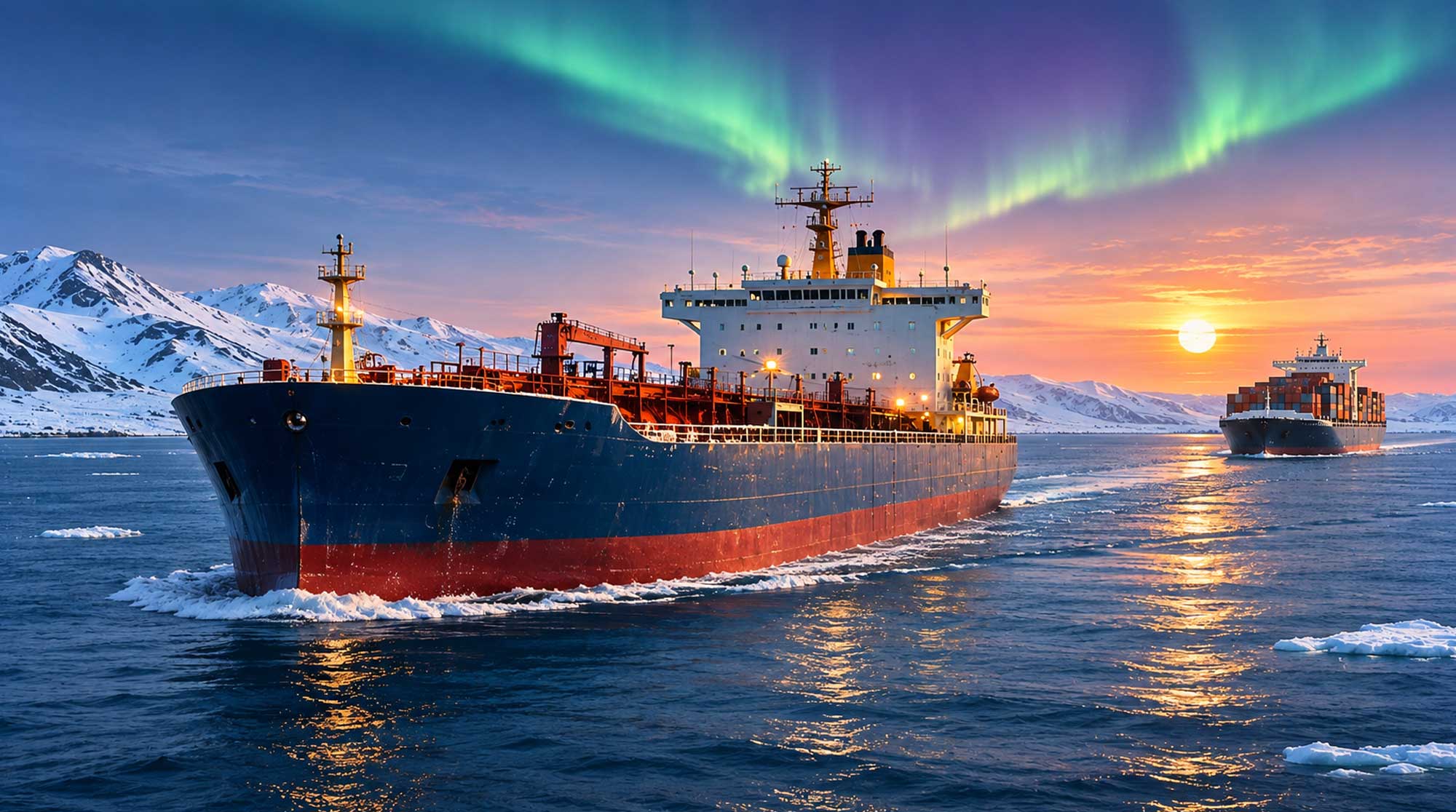
Environmental exposure is just as significant. The Arctic is an exceptionally sensitive ecosystem, and its waters are far from rescue and preparedness services, with weather and ice conditions that can change fast. In early August, a convoy of more than 15 vessels, mostly oil tankers, sailed north of the Severnaya Zemlya archipelago in what the Independent Barents Observer reported as the northernmost tanker convoy ever recorded. Extreme weather, remote operating conditions and limited emergency-response capability make oil-spill containment particularly difficult. Increased shipping also brings emissions, underwater noise and wildlife disturbance. Climate change may improve seasonal navigability as sea ice retreats, but greater accessibility does not make Arctic shipping environmentally safer.
A PERMANENT CORRIDOR OR A CRISIS-DRIVEN DETOUR?
The Arctic’s future depends on whether operators can use it consistently and profitably, not on whether vessels can navigate its waters. Carnegie’s conclusion is blunt: the route is viable only under certain conditions, and international demand for it is unlikely to last if the alternatives recover.
That is the logic of a crisis-driven detour. The Northern Sea Route may offer strategic advantages while established corridors are disrupted. When they recover, shipping companies must reassess whether the extra cost and operational uncertainty remain commercially justified. Its development is therefore more likely to complement existing maritime networks than to replace them in the foreseeable future.
For logistics operators, the wider lesson is clear. Supply-chain resilience increasingly depends on having alternative routes, diversified sourcing and the flexibility to respond when geopolitical conditions change. The Arctic is opening new possibilities for global mobility, and whether they endure will depend on infrastructure, commercial competitiveness, operational reliability and environmental responsibility.
By the Numbers
13 million
barrels of oil were shipped commercially through the Arctic in 2025, against 2.2 million in 2019, according to Carnegie.
20 million
barrels of Russian oil had been shipped via the Northern Sea Route to Asia by mid-October 2026, nearly 50% above the whole of 2025, according to Reuters.
37 million
tonnes of cargo moved along the route in 2025, down 2.3% year on year.
3.2 million
tonnes were carried by the record 103 transit passages in 2025, less than 9% of the route’s total cargo.
20
days is Sea Legend’s estimated container transit from Ningbo to Felixstowe, against 35 to 40 days via Suez.
[Figures are reported estimates and refer to specific operating conditions and periods.]
emBRWace Perspective
A shorter route is not necessarily a stronger supply chain.
The Arctic’s growing relevance reflects a fundamental shift in logistics strategy. Transport corridors can no longer be judged solely by distance, speed or freight rates. Geopolitical exposure, operational predictability and the cost of disruption matter just as much.
The Northern Sea Route could become a useful component of a diversified freight network. But resilience comes from having commercially viable alternatives, not from finding new routes on a map. For logistics decision-makers, the priority is the right balance of cost, reliability, accessibility and risk.
Thought to Take Away
The Arctic may shorten the journey between continents, but commercial reliability will determine its place in global trade.
Sources: Carnegie Endowment for International Peace, “International Demand for Russia’s Arctic Shipping Route Is Unlikely to Last” (30 September 2026); Reuters, “Russian oil exports by Arctic route jump amid world freight crisis” (19 October 2026); Independent Barents Observer, “Russian Arctic oil exports to China beat records” (4 September 2026); China Daily and trade-press reporting on Sea Legend’s China–Europe Arctic Express (June to August 2026)