Reading Time: 4 Minutes
DEEP DIVE No. 009
The next major contest in commercial vehicles may not be decided by who builds the best truck. It may be decided by who can build the most competitive electric-truck ecosystem.
China’s electric-truck market has accelerated at a pace Europe’s established manufacturers have struggled to match. Battery supply, industrial scale, domestic demand and fast-evolving vehicle platforms have combined into a powerful advantage. Chinese manufacturers are now preparing to take it into Europe, where truck makers have spent decades building engineering expertise, customer relationships and service networks.
The stakes extend well beyond vehicle sales. Electric-truck competition could reshape manufacturing economics, fleet purchasing decisions and the balance of power in the global commercial-vehicle industry. China has established the scale. Europe retains formidable industrial strengths. The question is whether those strengths can withstand a new model of competition.
WHY THIS MATTERS
Electric trucks are still a small part of Europe’s truck market, but the competitive consequences could be large. Fleet operators face pressure to cut emissions without compromising payload, availability or profitability. Manufacturers must deliver electric vehicles that meet those demands while competing with diesel economics and new international entrants.
For European OEMs, the task is to accelerate electrification without sacrificing the commercial advantages built around their existing businesses. For Chinese manufacturers, the opportunity is to turn domestic production scale into international sales, supported by local assembly, charging solutions and aftersales networks. For fleets, more competition could mean more choice, better technology and lower costs, but only if real-world performance, service support and ownership economics hold up.
THE SCALE THAT CHANGED THE EQUATION
The International Energy Agency’s Global EV Outlook 2026 puts numbers on the gap. Global electric-truck production reached around 440,000 vehicles in 2025, more than twice the previous year’s level. China alone built more than 400,000, over 90% of the total and more than in the whole of 2020 to 2024 combined. Production in the European Union also doubled, but only to just over 13,000.
Adoption tells the same story. One in four trucks sold in China in 2025 was electric. In Europe, electric trucks reached 3% of all truck sales, nearly 17,000 vehicles. Electric heavy trucks made up around 1.5% of sales, and medium-duty electric trucks around 7%. These are two markets moving at different speeds: China’s domestic demand is established, while Europe is held back by acquisition costs, charging infrastructure, operating requirements and the economics of fleet replacement.
But production is not the same as international reach. Only about 3% of electric trucks made worldwide in 2025, just over 12,000, were traded across borders, down from a peak of around 8% in 2023. China’s scale gives it the capacity to compete abroad. Turning that capacity into a lasting position takes a different set of capabilities.
THE INDUSTRIAL ECOSYSTEM ADVANTAGE
China’s edge lies in how its pieces fit together: manufacturing, batteries, vehicle development and domestic demand. CATL supplied about 80% of the batteries in China’s electric trucks in 2025, and sales there come almost exclusively from Chinese makers using Chinese batteries and chassis. A concentrated supply chain, established component suppliers and a large market in which new architectures can be deployed and refined all feed lower costs, quicker development and close coordination between batteries and vehicle platforms. Large volumes spread development costs, and real-world deployment generates data that informs the next design.
The industry’s structure is shifting too. New entrants without conventional models captured almost 30% of China’s electric-truck market in 2025, and Sany, a construction-machinery maker, is now China’s top-selling electric-truck brand, according to Reuters. Electrification is changing who competes, letting companies with different engineering backgrounds and business models challenge established truck makers.
EUROPE’S INCUMBENTS ARE NOT STANDING STILL
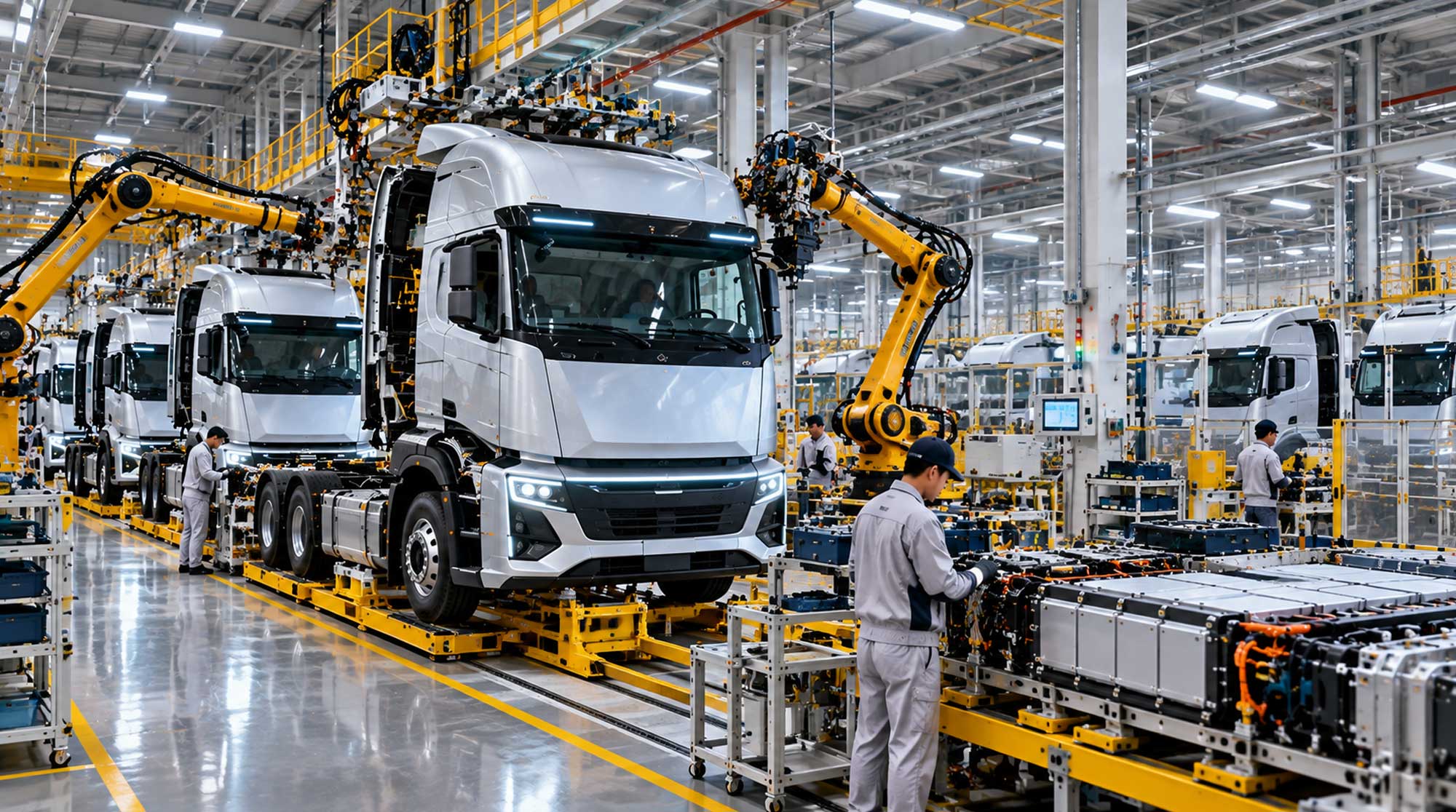
China’s momentum should not obscure Europe’s strengths. Daimler Truck, Volvo, Traton (MAN and Scania) and Iveco have deep engineering capability, extensive customer relationships and dealer networks. The IEA says they still account for two-thirds of electric-truck sales in the EU, and that Daimler and Volvo can now assemble battery-electric trucks on the same lines as their diesel models, which gives manufacturing flexibility as demand shifts.
They also understand their markets: payload requirements, road regulations, driver expectations, fleet financing, maintenance schedules and residual values. A truck has to fit the operator’s business, not just look good on a specification sheet. And fleets need parts availability, trained technicians, warranty support, roadside assistance and predictable uptime, which new entrants cannot reproduce quickly.
So, Europe’s challenge is not engineering competence. It is converting that competence into competitive electric-truck economics at scale, against rivals that built their businesses around electric propulsion from the start. Its battery supply is also exposed: about 70% of trucks sold in the EU in 2025 carried cells made by companies headquartered in China, Japan or South Korea.
THE PRICE CHALLENGE
Price is becoming the sharpest edge of the contest. In March, Reuters reported that more than half a dozen Chinese manufacturers, including BYD, Geely’s Farizon, Sany, Sinotruk, Windrose and SuperPanther, plan to launch heavy-truck sales in Europe in 2026, aiming to price up to 30% below the European average of €320,000. Those are market-entry signals, not proof that every Chinese model is cheaper or commercially equivalent.
Independent modelling points the same way, with caveats. Transport & Environment (T&E), an environmental advocacy group, estimated in September that a Chinese-built electric truck costs about €210,000, against €265,000 for a European equivalent. It found that buying from a new entrant could lower five-year total cost of ownership by around 9%. An earlier version of its analysis put the saving at up to 12%, and the figure was revised on updated data. In Germany, it estimates an operator could save a further €34,000 over five years. With haulage margins of just 1.5% to 2%, a saving like that could be decisive, but it is not a universal result across vehicles, countries or duty cycles.
BATTERIES, CHARGING AND SWAPPING
China’s concentrated battery base gives its makers close integration between cells and vehicle platforms, while European manufacturers depend on international supply, though their sourcing continues to evolve.
Battery swapping adds another dimension. Around 15% of electric-truck sales in China in 2025 were swap-capable, and CATL plans a nationwide swap network of roughly 150,000 km by 2030. Where compatible stations exist, swapping can cut downtime by replacing a depleted battery instead of waiting for it to recharge, which suits high-utilisation work around ports, mines, industrial sites and predictable corridors. But it needs heavy investment in stations, battery inventory and standardisation.
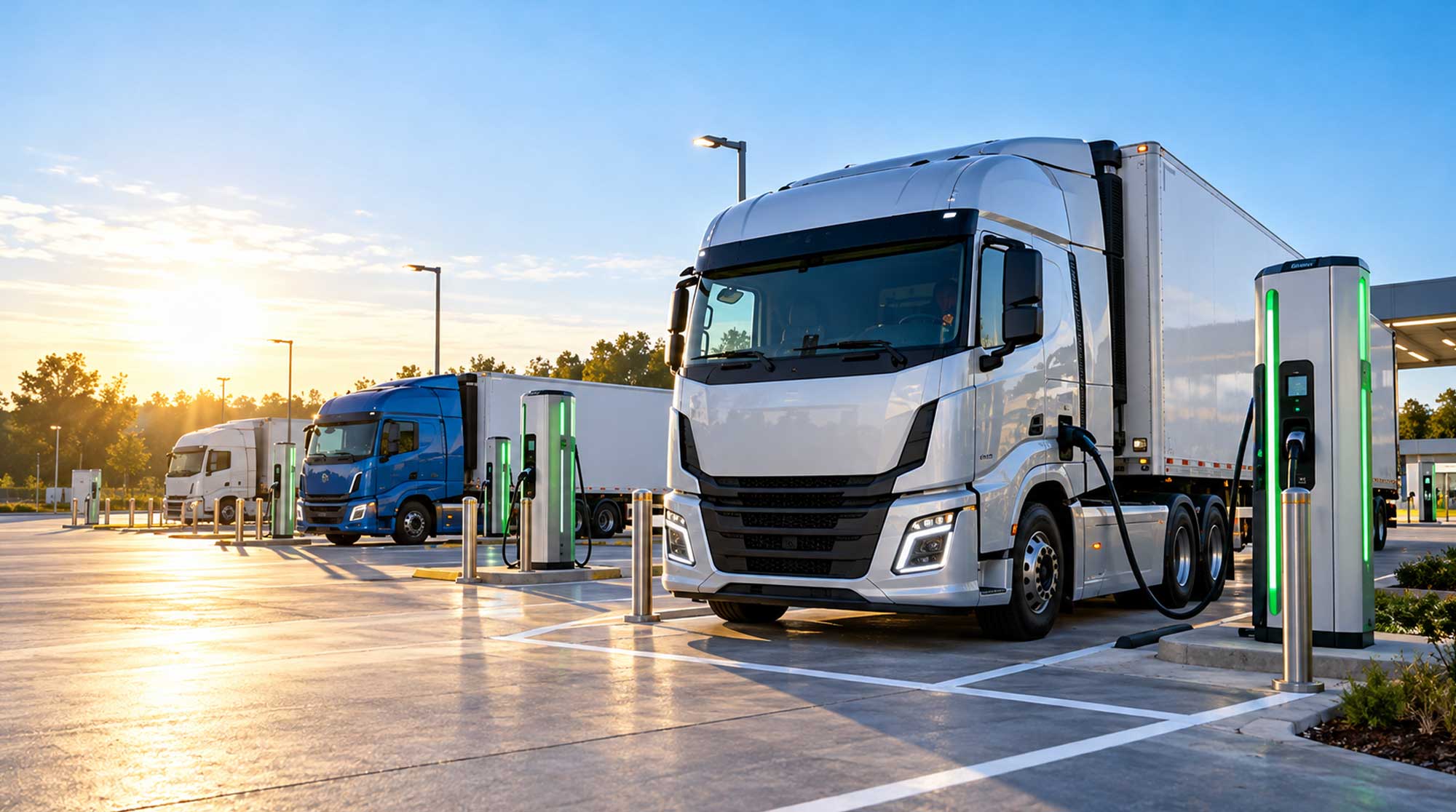
Europe is pursuing depot, public and high-power charging for long-distance freight, and the gap is plain. The IEA estimates that in 2025 more than 70,000 public charging points worldwide could accommodate heavy-duty vehicles, of which only about 1,200 were verified as dedicated to trucks. It also puts the average battery-electric truck range at around 300 km, below what long-haul work needs. Neither swapping nor high-power charging is a universal answer. The right one depends on utilisation, route design, electricity costs and the time available for charging.
FROM EXPORTS TO LOCAL PRESENCE
China’s next challenge is to turn domestic scale into international success. Electric trucks are harder to export than many cars. They are expensive to ship, need market-specific adaptation and must meet local homologation. More importantly, operators need confidence that parts, servicing and technical support will last the vehicle’s working life.
Chinese manufacturers are responding with partnerships and local production. SuperPanther and Sany have signed deals with Germany’s Alltrucks, which runs about 650 service centres across Europe. BYD will build trucks at its bus factory in Hungary, Steyr Automotive will assemble SuperPanther’s trucks at a former MAN plant in Austria, and Windrose plans to build in Europe.
Localisation can reduce logistical friction and build customer confidence. It does not remove the harder task of earning fleets’ trust, because long-term reliability, residual values, parts availability and service response have to be shown in actual operation. China’s international position is an emerging challenge, not a completed takeover.
THE ADVANTAGES THAT WILL LAST
Some of China’s advantages are structural: its domestic battery supply chain, manufacturing concentration, established demand and fast-evolving supplier ecosystem are hard to reproduce quickly. T&E calculates that if their stated ambitions are met, new entrants could take 24% to 31% of Europe’s electric heavy-truck market by 2030.
Other advantages may narrow. European manufacturers can raise volumes, improve battery sourcing, shorten development times and build more competitive platforms, while keeping their fleet relationships and service networks. The balance will depend on how well each side combines technology, cost, manufacturing and customer support. Chinese manufacturers must prove dependable performance and attractive ownership economics across European operating conditions. European manufacturers must show that engineering heritage and service strength can become electric vehicles that compete on both performance and price.
emBRWace Perspective
The electric-truck transition is exposing a deeper industrial divide. China has built an ecosystem in which batteries, vehicle manufacturing, domestic demand and product development reinforce one another, and that integration has accelerated adoption and created a formidable production base.
For fleet operators, the most important development is the prospect of a more competitive market. Greater choice can bring lower costs and better performance, provided purchasing decisions rest on verified operating data, not headline prices alone.
The next phase of competition will be decided not by manufacturing scale in isolation, but by which manufacturers can turn scale, technology and customer support into dependable value over the working life of a truck.
Thought to Take Away
The electric-truck race will be won not by scale alone, but by the ability to turn industrial strength into lasting customer value.
Sources: International Energy Agency, Global EV Outlook 2026; Reuters, “European freight truck makers brace for wave of low-cost Chinese rivals” (10 March 2026) and Reuters report on Transport & Environment’s cost analysis (28 September 2026); Transport & Environment, new-entrant competition analysis (September 2026); Volvo Group, Daimler Truck and Traton public information as cited by the IEA