Reading Time: 2 Minutes
On 10 November 1885, an experimental machine rolled out on the roads of Cannstatt, near Stuttgart, Germany, carrying the promise of a new form of personal transportation. The Daimler Reitwagen, developed by Gottlieb Daimler and Wilhelm Maybach, was powered by a petrol-driven internal-combustion engine. Its early test ride, associated with Gottlieb's son Paul Daimler, marked a defining milestone in the development of the modern motorcycle.
An Engine Looking for Two Wheels
Gottlieb Daimler and Wilhelm Maybach had been developing a compact, high-speed petrol engine that could power more than stationary machinery. Their ambition was to demonstrate its potential in a practical road vehicle.
The result was the Reitwagen, meaning riding car. Built around a wooden frame with iron-banded wooden wheels, it carried a single-cylinder, four-stroke engine mounted vertically between its wheels. Producing approximately 0.5 horsepower, the 264 cc engine drove the rear wheel through a belt transmission. Two small stabilising wheels helped keep the experimental machine upright.
It was an unconventional design, combining the basic form of a bicycle with an internal-combustion powerplant. Daimler had patented the riding carriage on 29 August 1885, laying the foundation for the test programme that followed.
During the November trial, Paul Daimler is widely credited with riding the machine from Cannstatt towards Untertürkheim and back. The journey demonstrated that the compact engine could propel a road vehicle under its own power.
The experience was not entirely comfortable. The hot-tube ignition system was positioned beneath the rider's seat, and the heat reportedly caused the saddle to catch fire. It was an extraordinary reminder that pioneering engineering often involved overcoming problems that later generations of designers would scarcely imagine.
From Riding Car to Motorised Mobility
The Reitwagen was never intended to become a mass-produced motorcycle. Its primary purpose was to prove that Daimler and Maybach's compact petrol engine could power a vehicle.
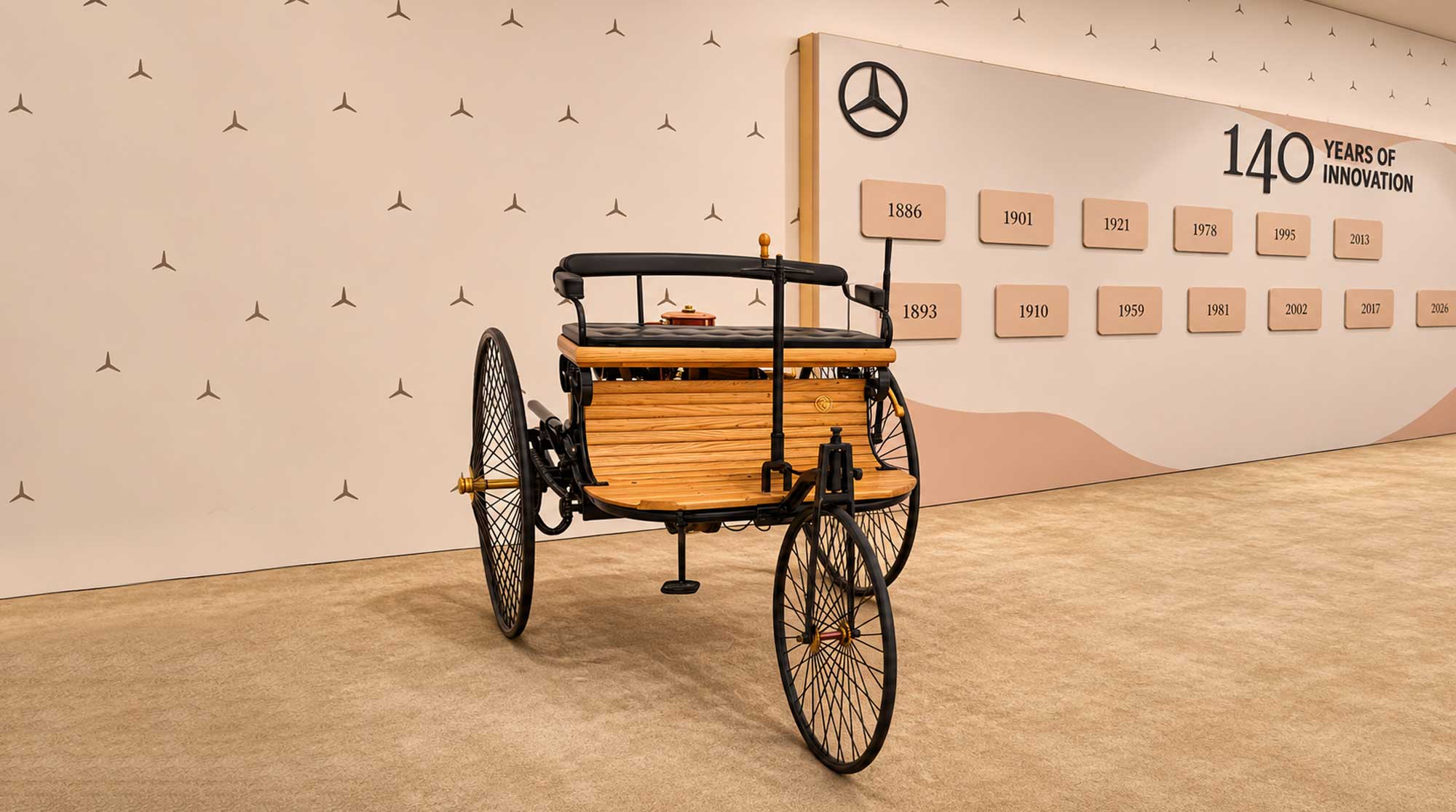
That proof had far-reaching consequences. In 1886, the same engine technology was adapted for Daimler's motorised carriage, extending the experiment from two-wheel mobility to four-wheel transportation. The Reitwagen had served as a test platform for an engineering concept that would help shape the future of motor vehicles.
The original machine was destroyed in the 1903 Cannstatt factory fire, but replicas preserve its unusual construction and historical significance. Today, it is widely recognised as the first petrol-powered motorcycle, although earlier steam-powered two-wheelers had already existed.
From that wooden experimental machine emerged an entirely new direction in personal mobility. Its legacy was not measured by speed, comfort or commercial success, but by the possibilities it unlocked. The journey towards the modern motorcycle had begun.