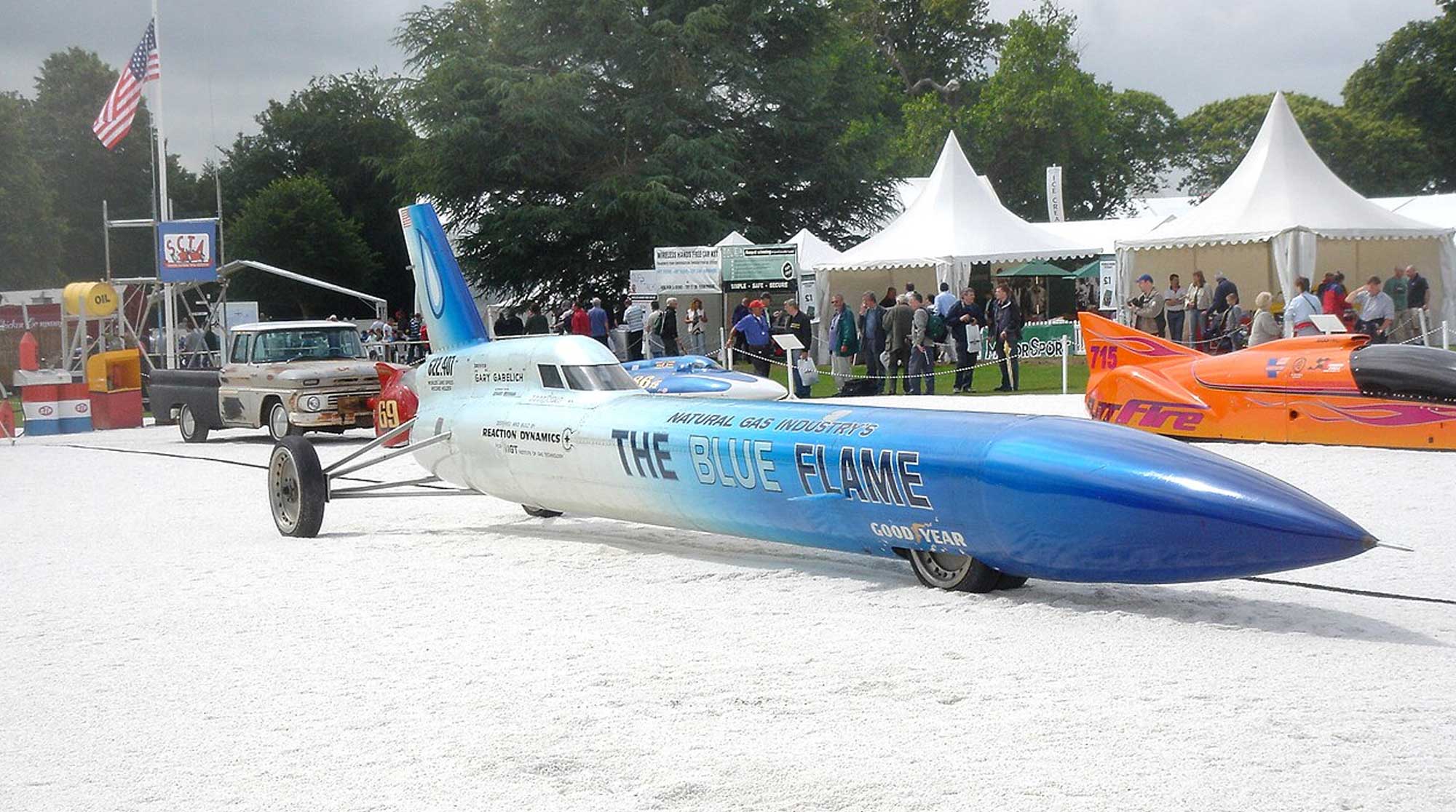
On 23 October 1970, Gary Gabelich and Blue Flame made history by breaking the 1,000 km/h barrier on land.
A Storm on the Salt
At Utah’s Bonneville Salt Flats, the pursuit of speed demanded more than a powerful engine. It required radical engineering, precision and the courage to control a machine hurtling across the salt at extraordinary velocity.
The answer was Blue Flame, a rocket-powered vehicle developed by Reaction Dynamics. It used liquefied natural gas as fuel and hydrogen peroxide as an oxidiser, producing immense thrust. At the controls was American racer Gary Gabelich, whose challenge was to turn that power into a record recognised by the rules of international motorsport.
A Record that Made History
On 23 October 1970, Gabelich set an officially recognised world land-speed record with a 622.407 mph (1,001.667 km/h) average over the flying mile. He also established a flying-kilometre record of 630.388 mph (1,014.511 km/h).
The achievement made Blue Flame the first rocket-powered car to set the world land-speed record and took the flying-mile average beyond 1,000 km/h for the first time. The record stood until Richard Noble’s turbojet-powered Thrust2 surpassed it in 1983.
Gabelich’s achievement was not the work of a driver alone. It reflected the ingenuity of the engineering team and the relentless pursuit of performance that defines land-speed racing.
For a brief, extraordinary moment, a rocket-powered machine transformed a vast stretch of salt into a stage for engineering history.