Reading Time: 4 Minutes
Bhutan’s carbon-negative outlook opens a wider conversation about sustainable transport, freight and logistics, and the opportunities reshaping the global mobility ecosystem.
A DIFFERENT MEASURE OF PROGRESS
What if the future of mobility were shaped not only by how quickly people and goods move, but also by how intelligently we use the resources that make the movement possible?
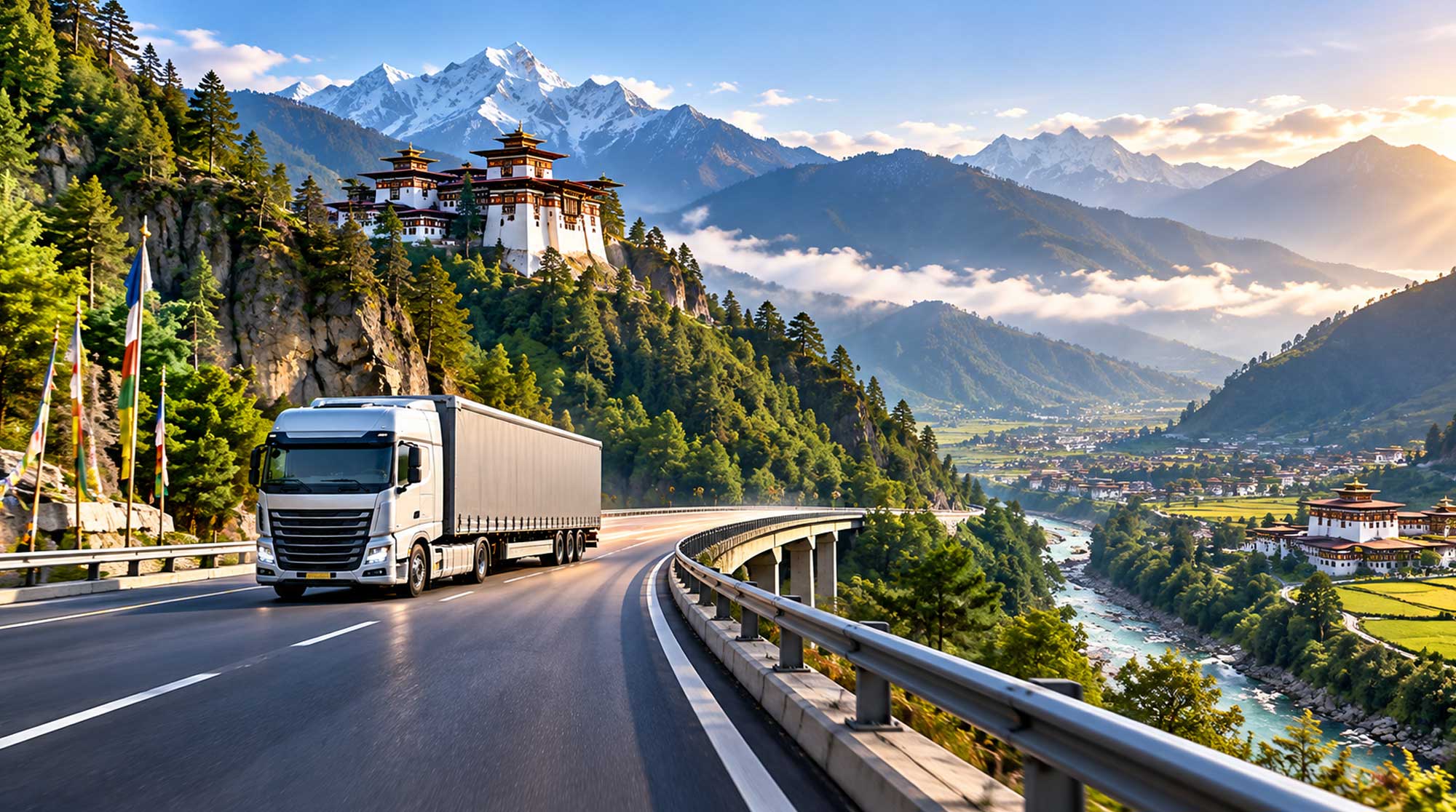
Bhutan offers an intriguing starting point. The Himalayan kingdom is known for environmental conservation and for Gross National Happiness, a development philosophy that places people’s well-being alongside economic progress. Its prime minister says its forests absorb more CO₂ than the country emits, and the UN Development Programme counts it among the world’s few carbon-negative countries. In its third Nationally Determined Contribution, issued in 2025, Bhutan reaffirmed its commitment to remain carbon neutral while pursuing sustainable, inclusive and climate-resilient growth.
That record invites a wider question about energy, economic development and the systems that connect people, businesses and markets. Could a different view of progress inspire fresh thinking about transport, commercial vehicles, freight and logistics? And what might emerge if sustainability became a catalyst for innovation rather than simply a constraint?
WHY THIS MATTERS
Mobility is undergoing a fundamental transformation. Electrification is changing vehicle technology, digitalisation is reshaping fleet operations, and energy security is influencing decisions about infrastructure and fuel. Meanwhile, freight networks must become more efficient while meeting growing environmental expectations.
The opportunity goes beyond swapping diesel engines for electric motors. It involves rethinking how vehicles are powered, how fleets are used, how goods are consolidated and how transport networks interact with energy systems.
Bhutan is the trigger for this exploration. The cases that follow come from elsewhere, because the opportunities belong to the wider world.
THE POWER OF DIFFERENT PATHWAYS
Electrification shows how alternative approaches can reshape mobility, and how unevenly they spread. According to the International Energy Agency’s Global EV Outlook 2026, electric trucks reached 9% of all truck sales worldwide in 2025, having doubled in a year. That passed 400,000 vehicles, but China accounts for more than 90% of them. In Europe, electric trucks made up 3% of all truck sales. The global figure is real, but it is mostly a Chinese story.
The opportunity is not simply to build more electric trucks. It is to develop the ecosystem around them: charging, suitable energy supplies, financing, maintenance, digital fleet management and vehicles matched to specific duty cycles.
A British example shows how. PepsiCo’s transport partner XPO Logistics ordered six Mercedes-Benz eActros 600 trucks for distribution across England and Wales, projected to run more than a million kilometres a year with zero emissions and to avoid over 1,200 tonnes of CO₂ annually. These are company projections, not independently verified results, and they refer to tailpipe emissions. Even so, the deployment shows how manufacturers, logistics providers and cargo owners can fit electric heavy trucks into established distribution networks.
For urban deliveries and predictable regional routes, electric vehicles can offer practical advantages. Long-distance heavy freight raises harder questions of payload, range, charging time, terrain and infrastructure. Battery-electric vehicles may suit some operations, while alternative fuels, more efficient conventional vehicles or combinations of technologies may suit others. The task is to match technology to real operating conditions, not to chase a universal solution.
WHEN LOGISTICS BECOMES THE INNOVATION
The movement of goods offers another way to rethink sustainability. A freight vehicle’s environmental performance depends not only on its powertrain but on how well it is used. Empty running, poor load planning, avoidable detours, waiting time and fragmented deliveries all consume resources without creating value. Digital freight platforms can improve visibility between shippers and carriers, AI can support route planning and demand forecasting, predictive maintenance can prevent breakdowns, and better consolidation can raise utilisation.
A trial in London shows another route. The Belgian intermodal operator ECS is running a 16-month trial of two electric trucks for first- and last-mile deliveries, with rail doing most of the distance. In the first three months, the trucks covered 14,775 km and completed 329 deliveries for 12 customers, all on time, according to the company. ECS says it will analyse the full results before deciding whether to expand its electric fleet.
The lesson is that sustainable freight does not always require one vehicle technology to cover an entire journey. Combining modes and choosing the right vehicle for each leg can improve asset utilisation and reduce pressure on road networks. For logistics providers, the question is increasingly whether advantage will come from owning more assets or from getting more out of the assets already running.
A TRANSITION BUILT AROUND REALITY
The shift to lower-emission freight need not follow a single path. In India, Jindal Stainless announced on 15 October that it had deployed ten electric trucks to carry finished goods from its Jajpur plant to Kharagpur and Kolkata, as part of a phased programme that also includes 80 LNG trucks and CNG vehicles. The company estimates, on a modelled basis, that the mix will cut CO₂ emissions by around 71 tonnes a month, about 26% less than diesel. That is a company estimate for the whole programme, not a verified saving from the ten electric trucks alone.
The example shows that different routes, payloads, distances and infrastructure conditions may favour different technologies, and that a phased approach lets a business introduce lower-emission vehicles where they work while it evaluates others. It also calls for care. Alternative fuels are not automatically low-carbon, because their performance depends on how the fuel is produced, how efficient the vehicle is and how clean the wider energy supply chain is.
ENERGY AND MOBILITY MUST MOVE TOGETHER
Bhutan’s hydropower brings the energy question into sharper focus, and it is more complicated than the headline suggests. Low-carbon electricity creates opportunities for electrification, but supply, affordability and reliability still matter. Bhutan’s electricity imports more than doubled during the 2025–26 winter lean season, reaching 2,118 million units from India at a cost of ₹7.09 billion, as demand outpaced hydropower generation. The country remains a net exporter, but winter imports come largely from a grid with a significant fossil-fuelled share, which raises concerns about its carbon-negative status.
Even the nation behind the question, then, faces the problem every transport system faces. A cleaner system needs more than low-emission vehicles. It needs reliable electricity, well-placed charging infrastructure, viable tariffs and coordination between transport operators and energy providers. Smart charging, renewable integration, energy storage and fleet charging management can help align demand with supply, and partnerships between manufacturers, charging operators, utilities and fleet owners may find new ways to finance and run that infrastructure. For emerging markets, the challenge is to build mobility systems that are environmentally responsible without becoming financially or operationally impractical.
NEW BUSINESS MODELS FOR A CHANGING WORLD
The transition also invites a rethink of how mobility services are delivered. Ownership is no longer the only model available. Leasing, Vehicle-as-a-Service, managed fleets and charging-as-a-service spread costs differently depending on the contract. Smaller fleets may find that integrated access to vehicles, maintenance, financing and charging reduces the burden of managing many suppliers, while manufacturers and service providers gain recurring relationships beyond the first sale.
The same principle extends to freight: digital marketplaces, shared logistics infrastructure and collaborative distribution can improve utilisation without necessarily adding physical assets. None of these models is automatically more sustainable or profitable. Their value depends on utilisation, contract terms, service quality and market economics.
DESIGNING FOR THE WORLD WE HAVE
There is no single global mobility pathway. Dense cities face different challenges from rural communities, mountainous regions need different strategies from flat freight corridors, and countries with abundant renewable electricity have different opportunities from those that import fuel. The money available to invest in new infrastructure varies widely too.
Climate resilience adds another dimension. Roads, bridges, charging networks and logistics facilities must withstand harsher conditions, which makes better infrastructure planning and resilient supply chains part of sustainable mobility itself. The opportunity is to design systems around local realities while sharing technologies, knowledge and business models across borders.
Bhutan’s experience cannot simply be transplanted, and its carbon-negative status does not make it a ready-made testbed for every mobility innovation. But its priorities offer a useful prompt to reconsider what progress should deliver and how resources might be used more intelligently.
THE QUESTION THAT TRAVELS FURTHER
The future of mobility will not be set by one country, one technology or one fuel. It will emerge from the interaction of energy systems, infrastructure, digital capabilities, public policy and commercial innovation. Manufacturers will need to build for diverse conditions, fleet operators to weigh acquisition cost against lifetime performance, logistics providers to improve utilisation and resilience, and energy companies and investors to find viable ways to support changing transport demand.
Bhutan provides the starting point, not a universal blueprint. Its significance lies in the question it inspires: can a carbon-negative nation become a testbed for sustainable transport, freight and logistics?
The answer must come from evidence, experimentation and practical outcomes. Yet the question opens a wider horizon for the global mobility ecosystem, one in which sustainability is not only about reducing the impact of movement, but about discovering better ways to move forward.
By the Numbers
9%
of all trucks sold worldwide in 2025 were electric, double the previous year’s sales, according to the IEA.
3%
of all truck sales in Europe were electric in 2025, against 9% worldwide.
1,200
tonnes of CO₂ a year is the projected saving from six electric eActros 600 trucks in PepsiCo’s UK distribution, a company-reported projection.
329
deliveries were completed on time by two electric trucks in the first three months of ECS’s London trial, according to the company.
71
tonnes of CO₂ a month is Jindal Stainless’s modelled saving for its combined electric, LNG and CNG programme, about 26% below diesel.
2,118
million units of electricity were imported by Bhutan from India during the 2025–26 winter lean season, more than double the previous winter.
Sources: International Energy Agency, Global EV Outlook 2026; Bhutan’s Third Nationally Determined Contribution (UNFCCC, 2025) and UN Development Programme reporting; XPO Logistics, PepsiCo and Mercedes-Benz Trucks announcements on the eActros 600 (July 2025); ECS announcement and trial update on electric trucks in London (June to July 2025); Jindal Stainless announcement (15 October 2026); Asia News Network reporting on Bhutan’s winter electricity imports