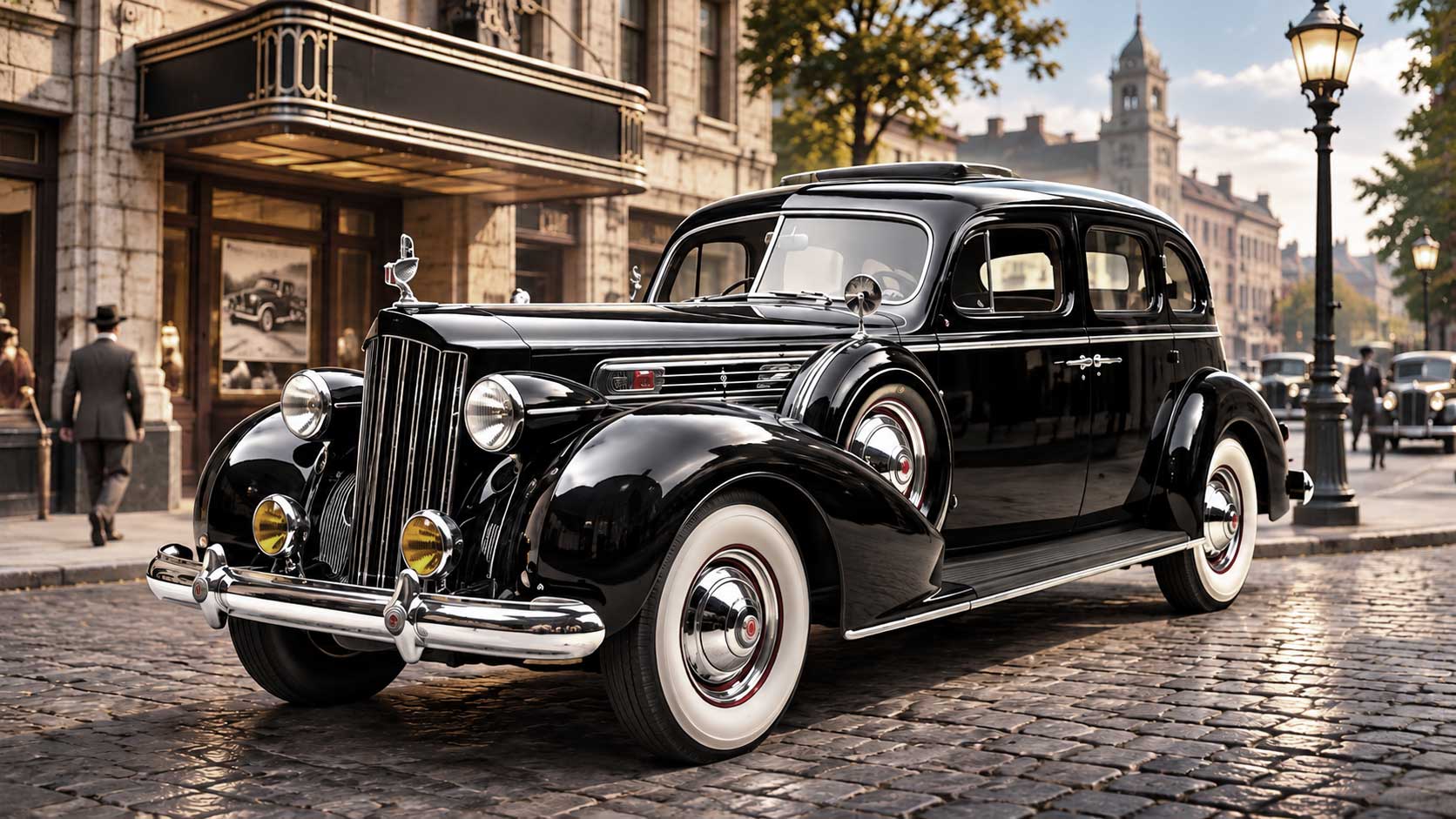
On 4 November 1939, visitors to the 40th National Automobile Show in Chicago encountered an innovation that would eventually transform the driving experience. Packard Motor Car Company presented an automobile equipped with a built-in air-conditioning system, offering a new level of comfort in an era when opening the windows was still the standard response to summer heat.
Comfort with A Mechanical Cost
Developed and installed by Bishop and Babcock, the system was marketed as the Weather Conditioner and offered as an option on Packard’s 1940 models. It did considerably more than cool the cabin. It could dehumidify, filter and recirculate air, while also providing heating for colder conditions.
Its engineering, however, came with considerable compromises. The refrigeration equipment was positioned behind the rear seats, with cooled air channelled into the passenger compartment through dedicated ducts. The compressor was driven by the engine, while the bulky evaporator and blower occupied approximately half the boot.
At around US$274, the system was also an expensive luxury. Its controls were rudimentary, with no thermostat or convenient mechanism to disengage the compressor. Switching off the blower did not necessarily stop the flow of cold air; the compressor belt had to be removed to disable the system completely.
The Beginning of a Cooler Era
Despite its limitations, Packard had demonstrated that automotive air conditioning could be engineered into a passenger car as a commercial option. The installation was far from the compact, integrated climate-control systems that drivers would eventually take for granted, but it established an important direction for automotive development.
The technology took years to become affordable and widely adopted. Post-war improvements in refrigeration, packaging and vehicle integration gradually made air conditioning more practical, eventually turning it from an expensive luxury into an expected feature in many markets.
Packard’s 1939 innovation was therefore more than a promise of relief from summer heat. It marked an early step towards treating the vehicle cabin as a controlled environment, where comfort could be engineered alongside performance, safety and reliability.