Reading Time: 1 Minute
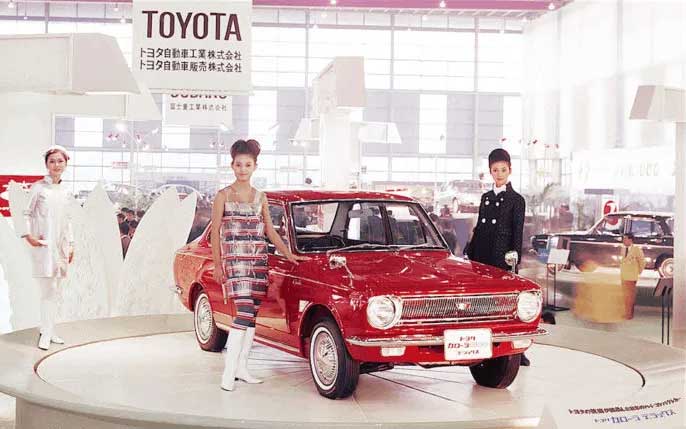
On 26 October 1966, Toyota unveiled the Corolla at the 13th Tokyo Motor Show, introducing a compact family car that would become a global bestseller.
Small Car, Big Impact
Japan was entering a new era of personal mobility. Families wanted cars that were affordable, practical and comfortable, without sacrificing performance. Toyota’s answer was the Corolla, developed under chief engineer Tatsuo Hasegawa.
Its 1,077 cc, water-cooled four-cylinder engine produced 60 horsepower. A four-speed floor-shift gearbox and independent front suspension helped distinguish it from many small cars of its time, combining responsive driving with everyday practicality.
The Corolla was more than basic transport. It offered motorists a taste of modern motoring at an accessible price, arriving just as Japan’s car-owning culture was gaining momentum.
From Japanese Roads to The World
The Corolla went on sale in Japan in November 1966. Demand grew rapidly, and overseas exports soon followed. Production expanded beyond Japan, while successive generations adapted the car to changing customer needs and markets.
Its enduring appeal rested on a straightforward formula: dependable engineering, practical design, economical ownership and continuous improvement. By 1997, the Corolla had become the world’s best-selling nameplate, according to Toyota.
By the end of 2024, cumulative global sales of the Corolla series had reached approximately 55.46 million vehicles, spanning more than 150 countries and regions.
From a modest compact car unveiled in Tokyo to a worldwide automotive phenomenon, the Corolla demonstrates that lasting success rarely depends on spectacle alone. Sometimes, the most influential car is the one that reliably carries millions of people through everyday life.