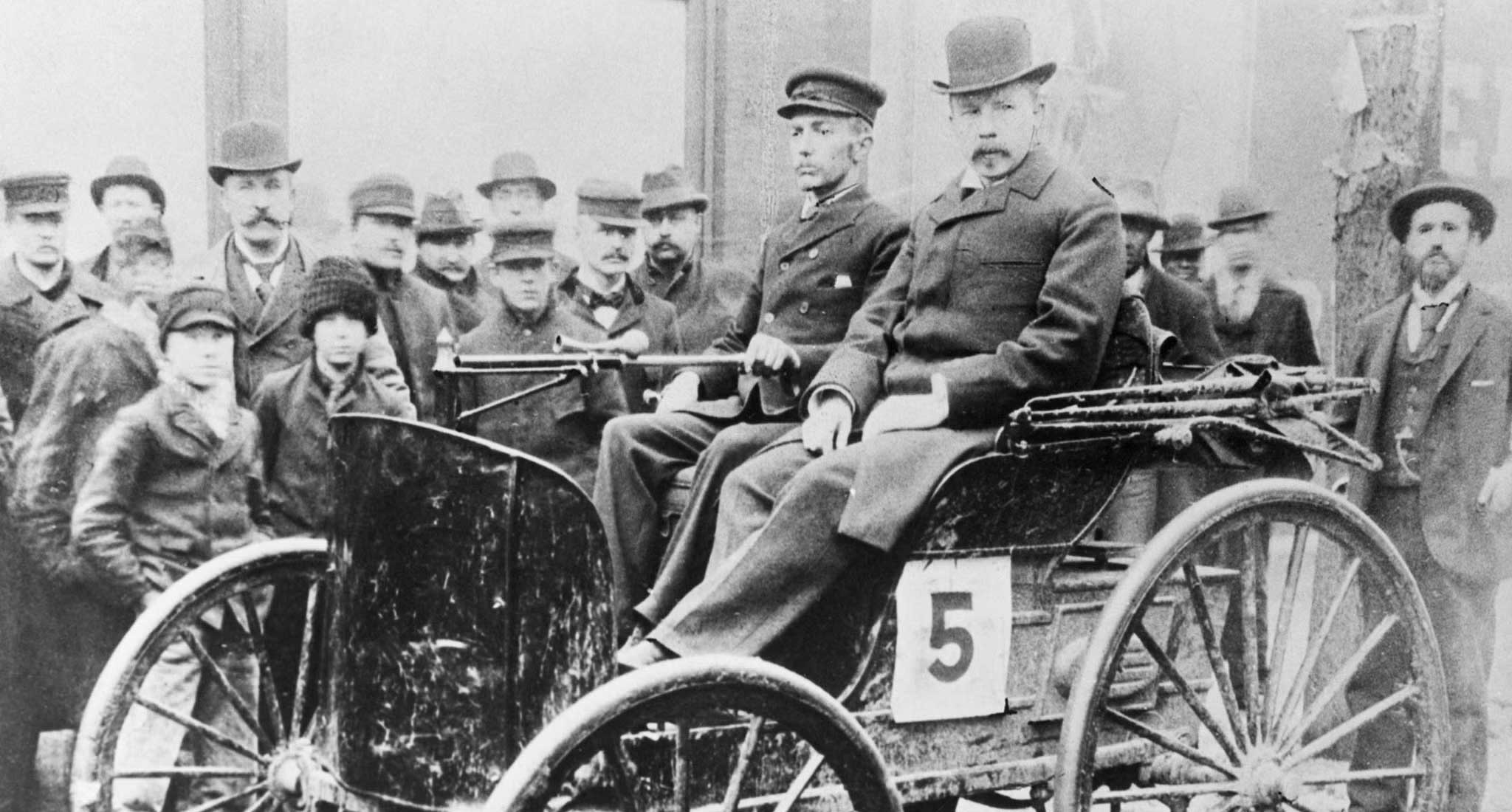
On 2 November 1895, two early automobiles set out from Chicago on an ambitious journey towards Waukegan, Illinois, and back. The planned Chicago Times-Herald automobile race had been postponed because most competitors were not ready, but organisers arranged an exhibition run to keep the public interested. What followed became an important episode in America's earliest motoring history.
When Only Two Were Ready
The original competition had attracted around 80 registrations from inventors and manufacturers eager to demonstrate their horseless carriages. However, building a working automobile in the 1890s was a formidable challenge. As the revised race date approached, it became clear that most entrants would not be ready.
Rather than abandon the occasion, the organisers arranged a special exhibition run. Only two vehicles were prepared to undertake the journey: a petrol-powered Mueller-Benz driven by Oscar Bernhard Mueller, and a Duryea motor wagon driven by J. Frank Duryea, accompanied by his brother, Charles.
The challenge was considerable. The planned route covered approximately 92 miles, from Chicago to Waukegan and back, with a 13-hour time limit. There were no modern service facilities, dependable road surfaces or established support networks. Every mile tested the reliability of machines still in their experimental stages.
One Reached the Finish
The journey quickly demonstrated the difficulties of sharing the road between horse-drawn transport and the emerging automobile. During the run, the Duryea vehicle encountered a horse-drawn team whose movement created an unexpected hazard. While attempting to avoid a collision, Frank Duryea drove into a ditch, damaging the vehicle's steering and rear axle.
Mueller continued and completed the journey in approximately nine and a half hours. His Mueller-Benz was awarded the $500 prize for completing the course within the prescribed time.
Although the exhibition run was not the official Chicago Times-Herald race, it provided an early demonstration of what American motor vehicles could achieve over a substantial road distance. It also exposed the mechanical limitations and practical challenges that inventors still needed to overcome.
The main competition eventually took place on Thanksgiving Day, 28 November 1895. J. Frank Duryea won that historic contest, securing his place in the story of American automobile racing.
But the journey of 2 November deserves its own place in that history. Before the celebrated race could begin, two determined inventors had already taken their machines onto the open road, testing not only their engineering but the possibilities of a new form of transportation.