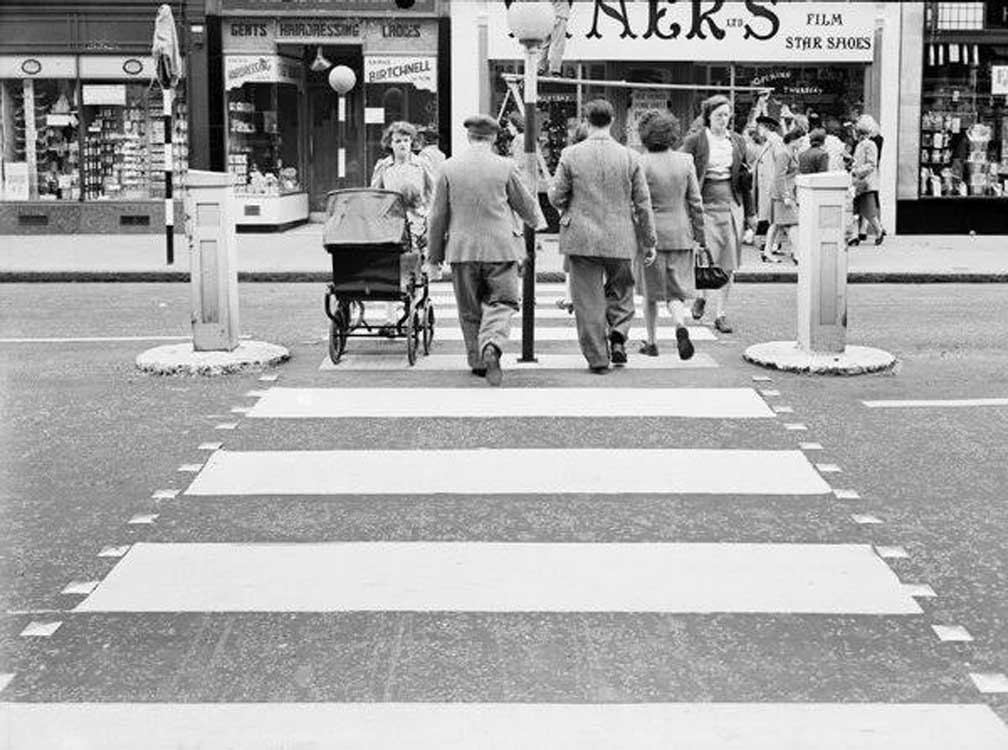
On 31 October 1951, a stretch of Slough High Street in Berkshire, England, witnessed a landmark moment in road-safety history. The first official zebra crossing was introduced, using bold white stripes painted across the road to make pedestrian crossing points far more visible to approaching drivers. A simple visual innovation was about to influence road design around the world.
From Metal Studs to Bold Stripes
Before the zebra crossing, British pedestrian crossings were marked by rows of metal studs embedded in the road, while orange Belisha beacons mounted on striped poles identified crossing points. However, as traffic increased, making crossings more visible and recognisable became an urgent safety priority.
The Ministry of Transport began testing alternative designs in 1949, with around 1,000 experimental crossings using different colours and patterns. The objective was simple: create a marking that drivers could recognise quickly, even in difficult visibility conditions.
Broad white stripes against the dark road surface emerged as an effective solution. The work involved traffic engineers, including George Charlesworth of the Road Research Laboratory, whose research helped shape the new design. On 31 October 1951, the first official zebra crossing was introduced in Slough, retaining the Belisha beacons as an additional warning to motorists. Its distinctive appearance soon gave it the name by which it is still known today.
A New Standard for Pedestrian Safety
The zebra crossing made pedestrian crossing points easier to identify and established a clearer expectation for motorists to give way. Its impact soon extended beyond the original installation.
Historical figures recorded an 8% reduction in pedestrian casualties in urban areas of England and Wales during the first ten months of 1952, compared with the same period in 1951. While this reduction cannot be attributed to the zebra crossing alone, the new design became an important element of Britain's wider road-safety efforts.
The concept gradually spread internationally, becoming one of the most recognisable features of modern road infrastructure. Its enduring appeal lies in its simplicity: no complicated technology, no mechanical systems, just a highly visible pattern that communicates a clear message to everyone using the road.
More than a road marking, the zebra crossing represented an important change in thinking. It acknowledged that streets must be designed not only for moving vehicles, but also for the safety of people on foot.
From one high street in Slough to roads across the world, those familiar black-and-white stripes became a lasting reminder that safer mobility begins with protecting the most vulnerable road users.